
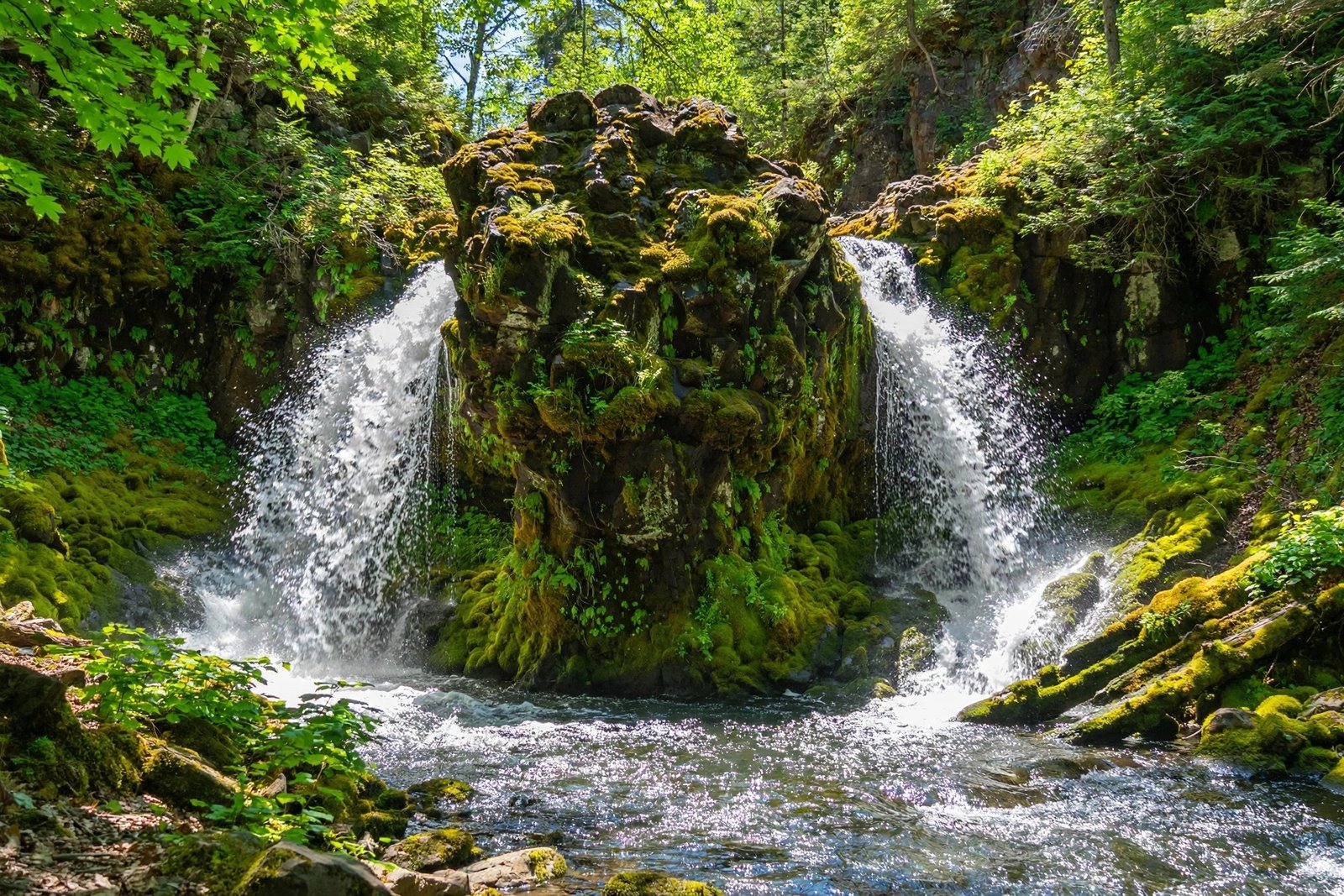
On Minnesota’s North Shore, where Lake Superior meets a rugged, forested coastline, a river does something that seems impossible. The Brule River rushes toward the great lake, reaches a mass of ancient volcanic rock, and splits in two. One half plunges about 50 feet down a classic waterfall and continues on its way. The other half pours into a deep pothole in the rock and simply vanishes from sight. Welcome to Devil’s Kettle, one of America’s strangest and most delightful natural wonders.
Devil’s Kettle sits inside Judge C. R. Magney State Park, on Minnesota’s North Shore, northeast of Grand Marais. It is the park’s most famous feature, and it has puzzled visitors for generations. For decades, people stood at the overlook and asked the obvious question: where does that water go? The answer, it turns out, is both simpler and stranger than the legends suggested.
A River Split in Two
The Brule River flows through the park on its way to Lake Superior, dropping through rapids and waterfalls along the way. At Devil’s Kettle, the river meets a mass of rhyolite, a hard, fine-grained volcanic rock, and divides around it. The split is dramatic and easy to see from the trail overlook.
On one side, the water behaves exactly as a waterfall should. It drops roughly 50 feet into a visible pool and flows on downstream toward the lake. On the other side, the water pours into a huge pothole, a smooth, deep depression carved into the rock over thousands of years, and disappears. There is no visible outlet. The water goes in, and it does not come out where anyone can watch it.
The rock itself is part of the story. The North Shore’s volcanic landscape is ancient, formed by lava flows that cooled and hardened long before the first humans walked the region. The official park materials describe the Devil’s Kettle area as part of a volcanic flow complex, and the hard rhyolite is what makes the pothole possible. Softer rock would have eroded away long ago. This rock holds its shape, and it holds its mystery.
The Legends Visitors Could Not Resist
For as long as people have visited Devil’s Kettle, they have tried to solve it. Local lore says visitors threw sticks, logs, and all kinds of floating objects into the pothole, hoping to see them reappear downstream. They did not. The stories grew wilder from there. Ping-pong balls were said to vanish without a trace. Dye poured into the kettle supposedly never showed up downstream. Some imagined secret tunnels leading to Lake Superior, or vast hidden caverns beneath the rock.
The legend was so persistent that it became part of the attraction. People came not just to see a beautiful waterfall, but to stand before a genuine mystery. In a world where satellites map every corner of the planet, Devil’s Kettle offered something rare: a puzzle in plain sight, in a state park, that nobody could quite explain.
Some of the stories were exaggerated over the years, as legends tend to be. But the core observation was real. Objects tossed into the kettle did not obligingly reappear where anyone could see them, and for a long time, no one had a satisfying scientific explanation for why.
What the Science Actually Found
The mystery began to unravel when Minnesota Department of Natural Resources hydrologists took a refreshingly simple approach. Instead of chasing objects through the pothole, they measured the river itself. In 2016, DNR hydrologists measured the flow of the Brule River above the falls and compared it with the flow downstream. The numbers told the story.
Above the falls, the river carried about 123 cubic feet of water per second. Below the falls, it carried roughly 121 cubic feet per second. Within the margin of error, the figures matched. In other words, no meaningful amount of water was being lost. The water pouring into Devil’s Kettle was finding its way back into the river downstream, even though no one could see exactly how.
The DNR announced its findings in February 2017, concluding that the water entering the kettle soon rejoins the Brule River. The most likely explanation is that the water slips through fractures in the ancient volcanic rock and reemerges downstream, out of sight. The plunge pool itself creates powerful, turbulent currents that can pull objects underwater and keep them circulating rather than sending them neatly downstream, which helps explain why tossed objects never reappeared.
There is an honest caveat worth keeping. The DNR considered using fluorescent dye to trace the water’s exact route, but that test was never completed, because the flow measurements had already established the important part. And the precise underground path the water takes has never been mapped in detail. So the grand mystery is solved in the sense that matters most, the water is not lost, but one small piece remains: nobody has ever watched the water come back out, or charted its exact route through the rock.
That is a wonderfully honest ending to a mystery. Science answered the big question and left a small one open, which is exactly why Devil’s Kettle is still worth visiting. You can stand at the overlook, watch half a river vanish, and know that it is on its way back, somewhere beneath your feet.
Visiting Devil’s Kettle: A Hiker’s Guide
Getting to Devil’s Kettle is part of the adventure. The park’s Devil’s Kettle Trail is about one mile one-way, following the Brule River through forest before descending roughly 175 stairs toward the falls. The official park guide warns that the hike can be strenuous, with steep terrain and elevation changes, and recommends allowing about one and a half to two hours for the round trip.
The trail passes the Upper Falls on the way to Devil’s Kettle, so you get two waterfalls for one hike. Wear sturdy shoes, bring water, and take your time on the stairs, especially on the way back up. The trail surface is packed dirt and rock, and it can be slippery after rain.
Judge C. R. Magney State Park is located at 4051 East Highway 61, Grand Marais, Minnesota, along the North Shore, roughly northeast of Grand Marais. The park is open for day use from 8 a.m. to 10 p.m. daily. It offers camping, picnicking, and hiking, and the campground is open from May into the fall season. In winter, the campground closes and services are limited, so check conditions before a cold-weather visit.
When is the best time to visit? Every season has its fans. Summer brings lush green forest and full water flow. Fall is spectacular on the North Shore, with autumn colors lighting up the maple and birch forest along the trail. Spring brings high water from snowmelt, which makes the falls especially dramatic. Winter turns the gorge into a snowy, quiet world, though the stairs can be icy and the hike becomes much more demanding.
A few practical tips make the trip better. Bring a camera, because the overlook is made for photos, but keep it secure on the stairs. Pack out everything you bring in. Do not throw objects into the kettle, no matter how tempting the legend makes it sound. The park asks visitors to leave the natural features undisturbed, and the DNR has noted that anyone hoping to run their own dye experiment would need a research permit. Enjoy the mystery with your eyes, not your hands.
More North Shore Magic Nearby
Devil’s Kettle is a perfect anchor for a North Shore trip, but it is far from the only wonder nearby. Grand Marais, the charming harbor town to the southwest, is worth a stop for its art galleries, restaurants, and Lake Superior shoreline. The town has a creative, outdoorsy spirit that pairs perfectly with a day on the trails.
The Superior Hiking Trail runs through the park, continuing past Devil’s Kettle to the north and along Gauthier Creek to the west. This long-distance trail stretches for hundreds of miles along the North Shore, from south of Duluth to the Canadian border, and the sections near the park are among its most scenic. Even a short walk on the trail beyond the falls rewards you with quiet forest and river views.
Other nearby state parks along Highway 61 offer their own waterfalls, gorges, and Lake Superior overlooks, making the North Shore one of the best road trips in the Midwest. If you are planning a longer trip, consider stringing together several parks over a few days, with Grand Marais as your base. The drive itself, along the lake, is half the experience.
Anglers should note that the Brule River and its tributary, Gauthier Creek, are known for brook and rainbow trout, but a valid Minnesota fishing license is required and regulations apply to specific stretches. Check current DNR rules before you fish.
Why Devil’s Kettle Endures
There are bigger waterfalls in America, and taller ones, and more famous ones. But few have a story like Devil’s Kettle. It is a place where the landscape itself seems to break the rules, where half a river disappears into the earth and comes back without ever showing its work. The science is satisfying, the legends are fun, and the hike is beautiful in its own right.
That combination is what makes it a true hidden gem. It is not on every national bucket list, and it does not draw the crowds of the country’s most famous falls. But for travelers who love a good mystery, a good hike, and a good story to tell when they get home, Devil’s Kettle delivers all three. Stand at the overlook, watch the river split, and enjoy one of Minnesota’s great wonders, a waterfall that swallows a river and gives it back.
Plan your visit with the official park information from the Minnesota DNR Judge C. R. Magney State Park map and guide, read more about the falls at Getaway on Devil’s Kettle, and see the full story of the investigation at the Devil’s Kettle evidence review.
Frequently Asked Questions
Where is Devil’s Kettle? Devil’s Kettle is in Judge C. R. Magney State Park on Minnesota’s North Shore, at 4051 East Highway 61, Grand Marais, Minnesota, northeast of Grand Marais.
What happens to the water that pours into Devil’s Kettle? DNR flow measurements showed the river carries about the same volume below the falls as above them, so the water rejoins the Brule River downstream, most likely through fractures in the volcanic rock. The exact underground path has not been mapped.
How long is the hike to Devil’s Kettle? The Devil’s Kettle Trail is about one mile one-way, with roughly 175 stairs down to the falls. Allow about one and a half to two hours for the round trip.
Is the hike difficult? The park describes it as strenuous, with steep terrain and a long stairway. Sturdy shoes and water are recommended.
When is the best time to visit? Summer offers full water flow, fall brings spectacular North Shore colors, and spring brings dramatic high water. Winter visits are beautiful but icy and demanding.
Can I throw things into the Kettle to test it? No. Visitors should leave natural features undisturbed, and running a dye experiment would require a DNR research permit.