
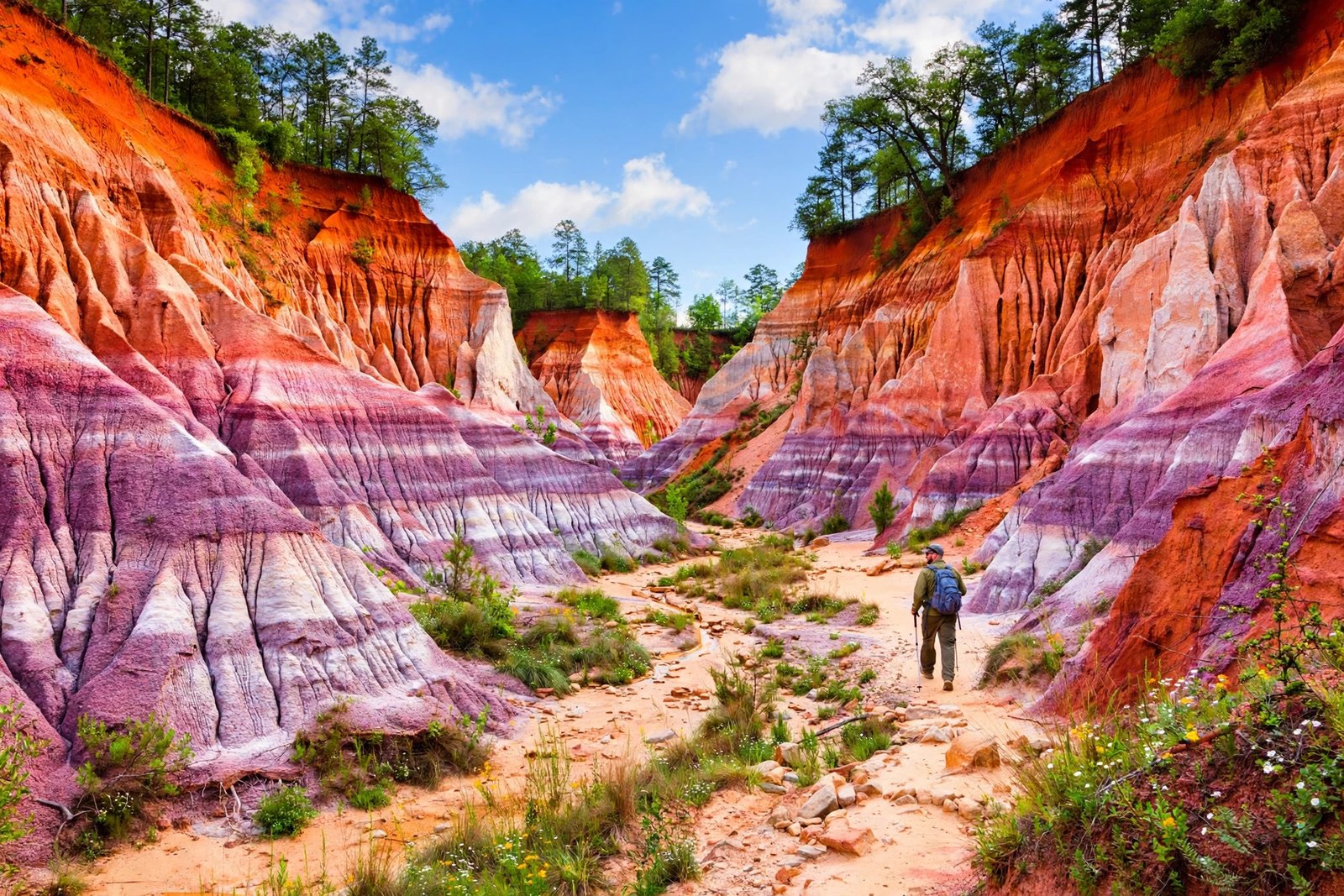
Deep in southwest Georgia, far from the mountains and far from the coast, the flat farmland suddenly drops away into a maze of canyons painted in reds, oranges, purples, pinks, and whites. This is Providence Canyon State Park, near the small town of Lumpkin, and it is called Georgia’s Little Grand Canyon. The nickname is both a compliment and a joke: the canyons are real, the colors are spectacular, and the scale is modest compared with Arizona’s giant — the deepest gullies reach more than 150 feet, not 6,000. But Providence Canyon has something the Grand Canyon does not: it was made, almost entirely, by people, in less than 200 years.
That is the twist that makes this place worth the drive. Providence Canyon is not a natural feature carved over millions of years by a river. It is the result of poor farming practices by settlers in the 1800s, who cleared the native longleaf pine forest and exposed soft coastal-plain soils to rain. The rain did the rest, cutting gullies that deepened year after year until flat farmland became a canyon landscape. Today the park covers 2,706 acres, protects nine major canyons, and is counted among the Seven Wonders of Georgia. It drew 339,594 visitors in 2024, yet it still feels like a secret to most Americans outside the Southeast.
How farming created a canyon
The story begins in the early 1800s, after the Treaty of Indian Springs in 1825 opened the area to heavy settlement. Settlers cleared the forest, planted row crops, and farmed the soft soils without the conservation practices that would later become standard. Rainwater, running off bare fields, cut small channels that deepened into gullies. The soils here are ancient marine sediments — layers of loam, clay, and sand laid down when this land was under the sea — and they erode easily once exposed. Iron, manganese, and kaolin deposits in those sediments give the canyon walls their striking range of colors, with some guides counting up to 43 different shades.
The canyon was first documented in a deed from 1836, and by the later 1800s the gullies were already a local curiosity. What began as an environmental failure became, over generations, a landscape of genuine beauty. The park became a Georgia state park in 1971, and the state now manages it as both a recreation area and a cautionary tale: a visible lesson in what happens when soil is left unprotected. Rangers and geology programs at the park use the canyon walls to teach visitors about erosion, sediment, and land stewardship, which gives a hike here an extra layer of meaning.
What you will see on the trails
Providence Canyon offers two main hiking experiences, and they suit different ambitions. The Canyon Loop Trail, under three miles, circles nine of the canyons and drops to the canyon floor, where you can walk among the towering walls and see the colors up close. Expect mud and wet clay on the canyon floor, especially after rain — this is a trail where old shoes are a good idea and white sneakers are a bad one. The trail is rated moderate, and the descent to the floor is the hardest part; the views from the rim are available without it.
The Backcountry Trail is the serious option: a seven-mile loop that takes roughly six hours, follows creek beds, climbs in and out of the canyon system, and reaches the park’s backcountry campsites. It is the trail for hikers who want the full landscape, including the quieter canyons that day visitors never reach. Whichever trail you choose, stay behind the fences and barriers on the rim trails. The canyon edges are soft, undercut soil, and they can collapse without warning. The park’s rule is simple and worth obeying: admire the edge from behind the fence, and explore the floor from the designated trail.
Between hikes, the park’s visitor center and museum explain the canyon’s formation, its history, and the best ways to explore it. The park also preserves traces of its human past, including old homestead ruins and the remains of a church, and a historic Civilian Conservation Corps camp from the 1930s, when the CCC helped develop parks across Georgia. The plumleaf azalea, one of the rarest native azaleas in North America, grows here and blooms in July and August — one of the latest-blooming native azaleas on the continent — which gives summer visitors a botanical bonus.
When to go and how to get there
Providence Canyon sits about two hours southwest of Atlanta and about an hour south of Columbus, Georgia, in Stewart County. From Atlanta, take I-85 south and then US-27 south toward Lumpkin; the park address is 8930 Canyon Road, Lumpkin. The drive itself is part of the charm: you leave the city, cross the rolling farmland of west Georgia, and arrive in a landscape that looks nothing like the countryside you drove through.
Spring and fall are the best seasons, when temperatures are mild and the light makes the canyon colors glow. Fall in particular is a fine time: the air is cooler, the trails are drier, and the surrounding forest adds its own autumn color to the reds and oranges of the canyon walls. Summer brings heat, humidity, and afternoon thunderstorms, and the canyon floor can be muddy and buggy. Winter is quiet and often beautiful, with fewer visitors and crisp light, though the days are short. Whenever you go, check the forecast and the park’s conditions before you leave, and bring more water than you think you need — there is little shade on the canyon floor.
Admission is modest, and the park is a day-trip destination for most visitors. If you want to stay overnight, Providence Canyon itself offers primitive camping: three pioneer group sites and six backcountry sites, all requiring reservations, with no electric or water hookups. For RV camping with full hookups, nearby Florence Marina State Park on Lake Walter F. George, about 15 minutes away, is the developed alternative, and it makes a good base for a two-park weekend. The park entrance closes in the early evening, so plan to finish your hike well before closing time.
What to bring and what to know
Footwear is the most important decision you will make. Wear sturdy shoes with good grip that you do not mind getting muddy, because the canyon floor trail follows creek beds where water is often ankle-deep in wet periods. Bring water, sun protection, and a hat, since the canyon floor offers little shade. A camera is essential — the colors are at their best in the low light of morning and late afternoon, when the sun rakes across the walls and deepens every shade.
Families should know that the Canyon Loop Trail is manageable for older children, but the descent to the floor and the muddy creek beds make it a poor choice for strollers or very young children. Dogs are welcome on the trails on a leash, and the park is a good introduction to hiking for kids who are ready for a real trail. Teach children the rim rule before you arrive: fences mean stay back, because the edge is not solid rock but soft soil that can give way.
Photographers should plan for the golden hours. The canyon walls face in different directions, so some canyons glow in the morning and others in the afternoon, and the full range of colors — reds, oranges, purples, pinks, whites, and grays — shows best when the sun is low. Overcast days are also good: soft light evens out the contrast and lets the subtle shades come through without harsh shadows. Canyons 4 and 5 draw the most visitors for their size and colorful clay walls, so arrive early if you want them without a crowd.
Why Providence Canyon matters
Providence Canyon is more than a pretty detour. It is one of the clearest places in America where you can see, with your own eyes, how quickly land can change when it is misused — and how nature can turn even a mistake into something beautiful. The same erosion that destroyed farmland created a landscape that now teaches thousands of visitors a year about soil, water, and stewardship. That is a rare combination: a place that is both a warning and a wonder.
It is also a reminder that hidden gems do not have to be remote. Providence Canyon is two hours from a major city, in a state better known for its mountains and its coast, and it still surprises the people who find it. If you are planning a Georgia road trip, or looking for a day hike that is genuinely different from anything else in the Southeast, put Lumpkin on the map. Georgia’s Little Grand Canyon is waiting, painted in 43 colors, at the end of a dirt trail in the middle of farmland.
Frequently asked questions
Is Providence Canyon really a canyon?
Yes, though it is not a river canyon. Its gullies, the deepest more than 150 feet, were cut by rain erosion after 19th-century settlers cleared the forest and farmed the soft soils. The park covers 2,706 acres and contains nine major canyons.
How long does the Canyon Loop Trail take?
The loop is under three miles and circles nine canyons, descending to the canyon floor. Allow two to three hours, wear shoes you can get muddy, and expect wet clay on the canyon floor after rain.
Can you camp at Providence Canyon?
Yes, primitive camping is available at three pioneer group sites and six backcountry sites, all by reservation, with no electric or water hookups. Florence Marina State Park nearby offers full-hookup RV camping.
When is the best time to visit Providence Canyon?
Spring and fall offer the mildest weather and the best light for the canyon colors. Fall is especially good, with cooler air, drier trails, and autumn color in the surrounding forest.
Related reading
For more hidden gems, explore Hocking Hills, Ohio, and its waterfalls and Bisbee, Arizona, and the Queen Mine. And for more surprising American geography, read U.S. state facts that sound fake but are true.
Sources for this article include the Providence Canyon State Park overview, America’s State Parks’ Providence Canyon guide, and PlanetWare’s guide to Georgia’s Little Grand Canyon. Check Georgia State Parks for current fees, hours, and trail conditions before you go.