
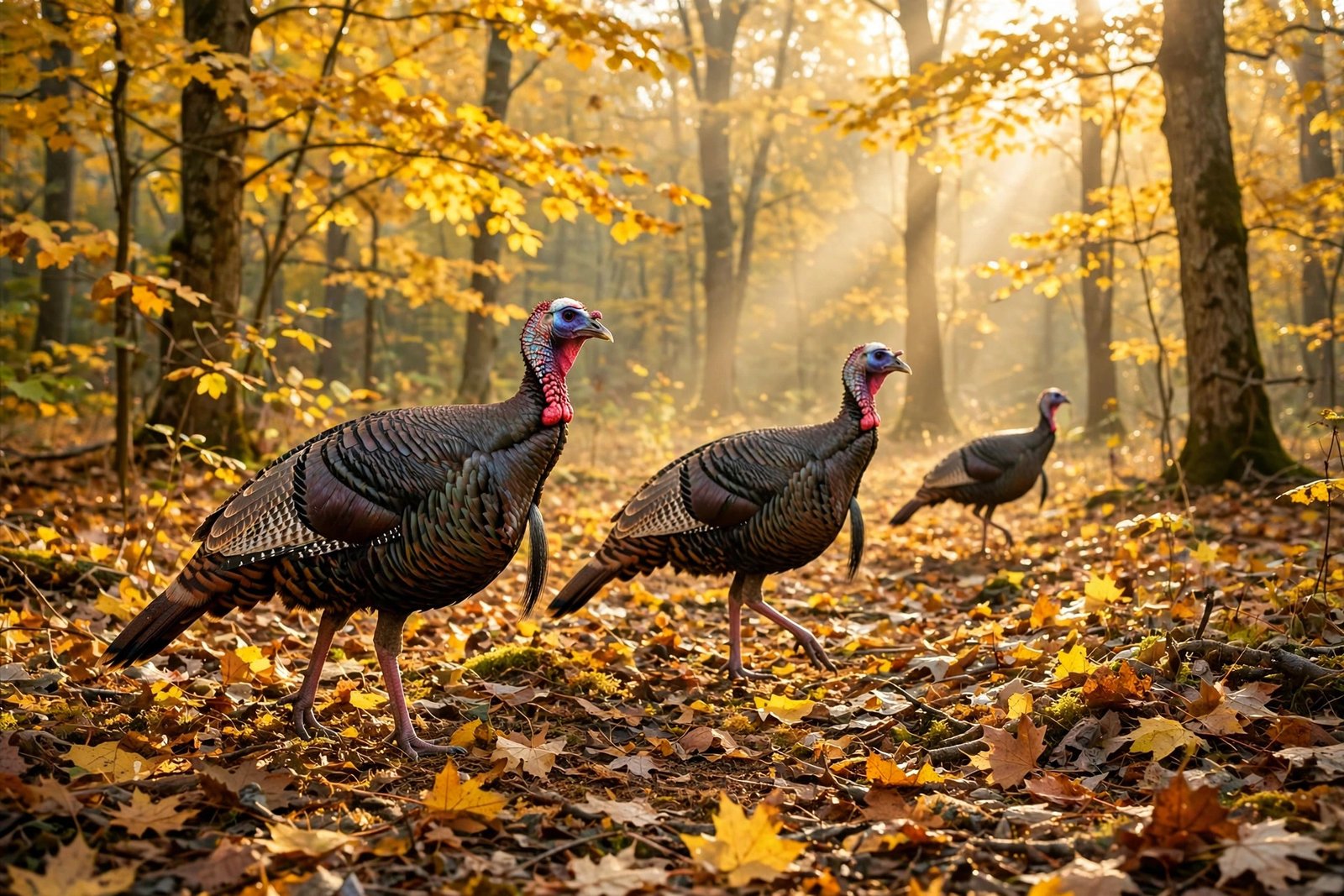
November is the month when America eats turkey — and the month when the wild turkey, the bird on the table’s ancestral family tree, is at its most visible. Drive a country road in New England, the Midwest, or the Southeast this month and you may see a flock crossing a field, tails fanned, heads bobbing, utterly unbothered by your car. It is an ordinary sight now, which is precisely what makes it extraordinary. A century ago, the wild turkey was nearly gone from the United States. Today, an estimated 7 million wild turkeys roam 49 states — every state except Alaska — in what conservationists call one of the greatest wildlife recovery stories in American history.
The comeback was not an accident. It was the result of decades of deliberate work: hunting regulations, habitat restoration, and a clever technique for moving wild birds to places where they had vanished. It is also, like most conservation stories, unfinished. In parts of the Southeast and Midwest, turkey populations have slipped in recent years, and biologists are studying why. November, with turkeys on our minds and in our fields, is a good time to tell the whole story — the collapse, the recovery, and the work that remains.
From millions to the edge of extinction
Before European settlement, an estimated 10 million wild turkeys lived in North America, from the Atlantic coast to the southern Rockies and into Mexico. They were a staple of Native diets and, famously, a bird Benjamin Franklin admired — he once wrote, in a letter to his daughter, that the turkey was a more respectable bird than the bald eagle, though he never formally proposed it as the national symbol. The wild turkey’s troubles began with the same forces that reshaped the continent: forests cleared for farms and towns, and unregulated market hunting that killed birds for sale in city markets.
By the early 1900s, the collapse was stark. Wild turkeys had disappeared from 18 of the 39 states they once inhabited, and by the 1930s the population had fallen to a low that biologists estimate at somewhere between 30,000 and 200,000 birds — the exact figure is debated, because surveys of the era were rough, but the direction was not. In much of the East, the bird was effectively gone. A Massachusetts official grouped turkeys with the extinct Passenger Pigeon and Great Auk as species “gone forever” from the state. The prediction, happily, was wrong.
Early restoration attempts failed for a revealing reason. State agencies raised turkeys on game farms and released them into the wild, but farm-raised birds, habituated to humans and unaccustomed to predators, mostly died. The breakthrough was to stop raising turkeys and start moving them: capture healthy wild birds where they survived, and relocate them to suitable habitat where they had vanished. Wild birds knew how to be wild, and that made all the difference.
The cannon net and the great relocation
The tool that made the relocation possible was the cannon net — a net propelled by small explosive charges that could be fired over a flock feeding in a field, capturing birds unharmed for transport. South Carolina biologist Herman Holbrook pioneered its use for turkeys in the 1950s, and the technique spread rapidly. State wildlife agencies trapped wild turkeys and moved them by the thousands: records cited by the National Wild Turkey Federation describe more than 200,000 birds relocated in total, and over 146,000 released at more than 7,000 sites in the United States and Canada over several decades.
The relocations were sometimes creative. Wildlife agencies traded species the way baseball teams trade players: Oklahoma once negotiated turkeys from Arkansas and Missouri in exchange for walleye and prairie chickens, and Ontario acquired turkeys from several American states in exchange for moose and river otters. West Virginia sent 26 turkeys to New Hampshire in 1969 in return for 25 fishers. Behind the charming barter was serious science: biologists matched birds to habitat, monitored survival, and learned, flock by flock, what turkeys needed to thrive.
Habitat helped, too. As farms were abandoned during and after the Great Depression, forests regrew across the Northeast, creating exactly the mix of mature woods, open fields, and edge habitat that turkeys prefer. At the same time, new laws changed the rules of the hunt. The Lacey Act outlawed moving wild game across state lines, market hunting was banned in 1918, and the Pittman-Robertson Act of 1937 directed excise taxes on firearms and ammunition into wildlife conservation funding. The National Wild Turkey Federation, founded in 1973, organized hunters, biologists, and landowners into a national restoration effort, investing hundreds of millions of dollars and helping conserve or enhance tens of millions of acres of habitat.
By the early 2000s, the results were undeniable. Wild turkey numbers reached an estimated 6.6 to 6.9 million, and later estimates put the population around 7 million across 49 states. Hunting, once the cause of the collapse, became part of the management: regulated spring and fall seasons, with limits set by state biologists, now fund much of the conservation that keeps the birds abundant. It is a paradox that hunters understand well — the people who harvest turkeys are also, through licenses and taxes, the people who pay to keep them.
Turkeys in November: what to watch for
November is a revealing month for turkey behavior. Wild turkeys are not migratory in the long-distance sense, but they do shift their patterns as autumn deepens. Flocks that scattered during the summer breeding season regroup into larger winter flocks, often segregated by sex: hens with young in one group, males in another. They spend their days scratching through leaf litter for acorns, beechnuts, seeds, and insects, and their nights roosting in trees, sometimes in groups of dozens, flying up at dusk with a noisy flurry of wings.
If you want to see them, look in the right places at the right times. Early morning and late afternoon are best, in open fields near woodland edges, along farm lanes, and — increasingly — in suburban parks and even city neighborhoods, where turkeys have learned that landscaped yards offer food and few predators. In New England, where turkeys were absent for over a century in some areas, suburban sightings are now routine, and residents trade stories of turkeys blocking driveways, chasing delivery drivers, and strutting across golf courses with complete confidence.
A word of caution for admirers: wild turkeys are not pets, and habituated birds can become bold, especially males during breeding season. Enjoy them from a distance, do not feed them, and give a strutting tom plenty of room. The same boldness that makes them entertaining is a sign that they have lost their healthy fear of people, which rarely ends well for the bird.
The comeback’s complicated second chapter
The turkey’s recovery is real, but it is not a simple happy ending. Since the mid-2000s, state surveys have shown harvests and populations falling in parts of the Southeast and Midwest, and researchers have documented that hens in some regions are raising fewer poults — baby turkeys — than they once did. The causes are still being studied, and they likely include habitat fragmentation, nest predation by raccoons and other predators, disease, and changing land use. In the Southeast, where pine plantations have replaced diverse forests in places, the habitat turkeys need has thinned.
Biologists are responding with the same cooperative approach that worked before. The Wild Turkey Lab at the University of Georgia and researchers across the country are tracking hens with transmitters, studying nest success, and testing habitat management practices. State agencies adjust season lengths and bag limits based on annual surveys rather than tradition. And citizen science helps: several states run summer turkey sighting surveys, inviting the public to report flocks they see, which gives biologists data across landscapes no research team could cover alone.
The broader lesson is one conservationists repeat often: recovery is not a finish line. A species that returns to abundance still needs habitat, management, and attention, or it can slip again. The wild turkey’s story is a model precisely because it shows both halves — how bad things can get, and how much determined, science-based work can repair.
Frequently asked questions
How many wild turkeys are there in the United States? Current estimates put the population around 7 million birds across 49 states — every state except Alaska.
How low did the population fall? From an estimated 10 million before European settlement, wild turkeys fell to a low in the 1930s, with estimates ranging from about 30,000 to 200,000 birds.
How were turkeys restored? State agencies captured wild turkeys with cannon nets and relocated them to areas where they had vanished, combined with hunting regulations, habitat restoration, and conservation funding.
Are wild turkeys the same as Thanksgiving turkeys? No. Domestic Thanksgiving turkeys are bred for size and cannot fly well. Wild turkeys are leaner, can fly in short bursts, and roost in trees.
Where can I see wild turkeys in November? Look in fields near woodland edges at dawn and dusk, and in suburban parks and farmland across the East, Midwest, and Southeast.
Related reading
- Black Bears in November: How America’s Bears Get Ready for Winter
- Bald Eagles in Winter: Where to See America’s Bird
- Elk Rut Season in the USA: Where to Hear Bugling Elk in Autumn
Sources: Audubon, “How Wild Turkeys Made a 49 State Comeback” (audubon.org); Audubon magazine, “The Wild Turkey Is a Comeback Bird We Can’t Take for Granted” (audubon.org).