
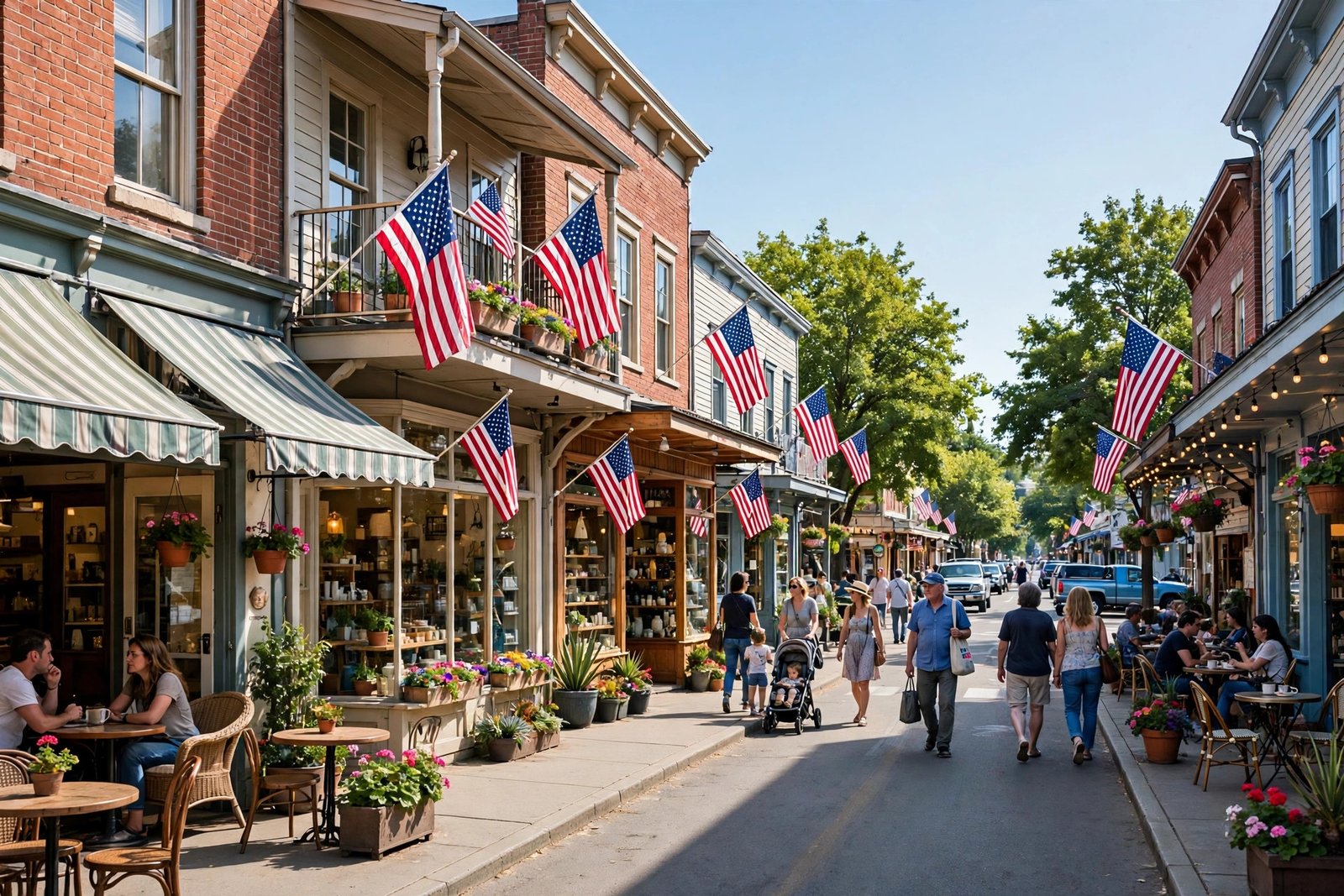
When Americans picture national power, they often picture aircraft carriers, rockets, or skyscrapers. But one of the most consequential forms of American power is far quieter: it sits behind a storefront on a small town’s main street, in a workshop, a clinic, a bakery, a trucking company, a software startup run from a spare bedroom. According to the U.S. Small Business Administration’s Office of Advocacy, the United States is home to 36.2 million small businesses — 99.9 percent of all businesses in the country — employing 62.3 million people, or 45.9 percent of the private-sector workforce. Small business is not a side note in the American economy. In many ways, it is the American economy.
That scale is easy to miss because small businesses are, by definition, small. No single one dominates the headlines the way a tech giant does. Together, though, they account for nearly half of private employment, a large share of economic activity — the SBA’s research puts small businesses’ share of GDP at 43.5 percent — and, strikingly, most of America’s net new job creation. From March 2023 to March 2024, the SBA reports, small businesses created approximately nine out of every ten net new jobs in the country. If you want to understand how America actually works, start on Main Street, not Wall Street.
What counts as a small business?
The SBA generally defines a small business as an independent business with fewer than 500 employees, though the precise threshold varies by industry. That definition covers an enormous range: the coffee shop with three employees, the manufacturer with 200, the freelance designer, the family farm, the franchise restaurant. Most small businesses are much smaller than the ceiling suggests. The Census Bureau counted 6.4 million employer firms in 2022, but the 36.2 million figure includes nonemployer businesses — sole proprietorships and single-person operations — which make up the vast majority of American firms.
That breadth is a strength and a challenge. Small businesses are nimble: they can open quickly, adapt to a neighborhood’s needs, and experiment in ways large corporations cannot. They are also fragile. The SBA’s data show that between March 2023 and March 2024, 1.28 million establishments opened and 1.13 million closed — a churn that reflects both opportunity and risk. Roughly two-thirds of new employer establishments survive at least two years, according to long-run SBA figures, which means starting a business is a bet that often does not pay off — and that Americans keep making it anyway, in extraordinary numbers.
The geography of small business is also worth noting. California has the most small businesses, at 4.34 million, followed by Texas at 3.52 million and Florida at 3.49 million, according to the SBA’s 2025 profiles. But small businesses matter most, proportionally, in rural states: Montana has the highest share of employment at small businesses, at 66.3 percent, followed by Wyoming at 65.2 percent and Vermont at 62.1 percent. In small towns, the closure of a single grocery store, pharmacy, or hardware store can reshape daily life — which is why local business is, for many Americans, not an abstraction but a neighbor.
The job engine no one sees
The most important small-business statistic is the one about jobs. Between January 1995 and December 2024, small businesses created 20.7 million net new jobs, compared with 13.2 million for large businesses — about 61 percent of net job creation over three decades. In the single year from March 2023 to March 2024, small businesses opened 1.1 million new establishments and created a net increase of 1.2 million jobs, or 88.9 percent of that year’s net total. These are not just service jobs, either: small firms are heavily represented in construction, manufacturing, health care, professional services, and wholesale trade.
Why do small firms create so many jobs? Partly because there are so many of them, and partly because new firms, by nature, hire as they grow. A startup that succeeds hires ten people, then fifty, then two hundred — and while most startups stay small, the ones that grow create jobs at a pace large, mature companies rarely match. Economists also note that small businesses drive competition: they pressure larger firms to innovate, keep prices honest, and serve markets — rural towns, niche industries, immigrant communities — that big companies overlook.
Small businesses are also exporters, to a degree that surprises many people. Of the firms that exported goods worth $1.8 trillion in recent Census data cited by the SBA, 97.2 percent were small. That includes manufacturers selling specialized parts abroad, food producers shipping to new markets, and e-commerce sellers reaching customers on the other side of the world from a warehouse in Ohio. American economic power, in other words, is not only projected by multinational giants; it is also packed, shipped, and invoiced by firms most Americans have never heard of.
The SBA: the government agency behind the scenes
Behind much of this activity stands an agency most Americans only encounter when they need a loan: the U.S. Small Business Administration, created in 1953. The SBA does not generally lend money directly. Instead, it guarantees loans made by banks and other lenders, reducing the lender’s risk and making credit available to businesses that might otherwise be turned away. Its best-known programs are the 7(a) loan program for general business purposes, the 504 program for major fixed assets like real estate and equipment, and microloans for very small borrowers.
In fiscal year 2025, the SBA guaranteed 7(a) and 504 loans to 85,000 small businesses totaling nearly $45 billion, according to recent reporting on the agency’s programs. The agency also runs disaster relief lending — a lifeline after hurricanes, floods, and wildfires — helps small firms win federal contracts (small businesses receive more than 23 percent of federal contracting dollars each year), and funds a nationwide counseling network through Small Business Development Centers, SCORE mentors, and Women’s Business Centers. For a first-time founder, a free session with an SBDC adviser is often the best first step available, and it costs nothing.
The SBA’s Office of Advocacy, an independent office within the agency created by Congress in 1976, plays a different role: it studies the small-business economy and argues, inside the federal government, for rules that do not crush small firms under compliance costs designed for large ones. Its annual state profiles are the source of most of the numbers in this article, and they are worth bookmarking for anyone who wants to understand their own state’s business landscape.
Why small businesses struggle — and persist
None of this is to romanticize small business. The challenges are real and well documented. Access to capital remains the top obstacle: banks prefer lending to established firms with collateral, and many founders start with personal savings, credit cards, or loans from family. Health insurance, taxes, and regulation weigh more heavily on a ten-person firm than on a ten-thousand-person one — the SBA’s own research notes that small businesses bear a disproportionate share of the paperwork burden, with the Internal Revenue Service accounting for over 80 percent of it. Hiring is hard in a tight labor market, and a single bad month can threaten a business with thin cash reserves.
And yet Americans keep starting businesses at a remarkable pace. Census Bureau data show applications for new businesses reaching cumulative highs in 2025, with high-propensity applications — those most likely to become employer firms — running well ahead of the previous year. The motivations vary: some founders chase an idea, some seek independence, some turn a layoff into a launch, and some build a business to serve a community they know intimately. The through line is a culture that treats starting something as a normal, even expected, life choice — a culture the rest of the world often envies and tries to imitate.
That culture is, ultimately, the real source of small-business power. It is not a single program or statistic. It is millions of people deciding, every year, that they would rather build something of their own than wait for someone else to hire them. Some fail. Many survive. A few become the large businesses of tomorrow. All of them, together, are why the American economy bends without breaking — and why a walk down any Main Street is also a tour of the country’s economic engine.
Frequently asked questions
How many small businesses are there in the United States? According to the SBA Office of Advocacy’s 2025 profiles, there are 36.2 million small businesses, or 99.9 percent of all U.S. businesses.
How many Americans work for small businesses? Small businesses employ 62.3 million people, or 45.9 percent of private-sector workers.
What is the SBA’s definition of a small business? Generally, an independent business with fewer than 500 employees, though thresholds vary by industry.
Do small businesses really create most new jobs? Yes, on net. From March 2023 to March 2024, small businesses created about nine out of every ten net new jobs, and since 1995 they have accounted for about 61 percent of net job creation.
Where can a new founder get free help? The SBA funds Small Business Development Centers, SCORE mentors, and Women’s Business Centers nationwide, offering free or low-cost counseling.
Related reading
- How America’s Freight Railroads Power the Economy
- National Parks: America’s $56 Billion Economic Engine
- GPS: The American Satellite System That Quietly Runs the Modern World
Sources: U.S. Small Business Administration, Office of Advocacy, 2025 Small Business Profiles (advocacy.sba.gov); SBA Frequently Asked Questions About Small Business 2026 (advocacy.sba.gov).