
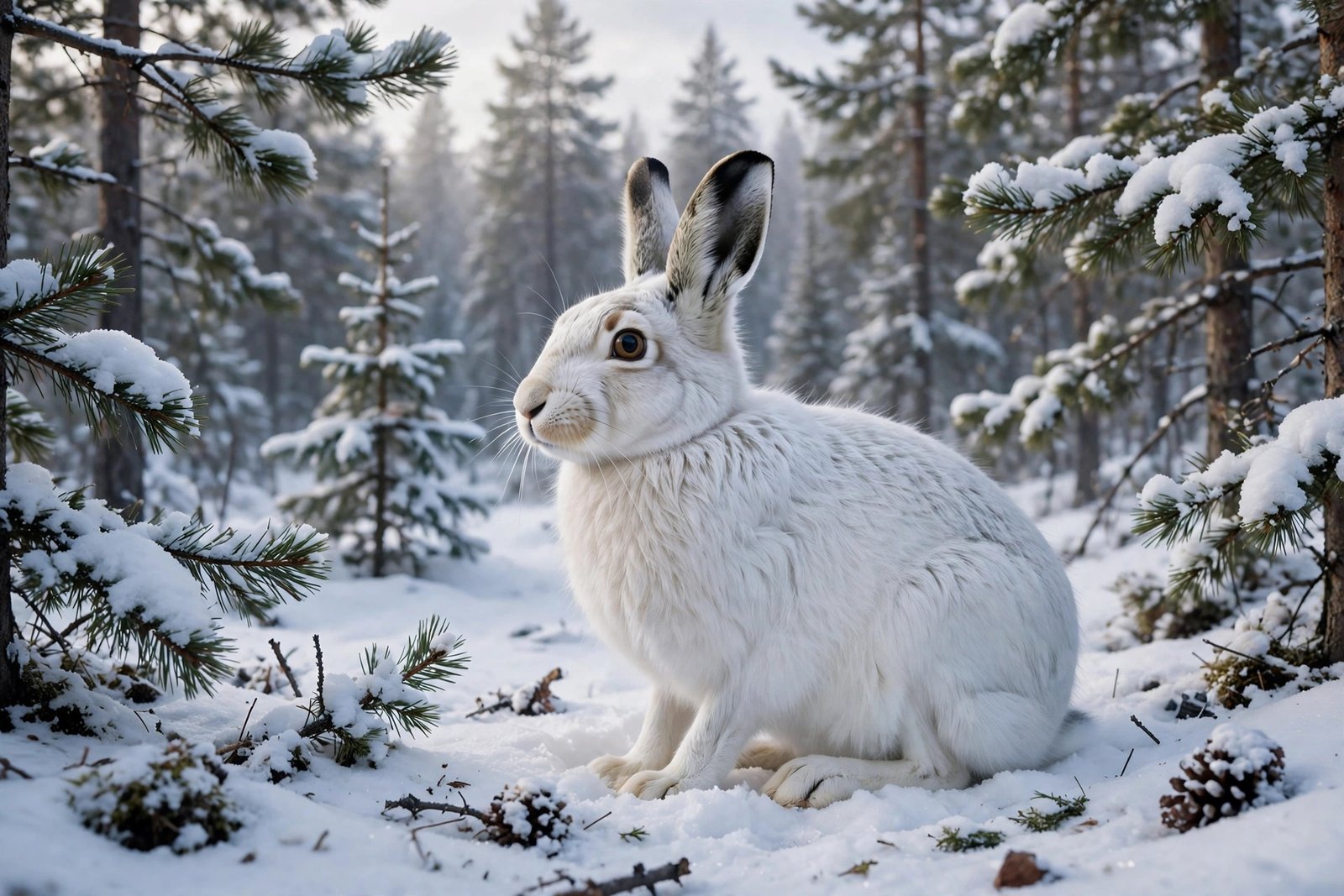
Somewhere in a northern forest this month, a snowshoe hare is changing color. Not all at once, and not because it is cold, but because the days are getting shorter. Over several weeks, its brown summer coat gives way to white, starting at the ears, feet, and legs and ending on the back, until the animal that was nearly invisible against fallen leaves becomes nearly invisible against snow. It is one of the most elegant tricks in North American wildlife, and it is happening right now, in the forests of Alaska, Canada, and the northern United States, from the Rockies to the Appalachians.
Snowshoe hares, Lepus americanus, are also called varying hares, and the second name is the clue to their fame. They are not rabbits, though people often mistake them for abandoned domestic rabbits when they appear in a yard with a patchy, half-changed coat. They are hares, built for northern forests: large hind feet covered with long, dense hair that work like snowshoes, letting the animal travel on top of deep snow instead of sinking into it. They are most active at dawn and dusk, they rely on acute hearing and camouflage to avoid predators, and they are a keystone prey species, feeding lynx, foxes, owls, hawks, and many other hunters.
How the change happens
The seasonal color change is a molt, and it happens twice a year. In summer, the snowshoe hare’s coat is a yellowish to cinnamon brown, with white to grayish-white on the chin, tail, and underside. In winter, the coat is mainly white, with black rimming the ears. The autumn molt begins in late September, and the change is gradual: hares are often seen with a mixed, patchy coat for about a month, and the full transition takes roughly 70 to 90 days. The spring molt begins in March or April, starting on the face, forehead, and nose, then spreading across the body in a mottled pattern until the animal is mostly brown again, with only the belly retaining white.
The trigger for the molt is not temperature or snow. It is day length, or photoperiod. As days shorten in autumn, hormonal changes set the molt in motion, and as days lengthen in spring, the reverse molt begins. That distinction matters enormously, because it means the hare’s camouflage is timed to the calendar, not to the weather. In a year when snow arrives early, the hare may still be brown when the ground turns white. In a year when snow arrives late, the hare may be white against brown ground. Either way, the animal is briefly, and sometimes dangerously, mismatched with its surroundings.
Why camouflage matters so much
For a snowshoe hare, camouflage is not a luxury. It is the main way the animal escapes predation. Hares are fast, but they are not faster than a lynx in deep snow or a great horned owl in the dark. Their best defense is not being seen in the first place, and their coat color is tuned to the two backgrounds they live against: brown forest floor in summer, white snow in winter. The black ear tips, which stay black year-round, are a small exception that proves the rule: they may help break up the animal’s outline, or they may simply be a trait that evolution never bothered to change.
The stakes are measurable. Research by the U.S. Geological Survey in Montana found that mismatched white hares on snowless ground had a 7 percent higher chance of being killed each week by predators than color-matched animals. That is a steep cost for a few weeks of mismatch, and it compounds over a season. The study also found that hares do not have much ability to compensate by hiding or fleeing more readily when mismatched, and they cannot readily adjust the timing of their molt to track shorter snow seasons. Their camouflage system, in other words, is powerful but inflexible, and that inflexibility is becoming a problem.
Climate change and the mismatch problem
As winters warm and snow seasons shorten in many regions, the hare’s calendar-based molt is increasingly out of sync with the actual ground cover. A long-term study spanning 44 years and nearly 4,500 hares, conducted by researchers from the University of Florida and ecologists in Canada’s Yukon Territory, found that snowshoe hares are beginning their molts later in the year, a possible response to changing conditions, but not enough to fully solve the mismatch. In some populations, particularly in the Pacific Northwest, hares have evolved a different solution: they stay brown all winter. That winter-brown camouflage is linked to a variant of the Agouti pigmentation gene, and it may spread as snow cover declines, though evolution works slowly and the change is far from universal.
The hare’s predicament is a window into a broader problem. Twenty-one other species around the world also undergo seasonal coat color changes, from Arctic foxes to ptarmigan, and many face the same mismatch risk as snow seasons shrink. The snowshoe hare is studied closely because it is abundant, well understood, and ecologically important: as the primary food source of the federally threatened Canada lynx, its fortunes ripple through the forest food web. When hares struggle, lynx struggle too, and the effects spread to the many other species that depend on the same forests.
Where to see snowshoe hares
Snowshoe hares live in boreal forests across Alaska and Canada, and in the Rocky and Appalachian mountain ranges in the United States, with populations extending as far south as Minnesota, Michigan, and Montana. In the Adirondacks of New York, they are a familiar forest mammal, and their tracks are among the easiest winter tracks to learn: large hind footprints ahead of smaller front prints, in a bounding pattern through the snow. The best time to look for them is at dawn or dusk, when they are most active, and the best places are young forests with dense shrubs, where hares find both food and cover.
If you see a hare in November with a patchy coat, leave it alone. A mixed coat during seasonal change is normal, and well-meaning people sometimes mistake molting hares for abandoned pets. Wild hares should never be handled or taken home. Watch from a distance, keep dogs leashed in hare habitat, and enjoy the fact that you are witnessing one of nature’s most precise seasonal transformations in real time. In a few weeks, that patchy animal will be white, and the forest around it, if the snow cooperates, will be white too.
What the hare teaches us
The snowshoe hare’s story is a reminder that nature’s timing is intricate and, in some ways, fragile. A system that worked for thousands of years, matching coat to season with the precision of a clock, can be thrown off when the seasons themselves shift. The hare cannot check the forecast or decide to stay brown for another week. It follows the light, and the light no longer matches the snow as reliably as it once did. That mismatch is small in any single week, but over a winter, over a population, and over a warming century, it adds up.
Still, the hare endures. It has survived ice ages, predators, and forest change, and its winter coat remains one of the great sights of a northern winter: a white shape against white snow, visible only when it moves, and then gone again into the trees. This November, as the molt reaches its peak, take a walk in a northern forest at dusk and look for it. You may not see the hare itself. That, in a way, is the point.
Tracking hares in winter is one of the simplest ways for beginners to learn animal tracking. Their large hind feet leave prints that are unmistakable in fresh snow, and their trails often lead to browse lines on shrubs, where hares have nibbled twigs and bark at a characteristic height. Following a fresh trail on a quiet morning, without disturbing the animal, is a gentle introduction to reading a winter landscape. Look for the places where trails converge near dense cover, and for the small, round droppings that mark a hare’s regular routes. Winter tracking rewards patience, and the hare, even when unseen, leaves a clear record of its nightly rounds.
Sources and further reading
The U.S. Geological Survey explains the camouflage and climate research: Can Camouflage Keep Up With Climate Change? U.S. Geological Survey. A detailed natural history of the species is available from the Adirondacks: Snowshoe Hare, Wild Adirondacks.
Related reading
Wild Turkeys in November: America’s Comeback Bird · Black Bears in November: Winter Denning Guide · November 2026 Night Sky: Beaver Supermoon and Leonids
Frequently asked questions
Why do snowshoe hares turn white? To match snowy ground in winter and avoid predators. Their main defense is camouflage, and the white coat makes them hard to see against snow.
What triggers the color change? Day length, not temperature or snow. Shortening days in autumn trigger the molt to white, and lengthening days in spring trigger the molt back to brown.
How long does the molt take? About 70 to 90 days for the full transition, with a patchy mixed coat for roughly a month in between.
Are snowshoe hares rabbits? No. They are hares, a different group from rabbits, with larger hind feet adapted for travel on snow.
Why is climate change a problem for snowshoe hares? Shorter snow seasons mean hares may be white against snowless ground, making them more visible to predators. Mismatched hares face a measurably higher weekly risk of being killed.