
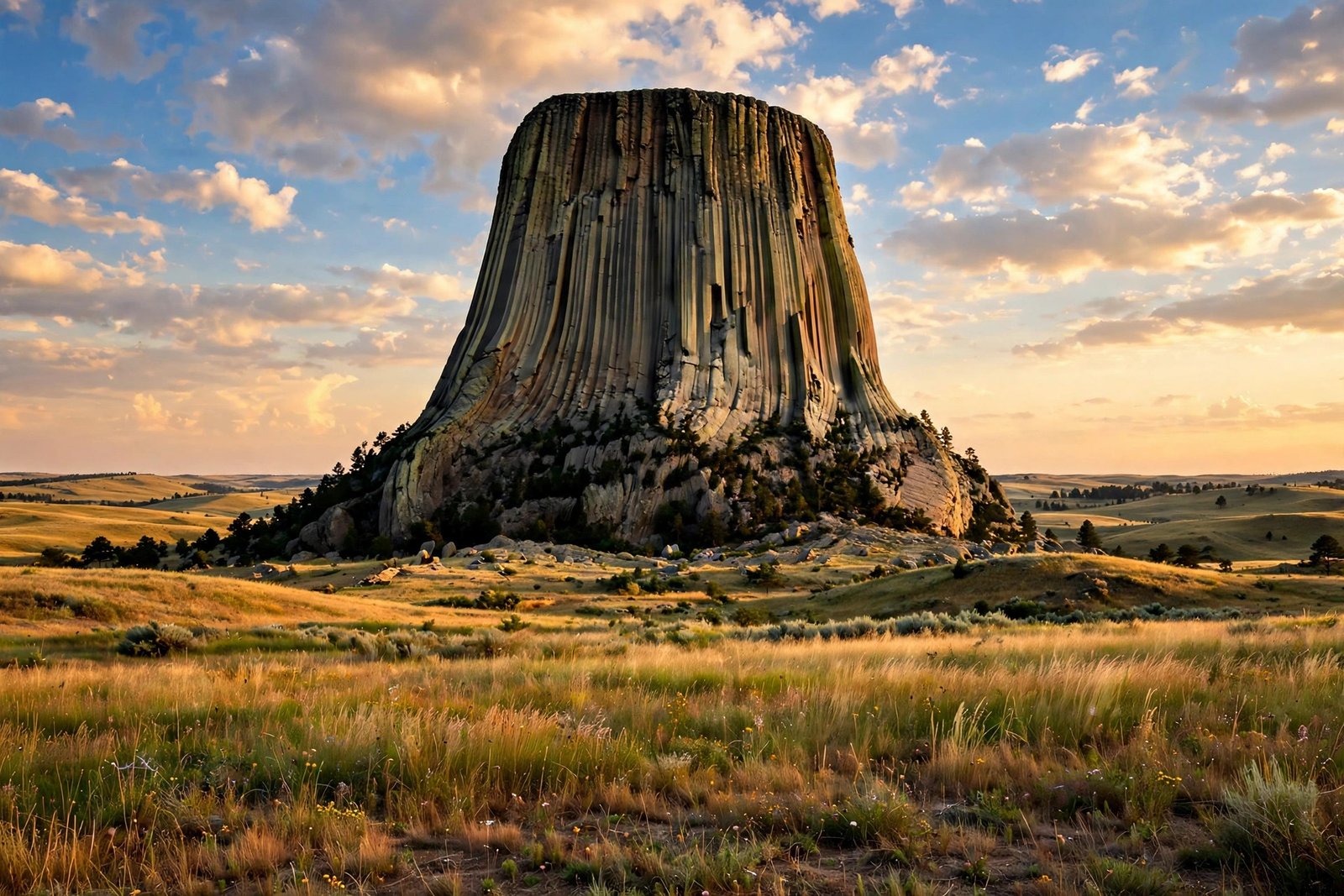
Rising more than 800 feet above the grasslands of northeastern Wyoming, Devils Tower looks like something that should not exist. Its fluted columns climb straight into the sky, its summit is flat and lonely, and its sides are scored with deep vertical grooves. Geologists explain it as a magma pillar that cooled underground and was exposed by erosion over geologic time. But for the Northern Plains tribes who have known this place for thousands of years, the tower has another explanation, and another name: Bear Lodge, Bear’s Tipi, Bear Peak, and Tree Rock. The stories they tell about it are not decorations on a geological wonder. They are sacred narratives, and they are still told today.
Devils Tower became the first U.S. National Monument in 1906, when President Theodore Roosevelt designated it under the Antiquities Act. That designation made it famous, and it also fixed a name that many Indigenous people consider a mistake. The name Devils Tower came from a mistranslation: during an 1875 expedition led by Colonel Richard Irving Dodge, an interpreter rendered the Native name for the formation as Bad God’s Tower, which was later shortened to Devil’s Tower. The tribes who revere the site had never called it anything like that. They called it by names that translate roughly to Bear’s House, Bear’s Lair, or Bear Lodge, and proposals to change the name to Bear Lodge have been discussed for years, though such a change would require congressional action or a presidential proclamation.
The story of the girls and the bear
The best-known sacred narrative about the tower is told in many versions by the Lakota, Kiowa, Cheyenne, Crow, Arapaho, and other Northern Plains tribes. In the Kiowa version preserved by the National Park Service’s history, seven little girls were playing at a distance from their village when bears chased them. The girls ran toward the village and, when the bears were about to catch them, jumped onto a low rock about three feet high. One of them prayed to the rock: Rock, take pity on us, Rock, save us. The rock heard them and began to grow upward, pushing the children higher and higher out of reach. When the bears jumped at them, they scratched the rock, broke their claws, and fell back to the ground. The rock kept rising until the children were in the sky, where they remain as seven little stars in a group, the Pleiades. The bears’ claw marks, in this telling, are the great columns on the sides of the tower.
Other versions change the details but keep the heart of the story. In the Crow telling, two young girls playing among large boulders are charged by a bear, scramble onto a rock, and are lifted to safety when the Great Spirit causes the rock to grow tall. The bear claws at the tower but cannot reach the top, and the girls remain atop the stone. In a Cheyenne version, seven brothers rescue a wife carried away by a giant bear, and prayer lifts them to safety on a rock that grows beneath them. The National Park Service is careful about language here: although popular culture would label these stories myths or legends, a more appropriate term is oral histories or sacred narratives, because they connect people with the site and carry religious meaning for living communities.
A sacred place, not just a landmark
For the Lakota, Kiowa, Cheyenne, Arapaho, Crow, Shoshone, and other tribes, Bear Lodge is a place of worship, prayer, and vision. Spiritual leaders have visited the tower to fast, pray, and receive visions and prophecies, including the Cheyenne prophet Sweet Medicine and the Lakota leaders Sitting Bull and Crazy Horse, according to tribal histories. The Lakota traditionally held a Sun Dance at Bear Lodge around the summer solstice, a ceremony focused on sacrifice and the renewal of people and nature. Northern Plains tribes still perform prayers and ceremonies near the tower, and the site remains a holy place in modern Indigenous belief.
That living significance shapes how the monument is managed today. Every June, rock climbing at Devils Tower is voluntarily suspended for the month, to recognize Bear Lodge as a sacred location during a time of traditional ceremonies. The closure is voluntary, not a ban, and it reflects a partnership between the Park Service and tribal communities: climbers are asked to respect the ceremonies, and most do. Visitors are also asked to treat prayer cloths, bundles, and other offerings left at the site with respect, and not to touch or remove them. These are not museum artifacts. They are part of ongoing religious practice.
What geology says
Science tells a different kind of story about the tower, and the two stories can sit side by side without canceling each other. Geologists describe Devils Tower as an igneous intrusion: magma that cooled underground into a hard rock called phonolite porphyry, which was later exposed as softer surrounding rock eroded away. The distinctive columns formed as the cooling rock contracted and cracked into tall, mostly hexagonal pillars. Scientists have studied the formation since the 1880s and still do not fully agree on every detail of the process, including whether the tower is the remains of a volcanic neck, a laccolith, or another kind of intrusion. That honest uncertainty is part of what makes the tower fascinating: even the scientific story has room for mystery.
The tower’s height adds to the drama. It rises about 867 feet from its base to its summit, and about 1,200 feet above the nearby Belle Fourche River, depending on where you measure from. Its summit is roughly the size of a football field, and reaching it requires technical rock climbing, not hiking. The first recorded climb was in 1893, by local ranchers who built a wooden ladder, parts of which are still visible on the tower’s side. Today, climbers from around the world come to test themselves on its cracks and columns, and the tower is considered one of the classic climbs in North America.
Visiting with respect
Visiting Devils Tower is straightforward, and the park rewards a slow visit. The Tower Trail, a paved path about 1.3 miles around the base, gives close views of the columns, the boulder field, and the prairie dog town near the visitor center. Ranger programs explain both the geology and the tribal histories, and the visitor center exhibits treat the sacred narratives with the seriousness they deserve. The best times to visit are late spring and early fall, when the weather is mild and the crowds are manageable, though the tower is striking in every season, including winter, when snow outlines the columns against a pale sky.
The most important thing a visitor can do is remember that the tower is not only a photo opportunity. It is a place where people pray. That means keeping voices low near ceremonies, staying on trails, not disturbing offerings, and considering the voluntary June climbing closure as an invitation to respect rather than a restriction to resent. It also means using the older names, Bear Lodge or Mato Tipila, alongside Devils Tower, and understanding why those names matter. Names carry history, and this tower’s history is longer and deeper than the name on the map suggests.
Devils Tower will keep drawing visitors for its geology, its climbing, and its sheer strangeness. But the reason it endures in American imagination is the story of the girls, the bear, and the rock that rose to save them. That story has been told for generations, and it is still being told, under a tower that still rises, unchanged, above the Wyoming grasslands.
Sources and further reading
The National Park Service’s collection of tribal stories is the essential source: First Stories, Devils Tower National Monument, National Park Service. A history of the Bear Lodge name and legend is available from Wyoming’s travel office: Bear Lodge: The Sacred Legend of Devils Tower.
Related reading
Area 51: Secrets, U-2 Planes, and Legends Explained · November Is Native American Heritage Month · Valley of Fire: Nevada’s Oldest State Park Guide
Frequently asked questions
What is Devils Tower’s Native name? The Lakota call it Mato Tipila, and the Cheyenne, Crow, Arapaho, and Kiowa have names translating roughly to Bear’s House, Bear’s Lair, or Bear Lodge.
Why is it called Devils Tower? An 1875 expedition interpreter mistranslated the Native name as Bad God’s Tower, which was shortened to Devil’s Tower. The name stuck despite tribal objections.
When did Devils Tower become a national monument? In 1906, when President Theodore Roosevelt designated it as the first U.S. National Monument.
What is the legend of Devils Tower? In the best-known sacred narrative, children fleeing bears pray to a rock, which rises into a tower to save them. The bears’ claw marks are said to be the columns on the tower’s sides.
Can you climb Devils Tower in June? Climbing is voluntarily suspended each June to respect tribal ceremonies at Bear Lodge. The closure is voluntary, and climbers are asked to honor it.