
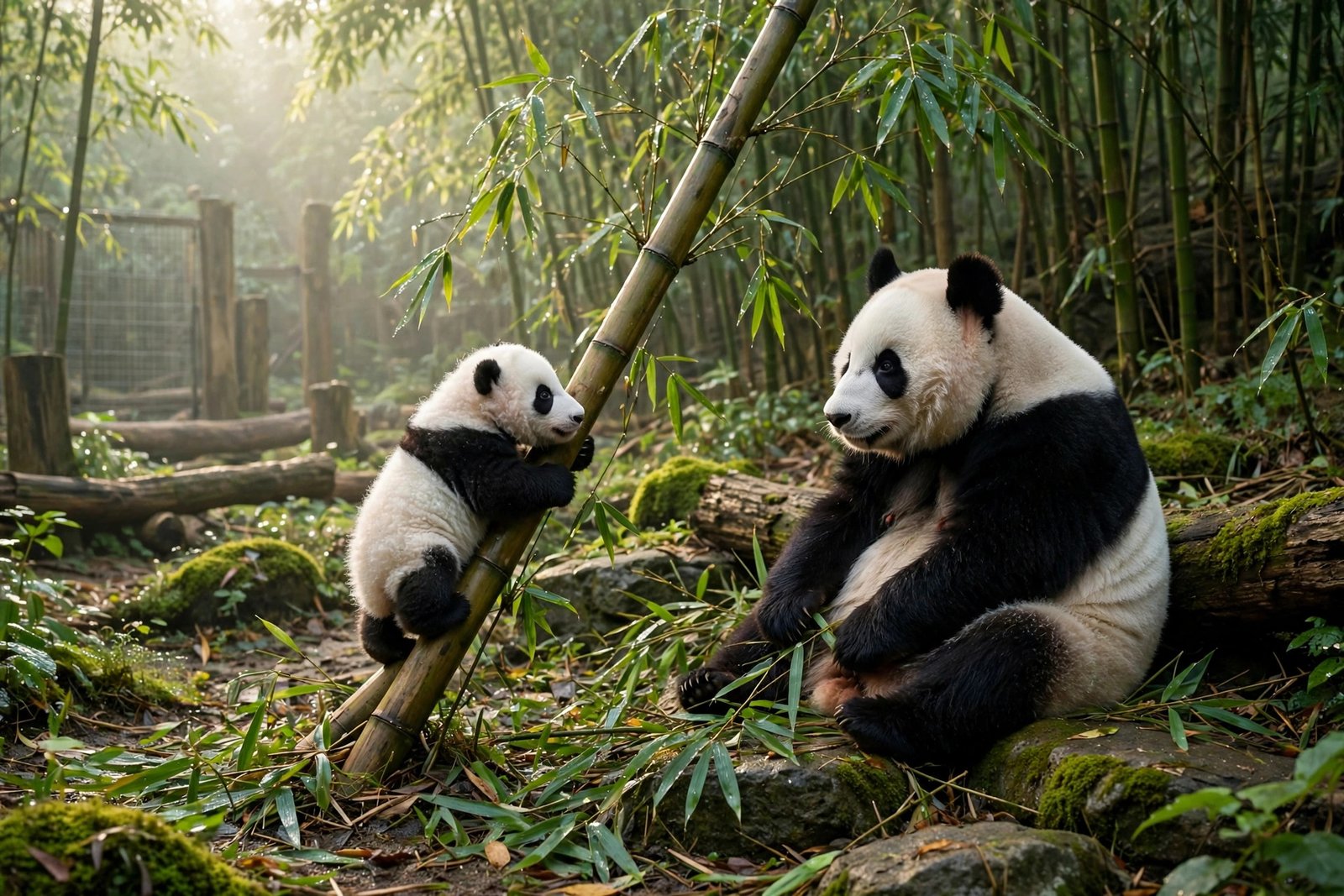
If your feed filled up this week with headlines about a baby panda named Shu Bao making her big debut today, you were not imagining it — but you may have been misled about where. Posts racing around social media have placed the five-month-old cub at the Smithsonian’s National Zoo in Washington, D.C. The truth is almost as delightful, and it is worth setting straight, because America’s actual panda story right now is a good one too.
Shu Bao is real, her debut is real, and it is happening today, October 30. It is just happening about 7,000 miles from Washington — at Everland, the big theme park in Yongin, South Korea. Here is what is actually going on, and what it means for the panda program in the U.S. capital.
Meet Shu Bao — in South Korea
Shu Bao is a female giant panda cub born on June 3, 2026, at Everland’s Panda World, to mother Ai Bao and father Le Bao, the panda pair on loan from China. She is the fourth cub born at the park, following her famous older sister Fu Bao and twin sisters Rui Bao and Hui Bao. According to Yonhap News Agency’s report on the announcement, she weighed just 171 grams — about six ounces — at birth, and has grown to more than 9 kilograms (roughly 20 pounds) in her first five months.
Everland announced on October 27 that the cub would begin meeting the public starting October 30, after a careful acclimation process in which she gradually explored the outdoor enclosure alongside her mother. Keepers say she took her first wobbly steps at around 120 days old. For now, her viewing hours will be extended gradually, with her health and comfort setting the pace — standard practice for a cub her age, since young pandas tire easily and still spend much of the day sleeping and nursing.
Her debut carries an extra layer of emotion for Korean panda fans. Her twin sisters, Rui Bao and Hui Bao, are scheduled to move to China at the end of the year, with December 11 set as their final day at Everland. That means for a few weeks this fall, visitors can see all five members of the family — both parents, the twins and baby Shu Bao — together before the family is separated, as panda loan agreements require cubs born abroad to eventually return to China.
So Why Did Everyone Think She Was Coming to Washington?
Partly, it is the name game. Panda cubs’ names often share characters and sounds — Bao means “treasure” — and Washington’s own young pandas are named Bao Li and Qing Bao. Mix a viral photo, a game of telephone across social platforms, and a public that spent more than a year in a full-blown “panda drought,” and a Korean debut can easily become a Washington debut by the third repost.
There is also genuine appetite behind the confusion. When the National Zoo’s previous pandas left for China in November 2023, Washington went without giant pandas for the first time since 1972, and American panda fans felt it. Any panda headline still lands on an audience that is primed to hope. (For the original announcement of Shu Bao’s debut, the Korea Times coverage has the details from Everland.)
America’s Real Panda Story: Bao Li and Qing Bao
The good news is that Washington’s panda program is very much alive — it just had its big debut last year, not this week. On October 15, 2024, two three-year-old pandas, male Bao Li and female Qing Bao, arrived at Dulles International Airport aboard a FedEx “Panda Express” flight from China, ending the capital’s 11-month panda drought. After quarantine and a members-only preview period, they made their official public debut on January 24, 2025, to crowds that included the mayor of Washington, D.C., local kindergarteners and a funk band. The zoo reported that nearly 16,000 people reserved visits for debut weekend alone.
The pair are in Washington under a new 10-year agreement between the Smithsonian and the China Wildlife Conservation Association that runs through April 2034, with the zoo paying a $1 million annual fee that supports conservation work in China. The full background on the pair is collected on the Wikipedia page for Bao Li and Qing Bao, and the Smithsonian’s own magazine covered the debut as the end of a 443-day wait.
Bao Li carries a particularly sweet piece of history: his mother, Bao Bao, was born at the National Zoo in 2013, which makes him a kind of hometown grandson returning to the habitat where his family line became famous. Washington is also not the only American city back in the panda business — the San Diego Zoo received Yun Chuan and Xin Bao in June 2024, the first giant pandas to enter the United States in 21 years.
Half a Century of Panda Diplomacy
To understand why a single cub’s debut can travel around the world in a day, it helps to remember how deep the panda bond runs in Washington. The National Zoo’s program began in 1972, when China gifted the pair Ling-Ling and Hsing-Hsing to the United States following President Nixon’s historic trip to China. The two became among the most beloved animals in America, drawing millions of visitors over two decades.
Their successors, Mei Xiang and Tian Tian, arrived in 2000 on a research and conservation loan and raised a series of cubs that each triggered full-scale pandemonium — most famously Xiao Qi Ji, born in 2020, whose early months on the zoo’s panda cam were a lockdown-era comfort for viewers around the world. When that family departed in November 2023 as their agreement expired, the uncertainty about whether pandas would return at all made the 2024 announcement of Bao Li and Qing Bao genuine national news.
How Panda Loans Actually Work
Every giant panda in an American zoo belongs to China, and the arrangements behind them are more structured than most visitors realize. Under the standard agreement, zoos pay an annual fee — in the National Zoo’s case, $1 million a year — that is directed to conservation projects in China. Any cub born abroad is Chinese property too, and typically travels to China around age four to join the breeding program there. That is the bittersweet rhythm panda fans know well: Xiao Qi Ji, the National Zoo’s pandemic-era superstar, left for China with his parents in 2023, and Shu Bao’s twin sisters face the same journey this December.
The system exists because it works two ways at once. Chinese conservation groups gain funding and research partnerships; American zoos gain an ambassador animal that draws millions of visitors and bankrolls broader wildlife programs. Decades of this cooperation, together with habitat protection in China, underpin one of conservation’s rare success stories.
Seeing America’s Pandas
If Shu Bao’s debut has you planning a panda trip, Washington makes it wonderfully easy. The Smithsonian’s National Zoo is free to visit — as all Smithsonian institutions are — though entry passes are required and the Asia Trail, home of the David M. Rubenstein Family Giant Panda Habitat, is best visited in the morning, when the bears are most active and often outside enjoying breakfast bamboo. Bao Li, the male, is famously the more playful of the pair, while Qing Bao has earned a reputation as the thoughtful climber of the two. Cannot make it to Connecticut Avenue? The zoo’s Giant Panda Cam streams the pair live, the same feed that carried Xiao Qi Ji’s childhood to a worldwide audience.
The west-coast option is San Diego, where Yun Chuan and Xin Bao settled into the zoo’s Panda Ridge habitat in 2024. Between the two coasts, American panda fans are better supplied than they have been in years — a sentence nobody could have written during the anxious, panda-less winter of 2023.
What It All Means
Panda debuts matter because these agreements are about far more than zoo attendance. The fees paid by zoos like the National Zoo fund habitat protection and research in China, and the breeding program is part of a decades-long conservation effort that helped move the giant panda’s status from “endangered” to “vulnerable” on the international Red List in 2016 — a rare piece of good news in wildlife conservation, and one American zoo-goers helped pay for.
One more detail worth knowing about Shu Bao’s big week: Everland has said her time outside will grow in stages, with keepers watching how she handles the crowds, the weather and the climbing structures before extending her hours. It is the same philosophy Washington used with Bao Li and Qing Bao, who spent months behind the scenes learning their habitat, their keepers’ routines and even the sounds of the city before their January debut. Panda debuts, it turns out, are marathons disguised as photo opportunities — on two continents at once.
So yes, celebrate Shu Bao today. Watch the videos, coo at the 20-pound ball of fluff learning to climb in her Korean enclosure, and share away. Just share the right caption: her debut is at Everland in South Korea. And if the photos leave you wanting a panda fix of your own, Washington’s Bao Li and Qing Bao are on view at the National Zoo right now — no plane ticket to Seoul required.