
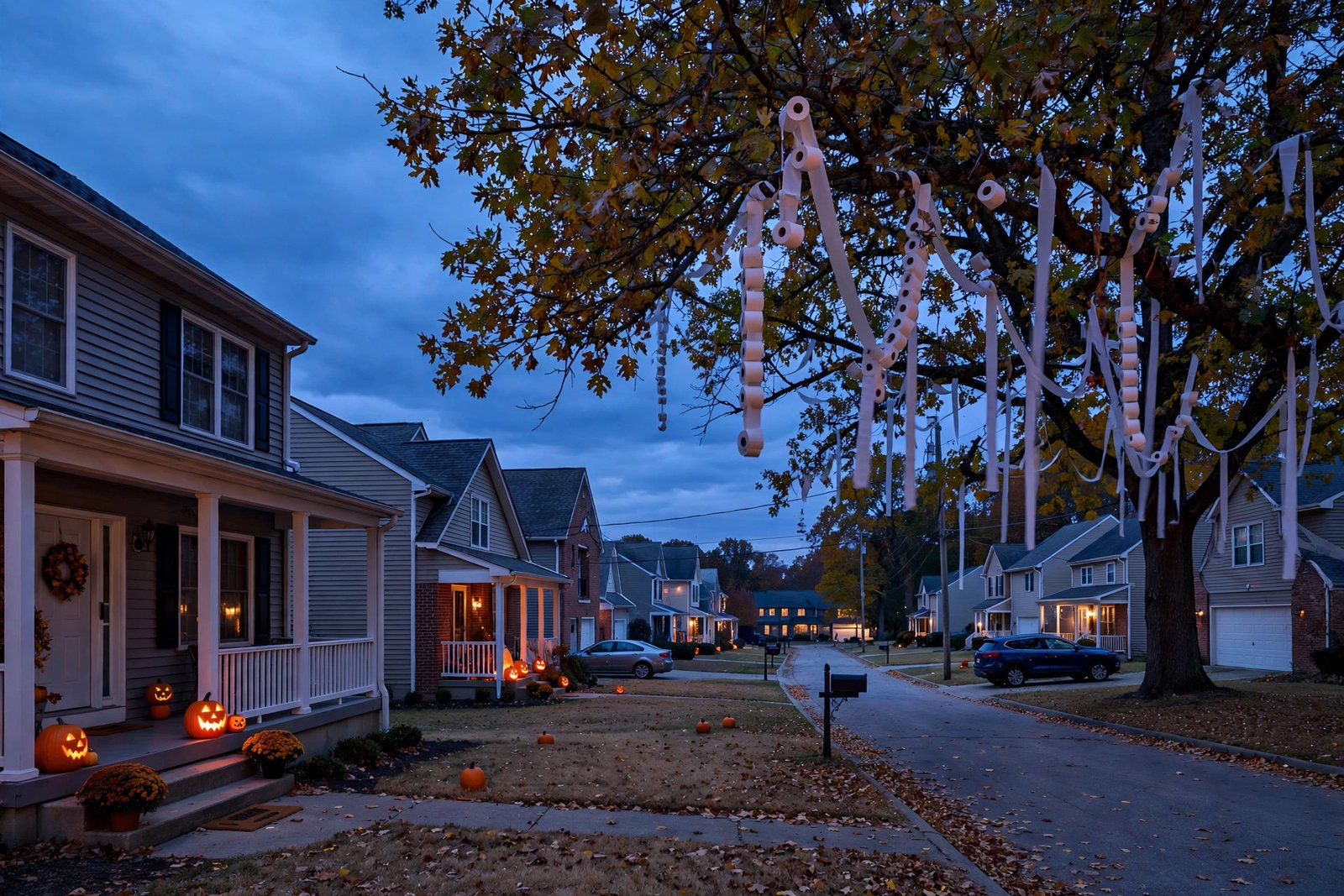
Tonight is October 30, and depending on where you live in America, that means something very specific: the toilet paper is coming out, the eggs are being counted, and the local police department has already posted its annual reminder on Facebook. For millions of people in the Northeast and Great Lakes, the night before Halloween is not just a warm-up act. It has its own name — several, in fact — and its own centuries-old tradition of glorious, mostly harmless trouble.
Welcome to Mischief Night, the regional holiday America cannot agree on a name for.
One Night, a Dozen Names
Ask a room of Americans what October 30 is called and you can practically draw a map from the answers. A famous 2013 dialect survey by the New York Times found that the name for the night before Halloween predicted where a person grew up with eerie accuracy. Here is the field guide:
- Mischief Night — the standard term across New Jersey, the Philadelphia area, Delaware and parts of New York and Connecticut.
- Devil’s Night — Detroit and the Great Lakes region, including Michigan and western Pennsylvania and New York.
- Goosey Night — pockets of northern New Jersey and parts of New York State.
- Cabbage Night — Vermont, parts of Connecticut, upstate New York, western Massachusetts and Bergen County, New Jersey, named for the rotten cabbages once hurled at houses.
- Gate Night — parts of New Hampshire, the Dakotas and elsewhere, from the old farm prank of opening gates and letting livestock wander.
- Mat Night — Quebec, where the classic move was stealing doormats.
- Moving Night — Baltimore’s contribution, named for the prank of relocating neighbors’ porch furniture.
- Beggar’s Night — Des Moines, Iowa, where the night works differently again: it is when many local kids actually go trick-or-treating.
And for a large share of Americans — roughly a quarter, by some estimates — the night has no name at all. It is simply the day before Halloween. The Wikipedia entry on the tradition (filed under Detroit’s “Angels’ Night”) catalogs just how hyper-regional the vocabulary gets, right down to individual counties.
Older Than Halloween Itself
Mischief Night is not an offshoot of Halloween. If anything, it is the older tradition. The earliest recorded reference dates to 1790 in England, when a school headmaster described a play ending with an ode praising children’s tricks on “Mischief Night.” Going back further, the Puritan writer Philip Stubbs was already complaining about May Day Eve mischief as early as 1583.
That is the first surprise: in Britain, the prank night originally belonged to spring, attached to the eve of May Day, and in parts of northern England it later migrated to November 4, the night before Guy Fawkes Night. When the tradition crossed the Atlantic, American communities gradually reattached it to the spookiest date available — the night before Halloween — and by the 1930s, newspapers were reporting organized pre-Halloween mischief as a distinct American custom.
The classic pranks were the stuff of small-town legend: soaping windows, ringing doorbells and vanishing, switching shop signs, overturning outhouses in the old days, and the cabbage raids that gave Cabbage Night its name. In rural Vermont and Massachusetts, farmers with bumper cabbage crops found their surplus produce redecorated across the neighbors’ porches. A Berkshire County newspaper in 1892 was already lamenting the “pent up devilry” let loose on Cabbage Night — proof that adults have been shaking their heads at October 30 for well over a century.
When Mischief Went Too Far: Detroit
The tradition’s darkest chapter belongs to Detroit. Through the 1970s and especially the 1980s, Devil’s Night in the city escalated from pranks into widespread arson, with hundreds of fires set on October 30 — by historical accounts, more than 800 fires in 1984 alone. The city became internationally notorious for a night that had started as schoolyard fun.
Detroit’s answer became a model studied by other cities. Officials imposed a curfew for minors in the mid-1980s, and the community eventually organized mass volunteer patrols — tens of thousands of residents walking and driving their neighborhoods with flashlights and radios to deter arsonists. The counter-tradition got its own hopeful name: Angels’ Night. The strategy worked. Arson numbers fell dramatically over the following decades, and Angels’ Night patrols became a point of civic pride. The Mystic Stamp Company’s history of the night traces this arc from harmless pranks to crisis and back again.
New Jersey has had its own escalations — one notorious year in the 1990s saw more than 130 arsons across the state on Mischief Night — which is why so many Garden State towns now treat October 30 as a planned public-safety event rather than a surprise.
Mischief Night in 2026: How Towns Handle It Now
Fast-forward to tonight. In the towns where the tradition lives, October 30 runs on a familiar modern script:
- Police reminders: Departments in New Jersey, Pennsylvania and Michigan post annual notices listing what counts as a crime — egging houses, spray paint and property damage can mean arrest and restitution, not a slap on the wrist.
- Curfews: A number of communities enforce youth curfews on October 30, typically requiring anyone under 18 to be off the streets by late evening unless accompanied by an adult.
- Extra patrols and volunteers: In Detroit, Angels’ Night-style patrols remain the template; elsewhere, neighborhood watch groups make a point of being visible.
- Retail quirks: Some stores in high-mischief areas quietly limit bulk egg and toilet paper sales to minors on October 30 — a rumor every year, and a real policy in more places than you might think.
- Organized alternatives: Towns increasingly schedule sanctioned fun — trunk-or-treats, haunted trails, school and rec-center parties — to give teenagers somewhere to be that is not a stranger’s front lawn.
The through-line is that communities have learned to separate the two Mischief Nights that share one date: the folkloric one, of chalked sidewalks and swapped garden gnomes, and the destructive one, which nobody defends.
Why October 30? The Logic of the Night Before
There is a practical genius to Mischief Night’s placement on the calendar. Halloween itself, by the mid-twentieth century, had become the children’s holiday — costumes, candy, parental supervision. Teenagers, too old for trick-or-treating and too young for everything else, needed a night of their own, and October 30 was sitting right there. The prank night became the unofficial rite of passage between the candy years and adulthood: your last sanctioned act of childhood chaos before you aged out entirely.
Historians of folklore also note that the “trick” half of “trick or treat” had to go somewhere. Early trick-or-treating carried a genuine, if mostly theatrical, threat — treats, or else. As Halloween grew more domesticated, the “or else” split off and moved a day earlier in the regions where the custom took hold, leaving October 31 sweet and October 30 spicy. The regional names stuck hardest where community traditions were strongest: New Jersey’s suburbs, industrial Detroit, rural New England, where a night of cabbage-throwing could be remembered, fondly or otherwise, for generations.
A Homeowner’s Survival Guide
If you live in Mischief Night country, the accumulated wisdom of generations of residents is simple and mostly cheerful. Bring in the things you love: the good doormat, the inflatable decorations, the garden gnomes with sentimental value. Park in the garage if you can. Leave the porch light on — pranksters historically prefer the dark, and a lit, occupied-looking house is the classic deterrent. Keep the pumpkins indoors for one night; they can make their debut on the 31st, un-smashed. And if you do wake to toilet paper in the maple tree, know that the etiquette of the night, honored in most neighborhoods, is that the prank is the prank — the cleanup is the tax you pay for living somewhere with traditions.
Parents have their own script, refined over decades: know where your teenagers are, make sure the group’s idea of “mischief” stops at toilet paper, and remember that what was a funny story in 1975 can be a viral video, a police report or a very expensive window in 2026. The night survives precisely where families and towns keep it in its original register — mischief, not damage.
The Pranks That Survive
For most celebrants in 2026, the night remains what it was in 1790: toilet paper in the trees, a lawn flamingo relocated to a neighbor’s yard, chalk messages on the driveway, and the timeless doorbell dash, now complicated by the fact that the doorbell films you. Social media has given the tradition a second life — prank videos rack up views every October 30 — while also making the old anonymity nearly impossible, which may be the most effective Mischief Night deterrent ever invented.
So if you wake up tomorrow to a tree full of toilet paper, take a breath before you shake your fist. You are participating, unwillingly, in a tradition older than the United States trick-or-treat custom itself — one that has survived ocean crossings, name changes in every region, an arson epidemic and its own reformation. Just leave the cabbages out of it. Some of us still remember Cabbage Night, and the smell takes weeks to fade.