
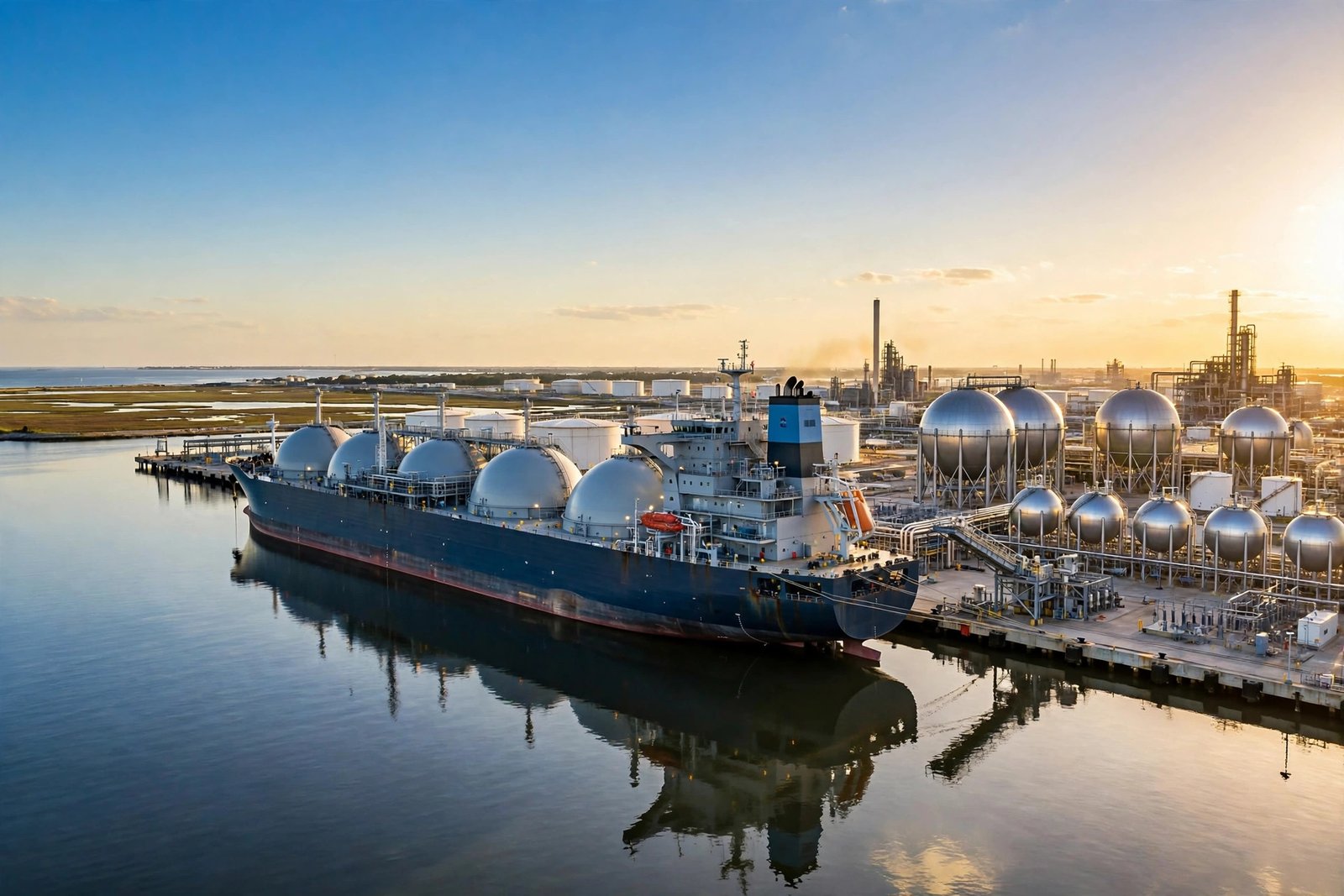
In 2023, the United States claimed a title that would have sounded impossible just twenty years earlier: the world’s largest exporter of liquefied natural gas. American LNG exports averaged 11.9 billion cubic feet per day that year, a 12 percent jump from 2022, pulling ahead of Australia and Qatar, the two countries that had long dominated the global gas trade. It was the crowning moment of one of the most remarkable energy turnarounds in modern history, a story that runs from shale fields in Texas and Pennsylvania to giant freezing plants on the Gulf Coast, and from there to homes and factories across Europe and Asia.
What makes the achievement so striking is how recently the opposite seemed certain. In the mid-2000s, American planners expected the United States to become a major importer of natural gas, and companies spent billions building terminals to receive foreign gas. Then the shale revolution rewrote the script, flooding the country with cheap, abundant gas and turning those import terminals into export machines. Today, American gas heats homes in Poland, powers factories in Japan, and gives Washington new leverage in world affairs. This is the story of how it happened, what LNG actually is, and why it matters for American power.
What Is LNG, Anyway?
LNG stands for liquefied natural gas, and the idea behind it is beautifully simple. Natural gas is mostly methane, and in its normal state it is a gas that takes up an enormous amount of space. That makes it very hard to move: you can push it through a pipeline, but you cannot practically load a gas onto a ship and send it across an ocean. Liquefaction solves the problem by cooling the gas until it becomes a liquid. At around minus 162 degrees Celsius, or minus 260 degrees Fahrenheit, natural gas condenses into a clear, colorless liquid that takes up only about one six-hundredth of its original volume.
That 600-to-1 shrink is the whole commercial reason LNG exists. Once the gas is a liquid, it can be stored in insulated tanks and loaded onto specially built ships called LNG carriers, which keep the cargo cold for the entire voyage. At the other end, a receiving terminal warms the liquid back into gas, a process called regasification, and feeds it into local pipelines. That shrink is what allows gas to be shipped safely and efficiently around the world, as Chevron explains in its guide to LNG.
Making LNG is an industrial feat. Raw gas arrives at a liquefaction plant by pipeline, where it is cleaned of water, carbon dioxide, and other impurities that would freeze solid at cryogenic temperatures. Then it passes through refrigeration stages, each colder than the last, until it reaches minus 162 degrees. The plants that do this are called trains, and a large terminal may run several side by side, each chilling a river of gas into liquid around the clock.
The Shale Revolution That Changed Everything
None of this would have been possible without the shale revolution. For decades, American natural gas came from conventional wells drilled into porous rock, and by the early 2000s, production was flattening while demand kept growing. Then engineers combined two older techniques, horizontal drilling and hydraulic fracturing, and used them to unlock gas trapped in dense shale rock formations deep underground. The results were staggering. Formations like the Marcellus, the Haynesville, and the Permian turned out to hold enormous quantities of gas, and American production surged.
The flood of shale gas changed everything. Prices fell, supplies became abundant, and the United States went from worrying about gas shortages to sitting on some of the largest recoverable reserves in the world. Federal forecasts expected the country to switch from net importer to net exporter by 2017, a reversal nobody had predicted a decade before. America had not been a net exporter of natural gas since 1957, and suddenly it was producing far more than it could use at home.
That surplus is what made LNG exports possible. Unlike countries such as Qatar, where gas comes from a single giant offshore field, American LNG draws on a vast, competitive domestic market fed by thousands of wells across many states. Producers compete with one another, pipelines crisscross the country, and the price of gas at the Henry Hub trading point in Louisiana is typically among the lowest in the world. That low-cost, flexible supply is the foundation of American LNG power, and it is the reason buyers around the world want American cargoes.
February 24, 2016: The Day America Started Shipping Gas
The symbolic starting point of the American LNG era is a single ship, the Asia Vision, which left the Sabine Pass terminal in Louisiana on February 24, 2016, carrying the first export cargo of the shale era to Brazil. The cargo held about 3.3 billion cubic feet of gas, modest by today’s standards, but its meaning was enormous. America had exported small amounts of LNG from Alaska since 1969, but this was the first cargo from the lower 48 states, announcing that America was now in the global gas business.
Sabine Pass itself tells the story of the turnaround. The terminal, operated by Cheniere Energy, began service in 2008 as an import facility, built for a country that expected to need foreign gas. Within a few years, the shale boom had made imports unnecessary, and Cheniere reversed course, converting the plant into an export terminal instead. Since that first cargo, Sabine Pass has shipped more than 3,300 cargoes worldwide, accounting for about 39 percent of all American export cargoes through November 2025, according to U.S. Department of Energy data.
From that first shipment, growth was rapid. American LNG exports rose from about 0.5 billion cubic feet per day in 2016 to roughly 15 billion cubic feet per day in 2025, according to the U.S. Energy Information Administration, a thirty-fold increase in less than a decade. New terminals opened along the Gulf Coast, existing ones added trains, and each year brought more cargoes to more countries. The transformation from importer to exporter, once thought to take a generation, was essentially complete within a few years.
The Gulf Coast Giants: Sabine Pass, Corpus Christi, and the Rest
Almost all American LNG comes from terminals along the Gulf Coast of Texas and Louisiana, where pipelines, ports, and gas fields meet. Sabine Pass remains the largest, with six liquefaction trains and a capacity of about 4.55 billion cubic feet per day, according to the Federal Energy Regulatory Commission. Its sister facility, Corpus Christi in Texas, also operated by Cheniere, has grown into the nation’s second-largest terminal, reaching about 3.1 billion cubic feet per day after its Stage 3 expansion was completed in 2026.
The rest of the fleet fills out the map. Freeport LNG in Texas, which returned to full operations in early 2023 after a fire-related shutdown, can handle about 2.38 billion cubic feet per day. Cameron LNG in Hackberry, Louisiana, adds about 2.06 billion cubic feet per day. Venture Global’s Calcasieu Pass terminal in Cameron Parish, Louisiana, contributes about 1.76 billion cubic feet per day, and smaller facilities at Cove Point in Maryland and Elba Island in Georgia round out the system. In 2023, seven American terminals were operating, and the Energy Information Administration estimated they ran at about 104 percent of nominal capacity, meaning the industry was pushing its plants beyond their nameplate ratings to meet demand.
More capacity is on the way. Projects under construction, including Plaquemines in Louisiana, Golden Pass in Texas, and the Rio Grande and Port Arthur terminals, will expand North American export capacity sharply. The Energy Information Administration projects capacity could more than double between 2024 and 2028, from 11.4 billion cubic feet per day in 2023 to 24.4 billion cubic feet per day in 2028. The Gulf Coast is still just getting started.
2023: The Year America Took the Crown
The decisive year was 2023. According to the U.S. Energy Information Administration, the United States exported more liquefied natural gas than any other country that year, averaging 11.9 billion cubic feet per day, a 12 percent increase over 2022. Australia and Qatar, the world’s two other largest exporters, each shipped between 10.1 and 10.5 billion cubic feet per day annually between 2020 and 2023, according to data from Cedigaz, so the American lead was clear. Russia and Malaysia trailed well behind, averaging 4.2 and 3.5 billion cubic feet per day respectively in 2023.
Several forces came together to deliver the crown. The return of the Freeport terminal to full operations added back a major source of supply. Strong demand in Europe pulled cargoes across the Atlantic. And the American terminals ran at extraordinary utilization rates, squeezing every possible shipment out of existing plants. Monthly records fell late in the year, with exports reaching 12.9 billion cubic feet per day in November and 13.6 billion cubic feet per day in December 2023.
The United States also exported around 90 million metric tons of LNG in 2023, roughly 15 percent more than in 2022. And the lead has held: by 2025, American exports had climbed to about 15 billion cubic feet per day, comfortably ahead of Australia and Qatar, with the Energy Information Administration projecting further growth to 18.1 billion cubic feet per day by 2027. What began as a race is increasingly looking like a durable American lead.
Why Europe Turned to American Gas
No factor did more to supercharge American LNG than the energy crisis that followed Russia’s invasion of Ukraine in 2022. For years, Europe had relied heavily on Russian pipeline gas, which arrived cheaply and in huge volumes. When the war began, that relationship shattered. European governments rushed to cut their dependence on Russian energy, and American LNG became the fastest available replacement. Cargoes that might once have sailed to Asia were redirected to European ports, and new import terminals were built in Germany, the Netherlands, and elsewhere at remarkable speed.
The shift shows up clearly in the destination data. Europe, including Turkiye, remained the primary destination for American LNG in 2023, accounting for 66 percent of exports, or about 7.8 billion cubic feet per day, according to the Energy Information Administration. Asia took about 26 percent, while Latin America and the Middle East combined took about 8 percent. In other words, two out of every three American LNG cargoes went to Europe, a dramatic reorientation of the global gas trade toward the Atlantic.
The pivot also revealed something important about American LNG: its flexibility. Many American contracts allow buyers to send cargoes wherever prices are highest, rather than locking them to one destination. That flexibility let American gas flow to where it was needed most, turning the United States into an emergency supplier for its allies. For European governments, American LNG was not just a commodity; it was a lifeline that kept homes warm and factories running through a crisis.
What LNG Power Means for America’s Future
The rise of American LNG is about more than export statistics. It is about jobs, trade, and influence. The LNG industry supports tens of thousands of American jobs, from roughnecks in the shale fields to engineers and operators at the Gulf Coast terminals, and it has narrowed the American trade deficit by turning a former import into a major export. Cheniere alone has invested about 50 billion dollars in its two export facilities over the past decade and aims to double output to 100 million metric tons per year by the mid-2030s.
Geopolitically, LNG has given the United States a new tool. Gas is no longer just a domestic fuel; it is a strategic export that strengthens alliances and weakens the leverage of rival suppliers. When American cargoes arrive in Europe or Asia, they carry a message that the United States is a reliable supplier, one that does not use energy as a weapon. That reliability has become a quiet pillar of American foreign policy, and one reason allies have welcomed the growth of American exports.
There are challenges ahead, of course. Building new terminals takes years and billions of dollars, and debates continue over the climate impact of natural gas and the pace of new export approvals. But the fundamentals are hard to argue with: abundant supply, low costs, flexible contracts, and strong demand from allies. As Reuters reported on the tenth anniversary of the first Sabine Pass cargo, American LNG dominance is set to keep growing, with exporters planning to lift liquefaction capacity to 28.7 billion cubic feet per day by 2029. A decade after that first small cargo sailed for Brazil, American gas has become one of the country’s great sources of strength, and the world is still catching up.
FAQ
What is LNG and why does it need to be liquefied?
LNG is natural gas, mostly methane, that has been cooled to about minus 162 degrees Celsius until it becomes a liquid. Liquefaction shrinks the gas to roughly one six-hundredth of its original volume, which makes it possible to load it onto ships and send it across oceans. Without that step, natural gas could only travel by pipeline.
When did the United States become the world’s largest LNG exporter?
The United States became the world’s largest LNG exporter in 2023, when exports averaged 11.9 billion cubic feet per day, according to the U.S. Energy Information Administration. That was a 12 percent increase from 2022 and put America ahead of Australia and Qatar, which each exported between 10.1 and 10.5 billion cubic feet per day.
Where does most American LNG come from?
Almost all American LNG is produced at terminals along the Gulf Coast of Texas and Louisiana. The largest is Sabine Pass in Louisiana, followed by Corpus Christi in Texas, with Freeport, Cameron, and Calcasieu Pass also playing major roles. The gas itself comes from shale formations across the country, including the Marcellus, Haynesville, and Permian regions.
Why did Europe buy so much American LNG?
After Russia invaded Ukraine in 2022, European countries rushed to replace Russian pipeline gas, and American LNG was the fastest large-scale alternative available. In 2023, Europe took about 66 percent of American LNG exports. The flexibility of American contracts, which let buyers redirect cargoes to where they are needed most, made the United States an ideal emergency supplier.
Will American LNG exports keep growing?
Yes. The Energy Information Administration projects North American export capacity could more than double between 2024 and 2028, and American exporters plan to raise liquefaction capacity to 28.7 billion cubic feet per day by 2029. New Gulf Coast terminals should keep exports rising for years.