
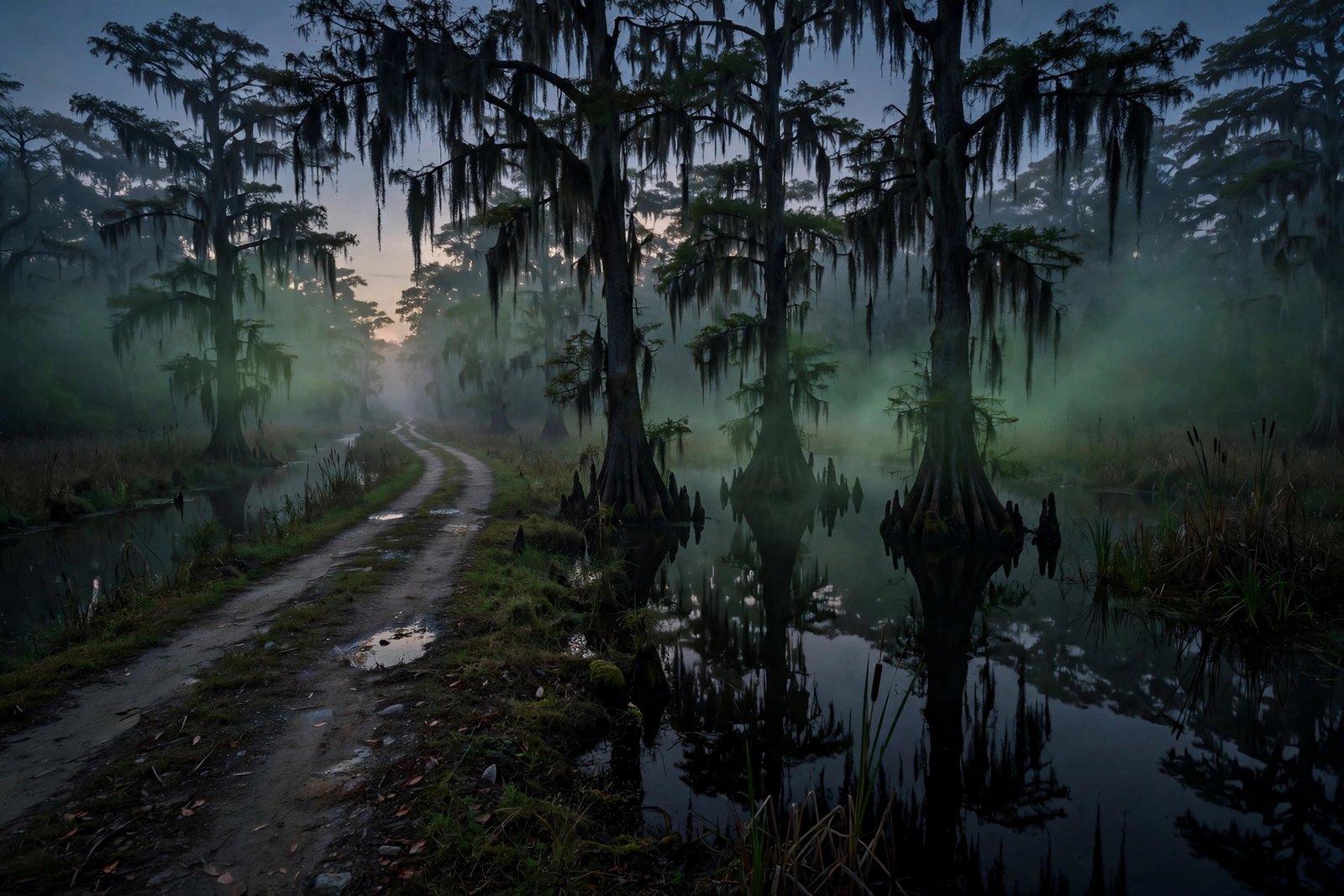
In the summer of 1988, a small town in South Carolina became the center of the strangest news story in America. The reports came from Lee County, a quiet cotton-farming corner of the state, and they described a creature seven feet tall, green and wet-looking, with red eyes, three fingers, and skin like a lizard. It lived, people said, in Scape Ore Swamp. It chased cars. It scratched vehicles and left three-toed footprints in the mud. A radio station offered a million dollars to anyone who could catch it alive. The Washington Post covered it. Good Morning America sent a crew.
The creature was called the Lizard Man of Scape Ore Swamp. Nearly forty years later, the town still celebrates it, the legend still draws visitors, and the story still raises the same question it raised in 1988: what did the people of Lee County actually see?
The Night on Browntown Road
The story begins, as the legend tells it, on the night of June 29, 1988. Christopher Davis, a 17-year-old from the town of Bishopville, was driving home from a late shift at a fast-food restaurant when his car blew a tire on Browntown Road, near the edge of Scape Ore Swamp. He stopped to change it. It was around 2 a.m. As he was finishing, he heard something moving behind him.
What Davis said he saw was a creature about seven feet tall, green and wet-looking, with glowing red eyes, three fingers on each hand, and skin covered in snakelike scales. He said it growled and ran toward him. He jumped in his car and sped away, but the creature kept up, grabbed at the car, and climbed onto the roof as he swerved down the road. He finally shook it off and made it home. His side-view mirror was badly damaged, and scratch marks were found on the car’s roof.
Davis did not report it right away. The first report that reached the sheriff’s office came two weeks later, on July 14, 1988, when a car parked at a home near Browntown was found damaged overnight, with tooth marks, scratches, hair, and muddy footprints left behind. Sheriff Liston Truesdale investigated, and the story of the damaged car made the local news — which prompted Davis to come forward with his own account. The newspapers picked it up, and within days, Lee County had a monster.
A Summer of Sightings
The weeks that followed were a frenzy. More residents reported sightings and damage to their cars. The sheriff’s department began logging calls as “Lizard Man sightings.” Plaster casts were made of three-toed footprints, some 14 inches long, found in the mud near the swamp. A local radio station, WCOS, offered a $1 million reward to anyone who could capture the creature alive. Tourists and monster hunters poured into Bishopville. Reporters came from across the country. The Washington Post ran a story on August 14, 1988, and Good Morning America covered it live.
Then came the twist. On August 5, an airman stationed at Shaw Air Force Base named Kenneth Orr filed a police report claiming he had encountered the Lizard Man on Highway 15 and shot and wounded it. Orr later admitted he had made the whole thing up, saying he wanted to keep the Lizard Man stories going. It was a hoax, and it did not help the legend’s credibility.
By the end of the summer, the reports were fading. Sheriff Truesdale, who had taken the sightings seriously and investigated them personally, said he believed people had seen something — but local law enforcement also said the most likely explanation was a bear. Biologists who looked at the footprint casts said they were unclassifiable. The summer of the Lizard Man was over.
What Was It, Really?
Skeptics have spent decades picking the story apart, and they have found plenty to work with. Investigator Ben Radford, who studied the case in depth, has argued that the details of Davis’s account do not hold up under scrutiny — including the claim that the creature kept pace with a car at 40 miles per hour. He has also questioned the polygraph test Davis was given, which was widely reported as proof that Davis was telling the truth. Radford’s conclusion is that the story grew in the retelling, with separate incidents — a damaged car here, a strange sighting there — merging into a single creature.
Other explanations have been offered. A black bear, startled in the dark, can look enormous and strange to a frightened teenager. A barred owl, seen in poor light, can look like a greenish figure with glowing eyes. One investigator, Alicia Lutz, has suggested that what Davis saw was a local farmer, Lucious Elmore, who was guarding his shed against thieves that night. And the original newspaper reports are less certain than the legend: The State newspaper, on July 19, 1988, said Davis’s encounter had happened “several weeks earlier,” and the date of June 29 only hardened into fact later.
None of this proves that Davis saw nothing. Sheriff Truesdale, who interviewed Davis multiple times, found him frightened, consistent, and not seeking attention. Truesdale’s own verdict was measured: “I don’t know what it was, but I believe people saw something.” That is the most honest sentence in the whole case.
Why the Legend Lives On
The Lizard Man did not die with the summer of 1988. Reports trickled in for years afterward — an estimated 20 to 30 incidents in total — and in August 2015, a South Carolina television station aired photos and video of a creature near the swamp, attributed to a witness named Jim Wilson. The footage was blurry and inconclusive, as such footage always is, but it was enough to bring the legend back to life for a new generation.
The 2015 revival showed how durable the legend is. When WCIV aired the photos and video attributed to witness Jim Wilson, the footage was dark, shaky, and inconclusive — a shape moving near the water that could have been anything. But it did not matter. Within days, the Lizard Man was back in the news, the town was fielding calls from reporters again, and a new generation was learning the story. Legends do not need proof. They need a good story, a real place, and someone willing to tell it again.
Lee County has embraced the Lizard Man. The town of Bishopville holds festivals celebrating the creature. The South Carolina Cotton Museum in Bishopville has a Lizard Man exhibit. The legend is on T-shirts, on signs, and in the local identity. For a small rural county, the monster is good business — and good fun. The people of Lee County know the story is probably not true, and they celebrate it anyway, because it is theirs.
That is the real lesson of the Lizard Man. The creature itself — seven feet tall, red-eyed, three-fingered — is almost certainly a story that grew in the telling, fed by a frightened teenager, a damaged car, a hoax, and a summer of attention. But the legend it became is real in the way that folklore is real: it brought a community together, it gave a small town a story the whole country knew, and it has outlived everyone who first told it. The swamp is still there. The road is still there. And on a dark night in Lee County, it is easy to understand why someone might look at the trees and wonder.
Frequently Asked Questions
What is the Lizard Man of Scape Ore Swamp?
A legendary creature said to inhabit the swampland around Scape Ore Swamp near Bishopville, in Lee County, South Carolina. It was first reported in the summer of 1988 and described as a seven-foot-tall, green, reptilian humanoid with red eyes and three fingers.
Who first saw the Lizard Man?
Christopher Davis, a 17-year-old from Bishopville, reported encountering the creature on Browntown Road in late June 1988, commonly dated June 29, while changing a flat tire around 2 a.m. He said it chased his car and climbed onto the roof.
Was there a reward for catching the Lizard Man?
Yes. Radio station WCOS offered a $1 million reward to anyone who could capture the creature alive during the summer of 1988. Nobody ever claimed it.
Was the Lizard Man a hoax?
Part of the story was. Airman Kenneth Orr admitted in 1988 that he had faked his own sighting to keep the stories going. The original Davis sighting was never proven to be a hoax, but skeptics argue the details do not hold up and the most likely explanation is a misidentified bear or other animal.
Are there still Lizard Man sightings?
Occasional reports have continued since 1988, with an estimated 20 to 30 incidents in total. The most notable recent one came in August 2015, when a South Carolina TV station aired photos and video attributed to a witness near the swamp.
Can you visit Scape Ore Swamp?
Yes. Scape Ore Swamp is a real place in Lee County, South Carolina, near Bishopville. The town embraces the legend, and the South Carolina Cotton Museum in Bishopville has a Lizard Man exhibit.
Related Reading
- The Amityville Horror: The True Story Behind the Legend
- Winchester Mystery House: Fact vs. Legend
- The Lost Dutchman Gold Mine Legend
Sources: Wikipedia: Lizard Man of Scape Ore Swamp; The Horror Collection: Lizard Man of Lee County