
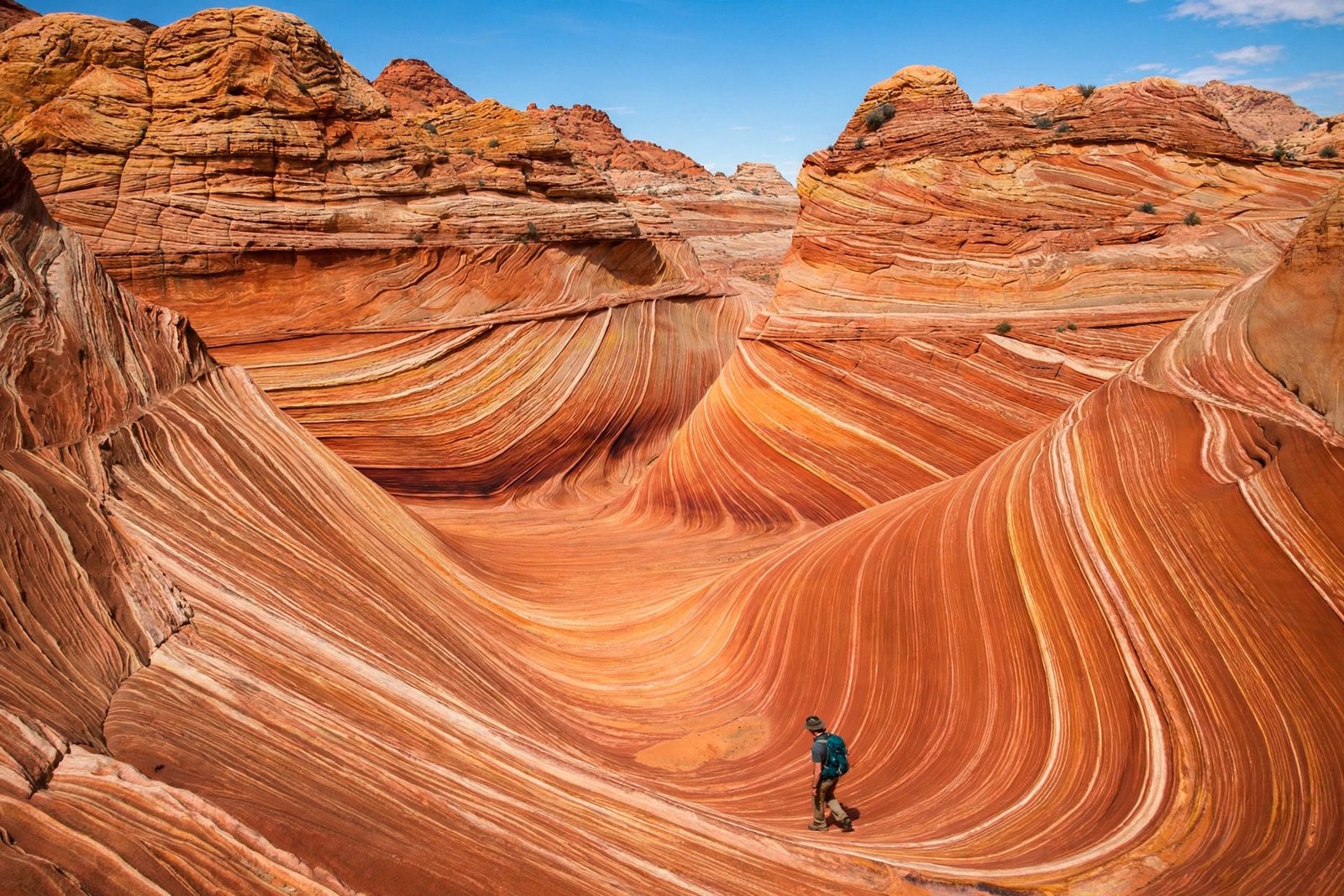
There are places in the American Southwest that look less like Earth and more like a dream someone had about Earth. The Wave is one of them. Tucked into a remote corner of the Arizona desert, near the Utah border, it is a sweep of striped, swirled sandstone that seems to flow like water frozen in rock. Bands of red, orange, pink, cream, and gold curve and fold across each other, shaped by wind and water over millions of years. Photographs of it have become famous around the world, yet very few people ever stand inside it in person. That is not an accident. It is the result of one of the strictest visitor limits in the entire American public-lands system.
Only 64 people a day are allowed to visit The Wave, and every one of them needs a permit won through a lottery. There is no ticket office at the trailhead and no walk-up purchase. This guide explains what The Wave is, how both lotteries work, what the hike is really like, and how to give yourself the best chance of getting in.
What Is The Wave?
The Wave is a sandstone rock formation in Coyote Buttes North, a rugged area of desert slickrock, canyons, and dunes. Its name comes from its appearance: the rock looks like a wave caught mid-curl. The stripes are layers of Navajo sandstone, laid down in different colors long ago, then carved by wind and rain into smooth, flowing shapes that change color through the day as the sun moves.
It is not a single viewpoint or a fenced attraction, but a natural formation in open desert, reached on foot, with no facilities, no shade, and no marked path. That wildness is part of its appeal, and also why access is so tightly controlled: the rock is fragile, the desert is easily damaged by footsteps, and even a modest crowd would wear the small area down quickly.
Where The Wave Sits
The Wave lies in Coyote Buttes North, part of Vermilion Cliffs National Monument on the Arizona-Utah border. The monument and the surrounding country are managed by the Bureau of Land Management, known as the BLM. The Wave sits inside the 112,500-acre Paria Canyon-Vermilion Cliffs Wilderness, a federally protected wilderness area where motor vehicles and bicycles are not allowed and visitors travel on foot.
The nearest towns are Kanab, Utah, and Page, Arizona, both small desert communities that serve as bases for visitors. The trailhead is reached by dirt roads that can become impassable in wet weather, and the hike crosses open desert with few landmarks. Cell service is unreliable, and summer heat here can be dangerous, so treat the visit as a backcountry trip, with plenty of water, sun protection, food, and a solid plan for navigation.
Why Only 64 People A Day?
The daily limit is 64 people, or 16 groups, whichever comes first. That means a day can fill up with fewer than 64 people if enough groups of six apply, because the group cap is reached first. The limit applies every day of the year, and it covers Coyote Buttes North only. A permit for The Wave does not cover Coyote Buttes South, a separate area with its own permit system, and it does not cover Paria Canyon either.
The limit has stayed small because the formation and its surroundings cannot handle heavy foot traffic. Sandstone can be scratched by shoes, and the thin desert soil and plants around it are slow to recover once trampled. Keeping numbers low also keeps the place quiet and uncrowded. The trade-off is clear: the limit preserves The Wave, but most people who apply will not get a permit on their first try.
How The Permit Lottery Works
Every visit to The Wave needs a permit won by lottery through Recreation.gov, the federal recreation booking system. There is no other way to get one. You cannot buy a permit at the trailhead, from a tour company, or from another person, because permits are non-transferable. You apply online, pay a small application fee, and wait for the draw.
The 64 daily spots are split between two lotteries. The Advance Lottery covers 48 people, or 12 groups, per day. The Daily Lottery covers the remaining 16 people, or 4 groups, per day. The two lotteries work on different timelines, and understanding that difference is the key to planning a trip.
The Advance Lottery: Plan Four Months Ahead
The Advance Lottery is the main route for people planning a trip in advance. You apply during a calendar month for a date in the fourth month ahead. For example, you apply in one month for a trip date four months later, and the draw takes place on the 1st of the following month at 9 a.m. Mountain Time. Each application can list up to three trip dates, which gives you a little flexibility if your first choice is already full.
Each application costs a $6 non-refundable fee, whether or not you are selected. If you are selected, you then pay $7 per person per day for the permit itself. Dogs cost $7 each and must be listed on the application. A permit covers a maximum of six people, including infants, so a group larger than six cannot travel on a single permit. Once a permit is issued, you cannot change the date, the permit holder’s name, or the group size, and the fees are non-refundable.
The BLM publishes no official success rate for the Advance Lottery. Independent analyses of historical data, however, have put the odds at roughly 2 percent in May, the busiest month, and around 8 percent in January, one of the quietest. Those are independent estimates, not official figures, and your own odds will depend on the month and how many people apply.
The Daily Lottery: A Second Chance On The Ground
The Daily Lottery is for people who are already in the region. It covers 16 people, or four groups, per day, and you apply for a permit two days ahead. Applications open at 6 a.m. and close at 6 p.m., and you must apply from a phone inside a geofenced area around Kanab, Utah, and Page, Arizona. That geofenced zone covers about 3,272 square miles along the Highway 389 and Highway 89 corridors, so you need to be physically in the area, not applying from home.
This system replaced the old walk-in lottery in Kanab in March 2022. Under the old system, hopeful visitors gathered in person in Kanab each morning for a draw. The geofenced daily lottery keeps the same idea — you have to be nearby — but moves the application onto a phone. The fees and rules are the same as the advance draw.
Independent analyses of historical data have put daily-lottery odds at roughly 3 percent in spring and around 9 percent in August. Again, these are independent estimates, not official BLM figures. August is hotter and quieter, which helps the odds, but it is also the most demanding time to hike in the desert. Some visitors spend several days in Kanab or Page applying each day, treating the daily lottery as a multi-day attempt rather than a single shot.
What The Hike Is Like
The hike to The Wave is about 6.4 miles round trip, rated strenuous, with about 350 feet of elevation gain. There is no marked trail. Instead, hikers follow a route across slickrock, sand, and desert washes, using landmarks, cairns, and a map or GPS to find their way. The route is not technically difficult in the climbing sense, but it is easy to lose in featureless terrain, especially on the return leg, when everything looks different from the other direction.
There is almost no shade and no water along the way, so heat is the main hazard. Summer temperatures in this desert can be extreme, so carry far more water than you think you need, start early, and turn back if conditions deteriorate. In winter the hike is cooler but the days are short, and snow or ice can make the slickrock slippery.
Rules Worth Knowing Before You Apply
A few rules catch first-time applicants by surprise, so it is worth knowing them before you pay the application fee. An America the Beautiful pass gives no exemption and no discount for The Wave; the permit fee applies to everyone, pass or no pass. Permits are non-refundable, non-transferable, and cannot be changed once issued, so double-check your dates, your group size, and the name on the application before you submit it. Infants count toward the six-person maximum, and dogs must be listed and paid for.
How To Plan Your Trip
Start with the calendar, not the camera. If you have fixed travel dates, apply for the Advance Lottery in the right month and list all three date choices. If your dates are flexible, consider the quieter months: winter brings better odds and cooler hiking, though with shorter days and colder nights. If you can spend several days in Kanab or Page, the Daily Lottery gives you repeated chances, and the area has plenty of other desert hikes and viewpoints to fill the waiting days.
Frequently Asked Questions
How many people can visit The Wave each day? Only 64 people, or 16 groups, whichever comes first, are allowed into Coyote Buttes North each day — 48 people in the Advance Lottery and 16 in the Daily Lottery.
Can I just show up and buy a permit at the trailhead? No. Every visit needs a permit won by lottery through Recreation.gov. There is no walk-up purchase, and permits cannot be bought from another person because they are non-transferable.
How far ahead should I apply? For the Advance Lottery, apply during a calendar month for a date in the fourth month ahead, with the draw on the 1st of the following month at 9 a.m. Mountain Time. For the Daily Lottery, apply two days ahead, between 6 a.m. and 6 p.m., from inside the geofenced area around Kanab and Page.
How much does a permit cost? The application fee is $6 per application and is non-refundable. If selected, the permit costs $7 per person per day, and dogs cost $7 each. An America the Beautiful pass gives no discount or exemption.
How hard is the hike? The round trip is about 6.4 miles, rated strenuous, with about 350 feet of elevation gain and no marked trail. The main challenges are navigation and heat, so preparation matters more than fitness alone.
Sources
- PermitSnag: The Wave Permit Guide
- Meridian Explorer: The Wave Guide
- Antelope Lower Canyon: The Wave Arizona Permit
- Recreation.gov