
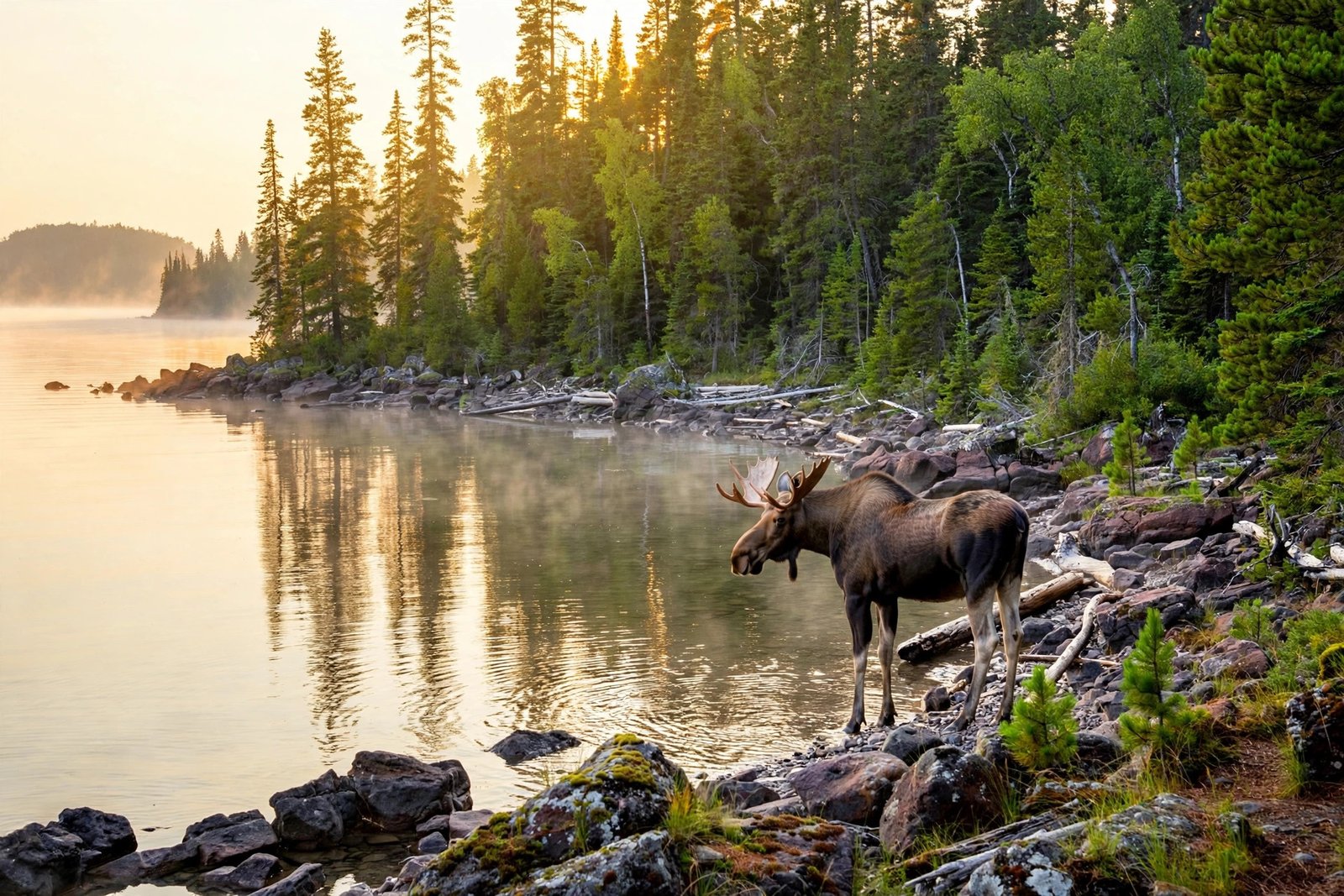
There is a national park in America where the loudest sound is a loon calling across still water at dusk, where the trails have no crowds because there are no roads, and where the entire year’s visitors would barely fill a single section of a football stadium. It is Isle Royale National Park, a roadless island archipelago in the middle of Lake Superior, and in 2025 it drew just 29,091 visitors — fewer people than Yellowstone or the Great Smoky Mountains see on a single busy day.
Isle Royale is the least-visited national park in the contiguous United States, and that is exactly the point. Getting there requires a ferry ride of several hours or a seaplane flight across open water, and the park closes entirely for the winter. What waits on the other side is one of the wildest places left in America: 45 miles of boreal forest and rocky shoreline, a wolf-moose drama that has run for nearly 70 years, and a silence that most Americans have never experienced.
Here is what makes Isle Royale special, how to reach it, and why the scientists who study its wolves and moose call it the most important island in American ecology.
An Island Closer to Canada Than to Michigan
Isle Royale sits in the northwestern corner of Lake Superior, about 15 miles from the Canadian shore and 56 miles from Michigan’s Upper Peninsula. It is a long, narrow island — roughly 45 miles end to end — surrounded by more than 400 smaller islands, and the whole archipelago is the park. The island is closer to Canada than to the state it belongs to, which is part of its strange, in-between character.
The park covers about 850 square miles, and 99 percent of it is federally designated wilderness. There are no roads, no cars, and no cell service. The only way in is by ferry from Houghton or Copper Harbor in Michigan, or from Grand Portage in Minnesota, or by private seaplane. The crossing takes three to six hours depending on the departure point, and the lake is famously cold and rough even in summer.
Isle Royale became the nation’s 25th national park in 1940, established by President Franklin D. Roosevelt. It protects more than 130,000 acres of wilderness, and it is the only national park in the country that closes entirely for the season. The park is open from April 16 through October 31 and shut from November 1 through April 15, when Lake Superior’s ice and storms make the island unreachable and uninhabitable.
The World’s Longest Predator-Prey Study
What makes Isle Royale famous among scientists is not its scenery, spectacular as it is, but its animals. The island is home to one of the simplest ecosystems on Earth: essentially one predator, the wolf, and one prey, the moose. That simplicity has made it the site of the longest continuous predator-prey study anywhere in the world, running since 1958.
The story began when moose swam to the island from the mainland in the early 1900s and found a paradise with no predators. Their numbers exploded. Then, around 1948, wolves crossed to the island on a winter ice bridge from Canada, and the two species have been locked in a dance ever since. Michigan Technological University has tracked the populations every winter for nearly seven decades, and the data has shaped how ecologists around the world understand the balance between predators and prey.
The study has had its dramatic chapters. The wolf population peaked at 50 animals in 1980, then crashed as disease and inbreeding took their toll. By 2016 to 2018, only two wolves remained on the island, and the moose herd had ballooned toward 2,000 animals. Faced with an ecosystem out of balance, the National Park Service authorized a relocation program, and between September 2018 and September 2019, crews translocated 19 wolves to the island from Minnesota, Michigan, and Ontario.
Wolves Near a 50-Year High, Moose in Freefall
The latest numbers from the winter study, led by Michigan Tech researchers Sarah Hoy and Rolf Peterson between January 22 and March 3, 2026, tell a remarkable story. The wolf population has climbed to 37 animals, the highest count since the late 1970s, spread across three packs that each raised pups. The moose, meanwhile, have paid the price: the survey put the herd at about 524 animals, down 38 percent from 840 the year before and down 75 percent since the 2019 peak near 2,000.
Wolves killed roughly 24 percent of the moose over the year, one of the highest predation rates ever recorded on the island. And for the first time in 68 years of the study, the team counted no moose calves at all. It is a stark illustration of how quickly the balance can tip, and a reminder that the island’s ecosystem is not a stable postcard but a living experiment that is still running.
Only 18 mammal species live on the island, and the absences are as telling as the presences. There are no bears, no white-tailed deer, no porcupines, no skunks, no raccoons, and no coyotes. Every animal on Isle Royale arrived by swimming, by walking across a winter ice bridge, or by human introduction. The result is an unusually simplified web of life, and one of the few places in America where visitors can see a nearly complete wilderness food chain in action.
What a Visit Is Actually Like
A trip to Isle Royale is not a casual day out. The ferry from Houghton takes about six hours each way, and the seaplane takes about 45 minutes but costs considerably more. Once there, visitors hike a network of backcountry trails, camp at 36 campgrounds scattered across the island’s 134,000 acres, or stay at the Rock Harbor Lodge, the park’s only lodging. There are no restaurants beyond the lodge, no shops, and no Wi-Fi. The park’s rangers are the only authority, and the weather is the only schedule.
The reward is a kind of quiet that has become rare in American life. Hikers regularly spot moose feeding in the island’s inland lakes at dawn, and loons call across the harbors at night. The island’s copper mining history is visible in old mine shafts and a lighthouse at Rock Harbor, and the waters around the island hold some of the best-preserved shipwrecks in the Great Lakes, protected in a marine sanctuary that draws divers from around the world.
Visitors should know that the island’s wildness is not an abstraction. In July 2026, the Park Service closed the Three Mile Campground after a wolf began approaching campers, a reminder that the island’s wolves are wild animals in a place where humans are guests. Food storage rules are strict, and rangers advise every overnight visitor to treat the island with the respect it demands.
Why It Matters
Isle Royale matters because it is a control group for the continent. In a country where almost every landscape has been shaped by roads, farms, and cities, the island shows what a North American ecosystem does when it is left alone — how wolves and moose find their balance, how forests recover, and how quickly things can change. The 68-year study is one of the longest-running ecological datasets in the world, and it has informed wolf reintroduction debates from Yellowstone to Colorado.
It also matters because it is proof that wildness still exists within reach. Isle Royale is not in Alaska or the far north. It is a day’s drive from Chicago and Detroit, and yet it feels like another world. That is the paradox of the least-visited national park in the lower 48: it is hard to reach, but not far away, and the difficulty is the point. The island rewards the effort with something no other park in America can offer — a wilderness that is still, in the truest sense, wild.
Frequently Asked Questions
How many people visit Isle Royale National Park each year?
Isle Royale drew 29,091 recreation visits in 2025, according to National Park Service statistics, making it the least-visited national park in the contiguous United States. By comparison, Great Smoky Mountains National Park receives more than 12 million visitors a year.
How do you get to Isle Royale?
The only ways in are by ferry from Houghton or Copper Harbor, Michigan, or Grand Portage, Minnesota, or by private seaplane. There are no roads to the island and no cars on it. The ferry from Houghton takes about six hours each way.
When is Isle Royale open?
The park is open from April 16 through October 31 and closes entirely from November 1 through April 15. It is the only national park in the country that shuts down completely for the winter.
How many wolves and moose are on Isle Royale?
The 2026 winter study estimated 37 wolves, the highest count since the late 1970s, and about 524 moose, down 75 percent from the 2019 peak near 2,000. The wolf-moose study has run continuously since 1958.
Is Isle Royale safe to visit?
Yes, with preparation. Visitors should follow food storage rules, check current conditions with the Park Service, and understand that the island is a true wilderness with no cell service. Wolves are wild animals, and campgrounds have been closed when wolves approached campers.
Sources
- More Than Just Parks — Isle Royale Facts: 11 About Its Wolves, Moose and Wrecks
- WorldAtlas — The Most Remote National Park in the Lower 48
- International Parks — Isle Royale, United States: Ratings & Visitor Guide
- National Park Service — Isle Royale National Park