
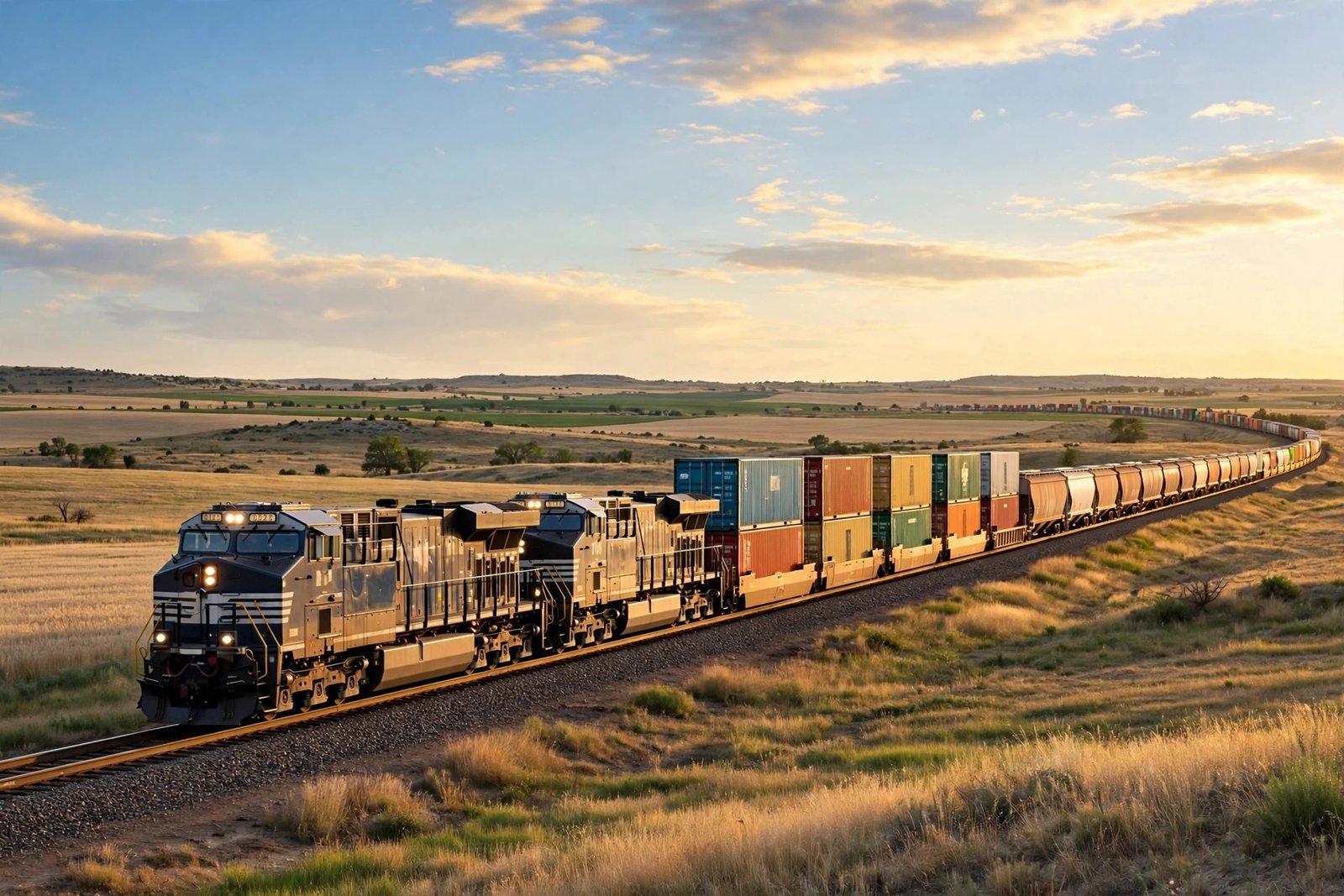
Look at almost anything in your home and ask how it got there. The grain in your bread, the lumber in your walls, the car in your driveway, the chemicals that cleaned your water, and the containers stacked at a port all have something in common: there is a good chance a freight train moved them for at least part of their journey. America’s freight railroads are easy to overlook because they work quietly, often at night, far from city centers. Yet they are one of the foundations of the American economy.
Freight rail is the heavy hauler of the nation. It moves raw materials and finished goods across long distances, connects farms and factories to ports and markets, and keeps supply chains running. It does this with a private network that spans much of the continent, a workforce of skilled railroaders, and trains that can stretch for more than a mile. This is how that system works, what it carries, and why it still matters in an age of trucks, planes, and next-day delivery.
The scale of the network
America’s freight rail network is vast. The Association of American Railroads describes freight railroads as operating across 49 states and Washington, D.C., and notes a network spanning nearly 135,000 miles in recent AAR material. Other AAR descriptions round the private North American network to about 140,000 miles, reflecting different ways of counting track across the United States, Canada, and Mexico. Either way, the scale is enormous: tens of thousands of miles of track, thousands of locomotives, and a web of yards, terminals, and intermodal facilities that link every region of the country.
You can explore AAR’s overview at https://www.aar.org/rail-facts-2/ and its history page at https://www.aar.org/celebrating-america-at-250/. The network includes six large Class I railroads, plus regional and short line railroads that connect local businesses and communities to the national system. Short lines are especially important in rural America, where they serve grain elevators, lumber mills, factories, and small towns that would otherwise be far from a main line.
Freight rail has been part of American life since the early steam era. AAR notes that freight rail has been helping build America since 1827, from the earliest rail lines to today’s modern network. That long history matters because rail infrastructure is built to last. Tracks, bridges, tunnels, and yards represent decades of investment, and railroads continue to invest heavily each year to maintain and modernize them.
What freight trains actually haul
Freight railroads move an astonishing variety. AAR summarizes it simply: they haul raw materials and finished goods that power the economy, from grain and energy to vehicles, chemicals, building materials, and consumer products. A more detailed AAR list includes intermodal containers, chemicals, agricultural products, autos, construction materials, pulp, paper, and energy resources like ethanol, crude oil, and coal. See https://www.aar.org/industries-we-support/.
Agriculture is a cornerstone. Railroads carry enormous amounts of corn, wheat, soybeans, and other grains, along with fertilizer, animal feed, flour, and other food products. Corn is by far the highest-volume grain carried by rail, according to AAR freight facts, and railroads account for well over a third of U.S. grain export movements, according to the U.S. Department of Agriculture figures cited by AAR. When harvests are good in the Midwest and Great Plains, trains carry that abundance to mills, processors, and export terminals.
Energy and industry depend on rail too. Coal, while declining as a share of electricity generation, still moves in large volumes to power plants and steel mills. Chemicals, including plastics and fertilizers, move in tank cars and covered hoppers. Steel, cement, sand, lumber, and crushed stone move to construction sites and factories. Autos and auto parts move at every stage, from iron ore and steel to finished vehicles rolling off assembly lines.
Consumer goods travel by rail more often than shoppers realize. Intermodal traffic, the movement of shipping containers and truck trailers by rail, has been the fastest-growing major rail traffic segment over the past 25 years, according to AAR. In 2023, U.S. rail intermodal volume was 12.7 million units, and intermodal accounted for approximately 25 percent of revenue for major U.S. railroads, more than any other single rail traffic segment. Around half of rail intermodal volume consists of imports or exports, reflecting rail’s vital role in international trade. You can find those facts at https://www.aar.org/freight-rail-facts-figures/.
Why rail is so efficient for heavy, long-distance freight
Rail has a basic physics advantage. Steel wheels on steel rails create very low rolling resistance, so one locomotive can pull dozens of cars, and a single train can carry the equivalent of hundreds of truckloads. That makes rail especially efficient for heavy, bulky, long-distance shipments where speed is less important than volume and cost.
AAR notes that railroads can move a single ton of freight nearly 500 miles on a single gallon of fuel, a striking illustration of fuel efficiency. Railroads are also described by AAR as three to four times more fuel-efficient than trucks, leading to a substantially lower greenhouse gas footprint per ton moved. Those efficiency gains matter for businesses trying to control shipping costs and for communities concerned about emissions and highway congestion.
Efficiency is not just about fuel. A train crew of a few people can move a huge amount of freight, reducing labor costs per ton. Rail cars are specialized for their cargo, from covered hoppers for grain to tank cars for chemicals to autoracks for vehicles, which protects goods and speeds loading. And because rail lines are dedicated corridors, trains can move large volumes without adding to highway traffic.
That does not mean rail replaces trucks. The two modes work together. A container may arrive by ship, travel inland by rail, and finish its journey by truck to a warehouse or store. That partnership, called intermodal transport, is the backbone of modern supply chains. Rail handles the long haul efficiently, trucks handle the flexible last miles, and ports connect the whole system to global trade.
Rail, ports, and supply chains
Ports are where America’s freight story meets the world. Containers arriving from Asia, Europe, and elsewhere are unloaded from ships and often loaded onto trains for the journey inland. From ports in California, Texas, and the East Coast, intermodal trains carry goods to distribution hubs across the country, where trucks take over for final delivery.
The reverse flow matters just as much. American grain, manufactured goods, and other exports travel by rail to ports for shipment abroad. AAR analysis cited in industry reporting found that in 2023, 38 percent of all rail traffic, or 11.3 million shipments, was directly tied to trade-related activity connecting domestic producers to international markets. You can read that reporting at https://www.railwayage.com/freight/new-aar-study-underscores-substantial-economic-impact-of-u-s-rail-transportation-industry/.
Chicago is a famous example of rail’s central role. About a third of freight rail traffic converges on Chicago, where lines from east and west meet. Intermodal yards there sort containers, swap cars between railroads, and send trains onward. When Chicago’s rail network runs smoothly, the whole national system benefits. When it snarls, delays ripple across the country, which is why investment in rail bottlenecks is a national economic issue, not just a local one.
Supply chains also depend on rail for resilience. When highways are congested, fuel prices spike, or a region faces a disruption, rail offers an alternative path for bulk goods. During harvest season, rail capacity helps move grain before storage fills up. During holiday retail peaks, intermodal trains help move containers from ports to inland warehouses. Rail is not the fastest option for every shipment, but for heavy, high-volume freight, it is often the most reliable and cost-effective.
The economic footprint
Freight rail’s economic impact goes far beyond ticket revenue for moving goods. AAR-cited research found that in 2023, the rail transportation sector contributed 233.4 billion dollars in total economic output, supporting nearly 749,000 jobs across various industries. In that year, freight railroads invested 26.8 billion dollars in capital improvements, modernizing operations, enhancing safety, and expanding capacity. The same research noted that every dollar invested in rail transportation drives about 2.50 dollars in economic activity, and that every railroad job supports 3.9 additional jobs in industries like manufacturing, logistics, and technology.
Rail jobs themselves are notable. In 2023, rail transportation directly employed about 153,000 workers, with total compensation significantly above the national average, according to AAR reporting. AAR also notes that over 80 percent of Class I workers are unionized, with wages about 40 percent above the national average and careers with a median tenure of about 14 years. Those are stable, skilled jobs, from engineers and conductors to mechanics, dispatchers, and signal maintainers.
The ripple effects reach small towns and rural counties. A grain elevator with rail service can sell to distant markets. A factory with a rail spur can receive raw materials cheaply and ship finished products widely. A port with strong rail connections can attract warehouses, logistics firms, and manufacturing. Remove rail service, and those communities lose a competitive edge that trucks alone cannot fully replace for bulk freight.
Challenges and the future of freight rail
Freight rail faces real challenges. Infrastructure ages and needs constant investment. Competition from trucking, especially for shorter hauls and time-sensitive goods, is intense. Energy transitions are reshaping coal traffic, pushing railroads to adapt toward more intermodal, agricultural, and manufactured goods. Safety, grade crossings, and community concerns about train length and noise require ongoing attention.
Technology is changing the industry too. Modern locomotives are more fuel-efficient and cleaner than their predecessors. Precision scheduling, advanced sensors, and data systems help railroads move trains more reliably and maintain track proactively. AAR notes that freight rail is the most fuel-efficient way to move goods over land, and continued investments in new technologies are further shrinking an already small carbon footprint.
Electrification debates illustrate the trade-offs. A 2025 AAR analysis estimated the cost of electrifying the nation’s 139,000-mile freight rail network at 1.1 trillion dollars, equivalent to 47 years of combined net income from all six Class I freight railroads, and concluded that overhead catenary electrification was infeasible for U.S. freight operations. You can read that study summary at https://www.aar.org/news/study-confirms-catenary-system-infeasible-for-u-s-freight-rail-network/. Railroads are instead pursuing other paths, including more efficient locomotives, alternative fuels research, and operational improvements.
The future will likely be a mix: continued bulk traffic, growing intermodal business, and a stronger focus on reliability and customer service. E-commerce, global trade, and domestic manufacturing all depend on moving goods efficiently over long distances. As long as America produces grain, builds homes, makes cars, and imports consumer goods, freight rail will have a central role.
Why it matters to everyday Americans
Freight rail matters even if you never see a train up close. It helps keep food prices steadier by moving grain efficiently. It helps keep store shelves stocked by moving containers from ports to warehouses. It supports jobs in farming, manufacturing, logistics, and retail. It reduces highway congestion and emissions by taking heavy freight off trucks for long hauls.
Next time you wait at a crossing while a long freight train rolls by, it is worth a moment of patience. That train may be carrying wheat for bread, lumber for a new home, parts for a car, or containers full of everyday goods. It is not just passing through your town. It is powering the economy that connects your town to the rest of the country and the world.
Frequently Asked Questions
How big is the U.S. freight rail network?
AAR describes freight railroads operating across 49 states and Washington, D.C., with a network spanning nearly 135,000 miles in recent material, and about 140,000 miles across North America in broader descriptions.
What do freight railroads haul most?
A wide mix: grain and agricultural products, coal and energy products, chemicals, autos, construction materials, pulp and paper, and intermodal containers full of consumer goods.
What is intermodal freight?
Intermodal is the movement of shipping containers and truck trailers by rail, often combined with truck or ship transport, without unloading the container itself. It is the fastest-growing major rail traffic segment over the past 25 years.
Why is rail more fuel-efficient than trucking?
Steel wheels on steel rails have low rolling resistance, so one locomotive can pull many cars. AAR notes railroads can move a ton of freight nearly 500 miles on a gallon of fuel.
How many jobs does rail support?
AAR-cited research found rail transportation supported nearly 749,000 jobs in 2023, including about 153,000 direct rail jobs, with wider effects in manufacturing, logistics, and related industries.
Does rail replace trucks?
No. Rail and trucks work together. Rail handles heavy, long-distance hauls efficiently, while trucks provide flexible local and last-mile delivery.