
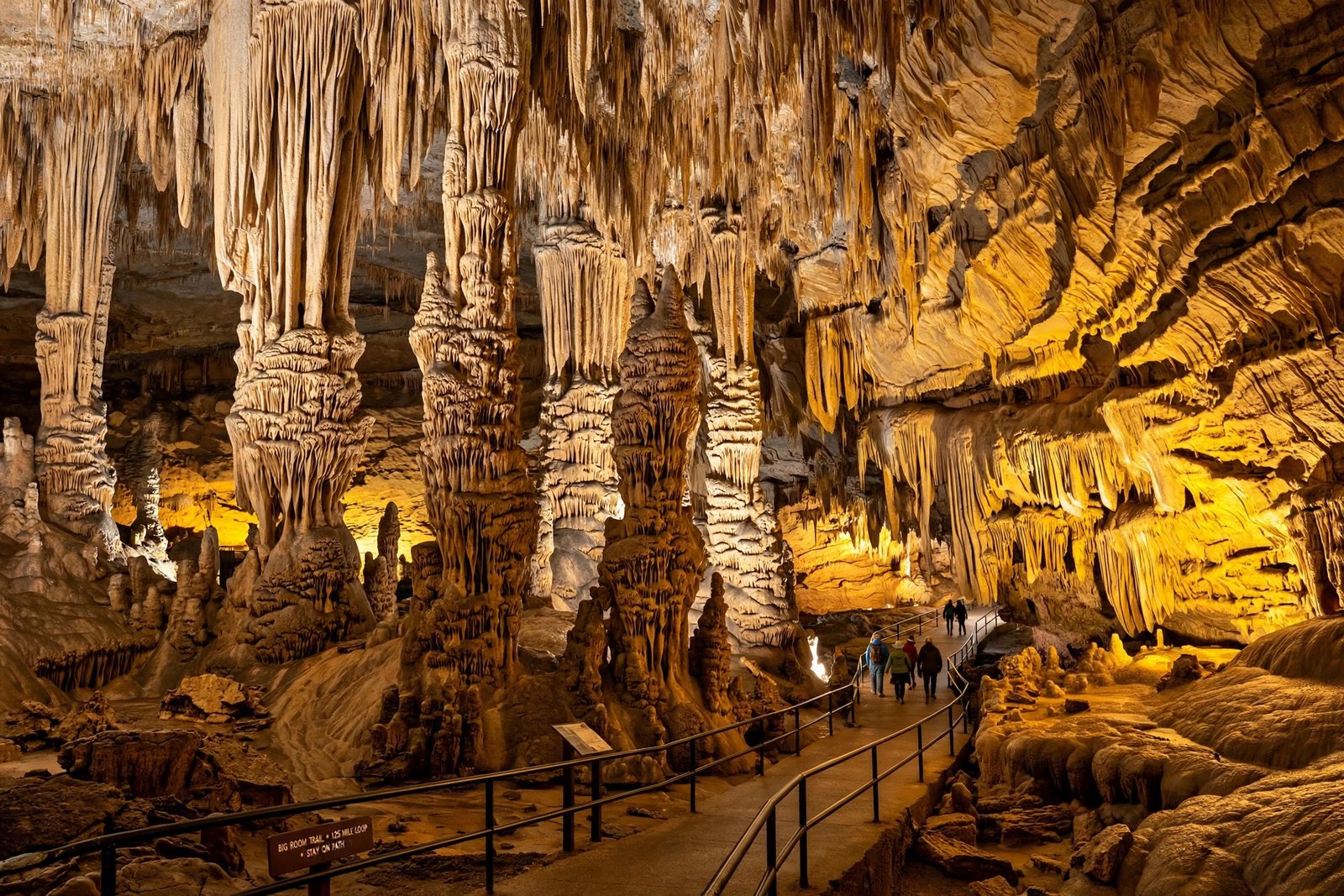
There is a moment, about 750 feet below the New Mexico desert, when the elevator doors open and visitors step into a darkness so large it stops feeling like a cave and starts feeling like weather. The air is cool and still. The ceiling disappears overhead. Ahead, a paved trail winds past stone shapes that look like frozen waterfalls, draperies, and giants caught mid-step. This is the Big Room at Carlsbad Caverns, the largest single cave chamber by volume in North America, and it is one of the most astonishing places in the entire national park system.
Carlsbad Caverns National Park sits in the Guadalupe Mountains of southeastern New Mexico, in the Chihuahuan Desert, about 20 miles southwest of the town of Carlsbad. Above ground, it is a landscape of cactus, scrub, and wide sky. Below ground, it is another world entirely: more than 119 known caves, formed over millions of years as sulfuric acid dissolved ancient limestone, leaving chambers, passages, and formations of extraordinary variety. Most visitors see only one cave, Carlsbad Cavern itself, but that one cave is enough to fill a day and linger in memory for years.
This guide covers what to see, how to get in, what to bring, and how to make the most of a first visit, whether you arrive by elevator, hike down the Natural Entrance, or stay for the summer bat flight.
How Carlsbad Caverns Formed
The story of Carlsbad Caverns begins hundreds of millions of years ago, when this part of New Mexico lay beneath a shallow sea. Limestone built up from marine life, and later, as the sea retreated and the Guadalupe Mountains rose, cracks and fractures opened in the rock. Unlike many caves formed by rainwater dissolving limestone from above, Carlsbad’s caves were shaped largely from below, as hydrogen sulfide rising from deeper oil and gas deposits mixed with groundwater to form sulfuric acid, which dissolved the limestone and carved out vast chambers.
That process left behind a cave system of unusual size and decoration. When water later seeped through the rock carrying dissolved minerals, it deposited calcite in the forms visitors see today: stalactites hanging from ceilings, stalagmites rising from floors, columns where the two meet, draperies that look like folded cloth, flowstone that resembles spilled wax, and pools so still they mirror the formations above them. The formations grow incredibly slowly, which is why touching them is prohibited. The oils on human skin can stop growth and discolor stone that took thousands of years to form.
The human history is almost as striking. Indigenous peoples knew the caves, and in the late 1800s and early 1900s, explorers and guano miners began mapping the main cavern. A young cowboy named Jim White, who is often credited with exploring and promoting the cave, described its wonders to anyone who would listen, and his accounts helped draw national attention. Carlsbad Cave became a national monument in 1923 and a national park in 1930, and today it is also recognized as a World Heritage Site for its exceptional cave resources.
The Big Room: The Essential Experience
For almost every first-time visitor, the Big Room is the reason to come. The National Park Service describes it as the largest single cave chamber by volume in North America along the developed visitor route, and the scale is hard to convey in photographs. Guides often say the room could hold several football fields, and standing inside it, that comparison feels conservative. The ceiling rises and vanishes into shadow, and the trail loops through a landscape of stone that seems too large and too strange to be indoors.
The Big Room Trail is a self-guided loop of about 1.25 miles, and most visitors need around an hour and a half to complete it at a leisurely pace. A shortcut reduces the walk to about 0.6 mile for visitors with limited time or stamina. The trail is paved, relatively flat, and, in its main sections, accessible for visitors using wheelchairs and other mobility devices, which makes it one of the most accessible major cave experiences in the country. Audio guides are available to explain the geology, history, and wildlife along the way, and they are worth picking up, because the formations have stories that are easy to miss without context.
Among the highlights, look for Giant Dome, a massive stalagmite built by countless mineral-bearing droplets over thousands of years, and the Hall of Giants, where towering stalagmites create a stone forest. The Bottomless Pit, despite its name, is not truly bottomless, but its dark opening and the illusion of depth make it a favorite photo stop. Take your time. The Big Room rewards slow walking, frequent pauses, and looking up, down, and sideways, because formations hide in every direction.
A practical note from the National Park Field Guide’s Big Room guide: the trail is self-guided, but rangers are stationed in the cavern and are happy to answer questions. If you are unsure about accessibility, mobility, or current conditions, stop at the visitor center information desk before descending and ask for the current accessibility map.
Two Ways Down: Natural Entrance or Elevator
There are two ways to reach the Big Room, and the choice shapes your visit. The elevator, from the visitor center, descends roughly 750 feet in a couple of minutes and opens directly into the cavern level. It is the easiest option, the best choice for families with young children, for visitors with limited mobility, and for anyone short on time. You can combine the elevator down with the Big Room loop and the elevator back up for a visit of about two to three hours, including the visitor center.
The Natural Entrance Trail is the more adventurous route. It is also about 1.25 miles, but it descends 750 feet on a steep, switchbacking path that follows the route of early explorers. The walk down takes roughly an hour, sometimes longer with stops, and it passes through a series of chambers and passages that the elevator bypasses entirely, including the dramatic main corridor and its bat-inhabited sections. Many experienced visitors recommend the combination that has become classic: hike down the Natural Entrance, walk the Big Room loop, and ride the elevator back to the surface. That way you see the most cave with the least uphill climbing.
Whichever route you choose, dress for the cave, not the desert. The temperature underground is a constant 56 degrees Fahrenheit, or about 13 degrees Celsius, year-round, regardless of the season above. A light jacket or sweater is essential, even in summer, when the surface temperature may be far hotter. Wear closed-toe shoes with good traction, because cave floors can be damp and uneven, especially on the Natural Entrance Trail. Bring water, but note that only water is allowed underground. Food, gum, and other drinks are prohibited to protect the cave environment.
Ranger-Guided Tours Beyond the Big Room
The self-guided trails cover the highlights, but ranger-guided tours open up chambers and stories that self-guided visitors do not see. The King’s Palace tour is the most popular guided option, a journey through decorated chambers that are more ornate and intimate than the vast Big Room. Other tours, when offered, include the Left Hand Tunnel, which explores the cave by lantern light, and more strenuous adventures into wilder sections like Slaughter Canyon Cave, Lower Cave, and Spider Cave, which require crawling, climbing, and a higher level of fitness.
Tour availability changes with staffing, season, and conservation needs, so check the current schedule before you travel and reserve early when reservations are offered. Some tours require additional tickets beyond the entrance fee, and the more adventurous tours have age, fitness, and equipment requirements. The park’s National Park Service pages confirm the cave’s cool temperature and the need for jackets, and the main NPS park site is the authoritative source for current tour schedules, alerts, and closures. Do not rely on older guidebooks alone, because a tour that ran daily a few years ago may now run only on certain days.
Above ground, the park also offers desert hiking, backcountry camping with a free permit, and ranger programs at the visitor center. The surface trails are a sharp contrast to the cave: hot, bright, and open, with views across the Chihuahuan Desert and the Guadalupe Mountains. If you have a full day, a morning in the cave followed by a short surface hike and an evening bat flight makes for a complete Carlsbad experience.
The Bat Flight: Nature’s Evening Show
From late May through October, Carlsbad Caverns hosts one of America’s great wildlife spectacles. Each evening, hundreds of thousands of Brazilian free-tailed bats pour out of the Natural Entrance in a swirling, chattering stream, heading out to hunt insects across the desert night. The Bat Flight Program, with a ranger talk beforehand, is free and unforgettable, and it draws visitors who plan their entire trip around it.
Bats are not a sideshow at Carlsbad. They are part of the cave’s ecology, and their guano once drew miners to the cave for fertilizer. Today, the bats are protected, and the evening flight is managed to minimize disturbance. Visitors sit in an amphitheater near the Natural Entrance, listen to a ranger explain bat biology and behavior, and then watch in silence as the colony emerges. Photography, including flash, is not permitted during the flight, and visitors are asked to remain quiet and still. Those rules protect the bats and preserve the experience for everyone.
If bats are a priority, plan for summer or early fall, arrive well before sunset, and check the program schedule, because flight times shift with sunset and bat activity varies through the season. In winter, most bats have migrated south, so the flight does not occur, but the cave itself is open year-round and is often quieter in the cooler months.
Planning Your Visit: Reservations, Fees, and Timing
Carlsbad Caverns now requires timed-entry reservations for cavern entry, booked through Recreation.gov. The reservation secures your entry window; the entrance fee itself, currently 15 dollars per person for ages 16 and older, with children 15 and under free, is paid at the visitor center, and America the Beautiful passes are accepted. Reservations are separate from the fee, and arriving without one risks being turned away, especially on weekends and holidays.
The visitor center is typically open from morning to late afternoon, with cavern entry permitted during set hours and last entry tickets sold in the early afternoon. Hours vary by season, so confirm them on the NPS site before you drive, because the park is remote and there is no nearby alternative if you miss your window. The park is about 30 minutes from the town of Carlsbad, about two hours from El Paso, Texas, and about four hours from Albuquerque, so most visitors drive and stay in Carlsbad or nearby Whites City, where lodging and restaurants cluster near the park entrance road.
Spring and fall offer the most comfortable desert weather and smaller crowds than summer, though summer brings the bat flight. Winter visits are quiet and the cave temperature feels the same as always, but surface roads can be affected by storms, and some guided tours may be limited. Whatever the season, book your timed entry early, arrive within your window, and allow at least half a day for the park. A rushed visit that squeezes the Big Room into an hour will miss the point. This is a place to slow down.
A few more practical tips: there is no lodging or developed campground inside the park, so book accommodation in advance during peak season. Cell service is limited in the area, so download maps and the NPS app before arrival. Only water is allowed in the cave, and backpacks, tripods, and other gear may be subject to rules that change with conditions, so check current guidance at the visitor center. And remember that the cave is a fragile environment. Stay on trails, do not touch formations, and leave nothing behind.
Why Carlsbad Still Amazes
It is easy, in an age of virtual tours and high-definition nature documentaries, to wonder whether a cave can still surprise. Carlsbad answers that question the moment you stand in the Big Room and realize that no screen conveys scale, silence, and cool air the way being there does. The cave is not a theme park. There are no rides, no music, no staged effects. There is only stone, water, time, and the quiet work of geology, and that restraint is what makes it powerful.
Carlsbad also rewards curiosity. A visitor who reads about sulfuric acid formation before arriving will see the cave differently from one who walks in cold, and a visitor who stays for a ranger talk will leave with stories that a self-guided loop alone cannot provide. The park’s guides, both in person and in the detailed planning guides that draw on NPS information, emphasize the same point: plan ahead, respect the resource, and give yourself time to look closely.
For American travelers seeking a hidden gem that is not actually hidden, just far from the usual routes, Carlsbad Caverns is hard to beat. It is remote enough to feel like a discovery, accessible enough for families and first-time cave visitors, and vast enough that even repeat visitors find new details on every trip. Go for the Big Room, stay for the bats, and leave with a new appreciation for what lies beneath the desert floor.
FAQ
Do I need a reservation to visit Carlsbad Caverns?
Yes. Timed-entry reservations through Recreation.gov are required for cavern entry. The reservation holds your entry window, while the entrance fee is paid separately at the visitor center.
How long does the Big Room Trail take?
The full 1.25-mile loop takes about an hour and a half at a leisurely pace. A shortcut of about 0.6 mile takes roughly 45 minutes and is a good option for visitors with limited time.
What should I wear in the cave?
Bring a jacket or sweater, because the cave stays at about 56 degrees Fahrenheit year-round. Wear closed-toe shoes with good traction, and bring water. Food and drinks other than water are not allowed underground.
When can I see the bat flight?
The Bat Flight Program runs from late May through October, when Brazilian free-tailed bats exit the cave at dusk. Check the park schedule for current times, arrive early, and note that photography is not permitted during the flight.
Related reading
Guadalupe Mountains and McKittrick Canyon Fall Color
Devil’s Kettle: Minnesota’s Disappearing River Hidden Gem
Providence Canyon: Georgia’s Little Grand Canyon