
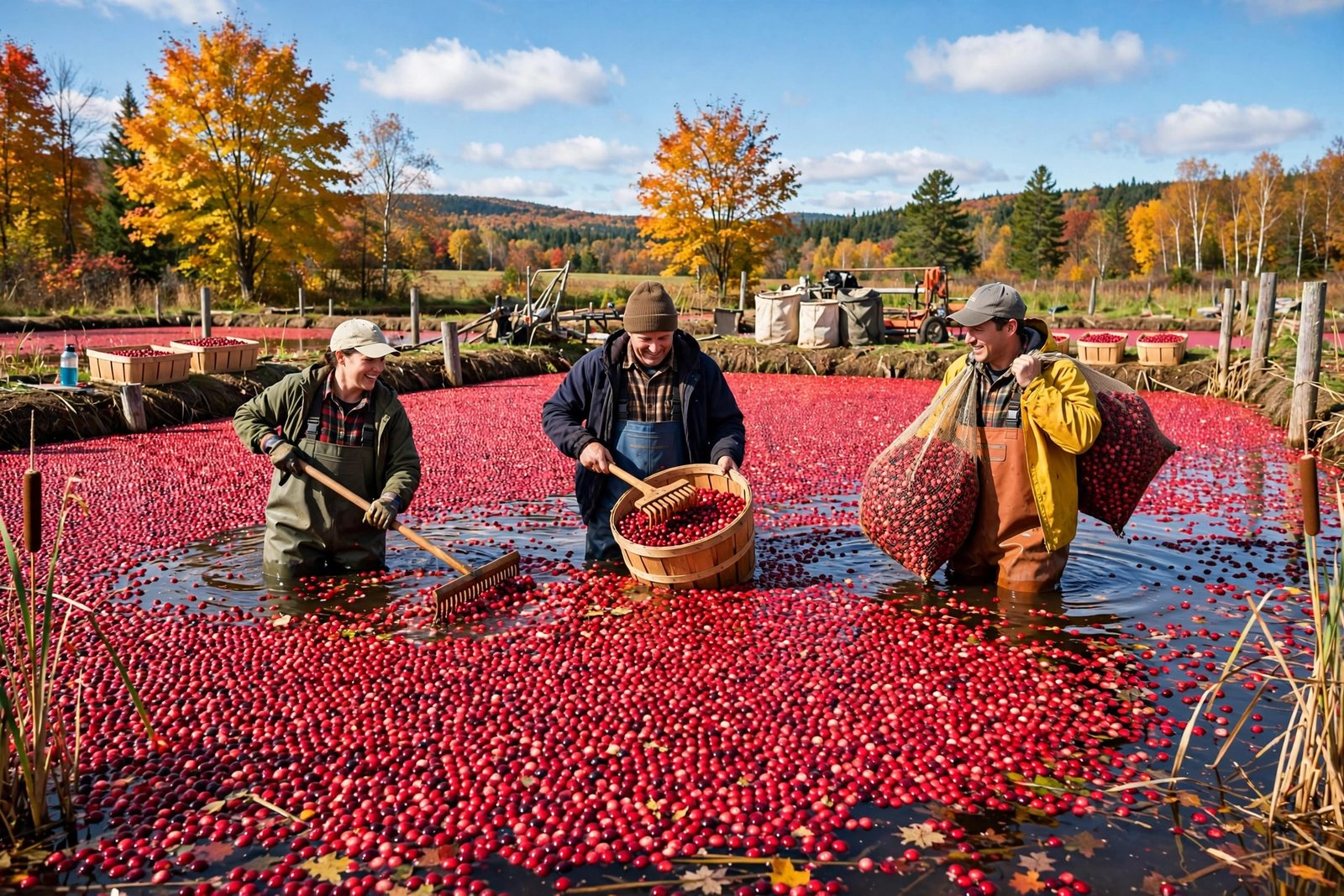
Every November, just as the days shorten and kitchens across America fill with the smell of roasting turkey, another quiet harvest reaches its peak. In flooded bogs in Wisconsin, Massachusetts, New Jersey, and Oregon, workers in waders corral millions of small red berries across the water until the whole field looks like a crimson sea. It is one of the most photographed farm scenes in the country, and it ends, more often than not, on a Thanksgiving table.
The cranberry is one of only a handful of fruits native to North America, and its story is deeply American. It was gathered by Indigenous peoples long before European settlers arrived, turned into a commercial crop by a Massachusetts veteran in the early 1800s, and then carried into national fame by canned sauce, juice, and a holiday that arrives at exactly the right moment in the harvest calendar. Understanding the cranberry harvest means understanding how a tart, hardy berry survived in cold wetlands, how farmers learned to work with water rather than against it, and why a fruit most Americans eat only a few times a year still supports thousands of jobs.
This is the story of that harvest, from the bog to the table, and what it looks like in America today.
A Berry Older Than Thanksgiving Itself
Long before cranberries appeared in cookbooks, they were part of life for Indigenous communities in the Northeast, especially the Wampanoag people. The berries were eaten fresh, dried for winter storage, ground into pemmican with meat and fat, and used for dye and medicine. Their tartness was a feature, not a flaw: in a diet without refrigeration, a sour, long-lasting fruit that could be stored through cold months was genuinely valuable.
Early English writers noticed the berry quickly. In 1672, John Josselyn described cranberries in his book about New England plants, noting their sour taste and their ripening in late summer and early fall. That early mention, preserved and discussed by the U.S. Department of Agriculture’s National Agricultural Library, is one of the first written records of the cranberry in American cuisine. It shows that the berry was already familiar to colonists within a few generations of settlement, even if it had not yet become a holiday fixture.
The link to Thanksgiving itself grew slowly, and honestly, it grew for practical reasons as much as romantic ones. Cranberries ripen from mid-September through mid-November, which means Thanksgiving falls right inside the fresh harvest window. A cook in November did not need to import anything exotic or preserve anything from summer. The berry was simply there, bright and available, at the moment when a big feast needed something sharp to cut through rich food. Over time, that practical pairing hardened into tradition.
By the time the first American cookbook appeared in 1796, cranberry sauce was already being suggested alongside turkey. By the early twentieth century, it was a standard part of the holiday table, and by 1942, as the USDA history notes, cranberry sauce had become a standard item at the holiday dinner table. The berry had gone from a wild wetland food to a national ritual in a little over two centuries.
How Henry Hall Turned a Wild Berry Into a Crop
Commercial cranberry farming in the United States is usually traced to 1816, when Revolutionary War veteran Henry Hall, farming in Dennis, Massachusetts, on Cape Cod, noticed something curious. Wild cranberry vines that had been dusted with windblown sand seemed to grow more vigorously than vines left alone. Hall began fencing in wild vines and covering them with sand by hand, and his yields improved.
It sounds like a small observation, but it changed everything. Sanding is still part of bog management today, because a thin layer of sand encourages new runners, suppresses weeds, and helps keep the vines healthy. Hall’s experiment proved that cranberries did not have to be gathered wild. They could be farmed, improved, and harvested at scale. From Cape Cod, cultivation spread through the Northeast and then to the Upper Midwest, where Wisconsin’s sandy soils, abundant water, and cold winters proved ideal.
The early work was hard. Bogs had to be built by hand from layered sand, peat, gravel, and clay. Harvesting meant hand-picking or using scoop-like tools that raked berries from low vines. The fruit’s season was short, and fresh berries spoiled quickly. The breakthroughs that made cranberries a national food came later: canning, which let sauce be sold year-round, and the cooperative marketing that eventually became Ocean Spray. In 1912, Marcus L. Urann began canning cranberry sauce, solving the short-season problem at a stroke, as described in a Smithsonian Magazine look at the harvest. The familiar jellied log followed decades later, and for many families it remains the only cranberry sauce that counts.
Inside the Harvest: Why Farmers Flood the Bogs
If you have ever seen a photo of the cranberry harvest, you have seen the wet harvest. Farmers flood a bog with water, then drive machines with large spinning reels, often nicknamed eggbeaters, through the field. The reels knock berries loose from their vines. Because each cranberry contains tiny air pockets, the berries float. Workers then corral the floating fruit with booms and pump it into trucks bound for processing plants.
It is spectacular to watch, and it is also efficient. Wet-harvested berries go mostly to juice, sauce, and dried cranberries, which is where most of the crop ends up. Industry accounts consistently note that the large majority of cranberries are processed rather than sold fresh, and the wet method is far faster than picking berries one by one. The dry harvest, by contrast, uses mechanical combing machines that lift berries from vines without flooding. Dry-harvested fruit stays in better shape for the fresh market, which is why the bags of whole cranberries in grocery produce sections in November usually come from a dry harvest.
The harvest calendar runs from mid-September through early November, and the work does not end when the berries leave the field. After harvest, growers flood bogs again for winter, letting ice protect the vines from cold and drying winds. In spring, the water is drained, and the cycle starts again: blossoms in early summer, bees for pollination, irrigation and careful monitoring through hot months, then the return of color in fall. Cranberry vines are perennials, so a well-kept bog can produce for decades, with some beds bearing for generations.
The scale is easy to underestimate. The University of Connecticut’s home garden program, drawing on USDA estimates, put the 2024 United States harvest at about 8.24 million barrels, roughly 824 million pounds of fruit, with Wisconsin producing nearly 4.9 million barrels, around 60 percent of the national total. Massachusetts, the historic home of commercial cranberries, followed with about 2.2 million barrels. Those numbers shift from year to year with weather and acreage, but the geography stays consistent: Wisconsin first by a wide margin, then Massachusetts, Oregon, and New Jersey.
Why Thanksgiving Still Belongs to the Cranberry
Ask ten American families what cranberry sauce means at Thanksgiving and you will get ten different answers, and probably one argument. For some, only the canned jellied sauce, sliced into neat rounds straight from the can, will do. For others, only a homemade sauce, simmered with orange zest or spices, counts as real. That friendly argument is itself a sign of how deeply the berry is woven into the holiday.
Part of the appeal is flavor. Turkey, stuffing, mashed potatoes, and gravy are rich, savory, and heavy. Cranberry sauce is tart, bright, and a little sweet, and it resets the palate with every bite. Cooks have long understood that balance, which is why cranberry relishes, chutneys, and baked goods also appear at Christmas feasts and winter gatherings, not just Thanksgiving. The berry’s color helps too. On a table dominated by browns and golds, a dish of deep red is a visual anchor, and in a season of decoration, that matters.
There is also a numbers story behind the holiday rush. The UConn summary notes that around 400 million pounds of cranberries are eaten each year in the United States, with an estimated 20 percent consumed during Thanksgiving week alone, about 80 million pounds. Even allowing for year-to-year variation, the pattern is clear: Americans do not eat cranberries evenly across the year. They eat them in a concentrated burst around late November, and the industry plans its processing, shipping, and marketing around that burst.
That concentration has a downside for growers. A crop that depends so heavily on one holiday is vulnerable to changing tastes, and younger shoppers who did not grow up with canned sauce may not reach for it automatically. Growers and food writers have responded by pushing cranberries beyond the sauce dish: into salads, grain bowls, cocktails, baked goods, stuffing, and dried snacks. Fresh cranberries freeze beautifully, which means a bag bought in November can flavor muffins and sauces well into winter, and that versatility is part of the modern pitch.
What to Do With Fresh Cranberries at Home
If you buy a bag of fresh cranberries this month, you have more options than sauce, though sauce is still the best place to start. A basic sauce needs only cranberries, sugar, and water, simmered until the berries pop and the mixture thickens. Orange juice or zest, a cinnamon stick, or a splash of port can change the character without complicating the recipe. The sauce keeps in the refrigerator for days and freezes well, so making a double batch is rarely a mistake.
Beyond sauce, fresh cranberries are excellent in baking. They hold their shape in muffins and quick breads, add tart bursts to cookies and scones, and roast beautifully alongside root vegetables or Brussels sprouts. A handful tossed into stuffing or a grain salad adds color and acidity that heavier dishes need. Dried cranberries, meanwhile, are a pantry staple for salads and trail mix, though cooks should check labels, since many dried versions are sweetened.
For drinks, cranberry juice is a classic mixer and a base for holiday punches, and sugared cranberries make a striking garnish. Simply roll damp berries in sugar and let them dry, and you have a sparkling decoration that is also edible. None of this requires special equipment, which is part of the berry’s charm. It is a humble ingredient that rewards simple treatment.
Visiting Cranberry Country
For travelers, cranberry country is worth a detour in fall. In Massachusetts, the Cape Cod and South Shore bogs, especially around Carver and Plymouth, offer harvest views and farm stands in October and November. In Wisconsin, the central part of the state around Wisconsin Rapids calls itself a cranberry hub, and local festivals, farm tours, and cranberry-themed foods mark the season. New Jersey’s Pine Barrens and Oregon’s southern coast also have bogs and harvest traditions, though they are smaller in scale.
If you visit, remember that bogs are working farms, not parks. Many growers welcome visitors at farm stands or during festivals, but walking into a flooded bog uninvited is not appropriate, and harvest machinery deserves a wide berth. The best views often come from roadsides and organized tours, where guides can explain what you are seeing without interrupting the work. Bring layers, because November mornings in bog country are cold, damp, and windy, and the most beautiful harvest light often comes early.
There is also a quieter reason to care about cranberry country. Bogs are wetlands, and well-managed bogs support wildlife, store water, and preserve open land in regions under development pressure. Massachusetts cranberry land has faced pressure from retiring growers and changing economics, and conservation groups have worked to keep bogs in farming or restore them as wetlands when farming ends. Eating cranberries will not save a bog on its own, but a healthy market for the fruit gives growers a reason to keep the land working.
The Cranberry’s Next Chapter
The American cranberry industry today sits between tradition and change. On one side, the Thanksgiving table still drives demand, the canned sauce still sells, and the flooded-bog photograph still stops people mid-scroll. On the other, growers face labor costs, water management challenges, climate variability, and competition for shelf space from newer superfoods. The response has been to diversify: new products, new flavors, exports, and a push to present cranberries as an everyday ingredient rather than a once-a-year side dish.
What has not changed is the berry itself. It still grows low on vines in sandy, acidic soil. It still needs cold winters and careful water. It still ripens in that narrow window between late summer and late fall, and it still tastes unmistakably tart. That stubbornness is part of its appeal. In a food system full of year-round imports and engineered flavors, the cranberry remains stubbornly seasonal, stubbornly local to North America, and stubbornly itself.
So when the sauce dish comes around this Thanksgiving, it is worth a second look. Behind that small red mound is a wetland, a veteran’s sand experiment from 1816, a flooded field in Wisconsin or Massachusetts, and a harvest that has been refined over two centuries. It is a small berry carrying a large story, and it arrives, as it always has, right on time.
FAQ
When is the American cranberry harvest?
The harvest runs from mid-September through early November, which is why fresh cranberries and Thanksgiving arrive together. Wet-harvested berries go mostly to processing, while dry-harvested berries supply the fresh market.
Which state grows the most cranberries?
Wisconsin grows about 60 percent of the United States cranberry crop, followed by Massachusetts, Oregon, and New Jersey. Massachusetts remains the historic home of commercial cranberry farming, which began there in 1816.
Why do farmers flood cranberry bogs?
Cranberries contain tiny air pockets, so they float when knocked from their vines. Flooding lets workers corral the berries efficiently for juice and sauce production. Dry harvesting, without flooding, is used for fresh berries sold whole.
Are cranberries native to North America?
Yes. Cranberries are one of the few fruits native to North America, and Indigenous peoples gathered and used them long before commercial cultivation began. The American Farm Bureau’s Thanksgiving overview notes that the United States is the world’s largest cranberry producer.
Related reading
How Thanksgiving Became a National Holiday
November Seasonal Produce Guide for the USA
Pumpkin Everything: Fall Baking and the American Autumn