
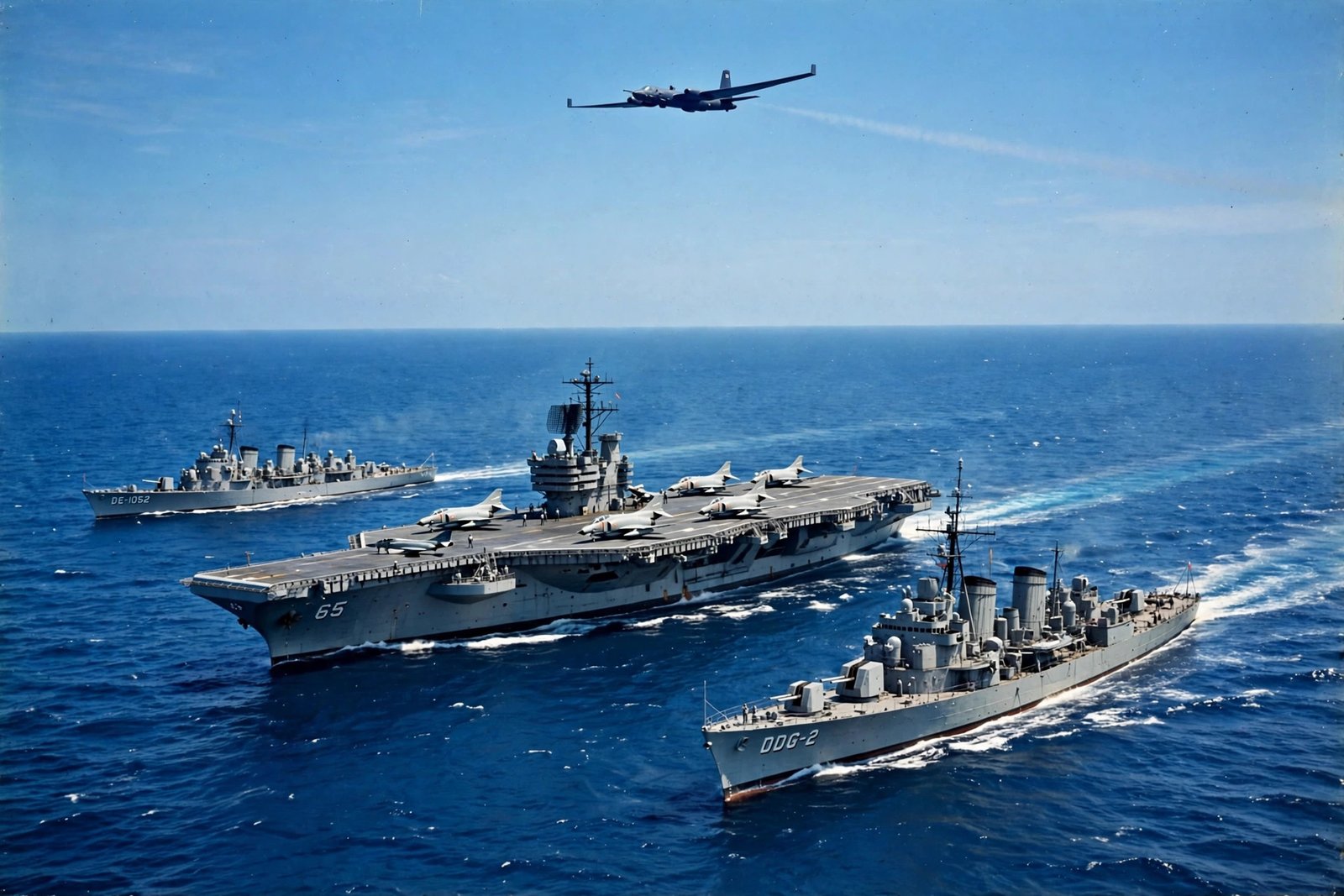
For thirteen days in October 1962, the world held its breath. The United States and the Soviet Union, the two nuclear superpowers of the Cold War, stood closer to all-out nuclear war than they ever have before or since. The crisis began with photographs from a spy plane and ended with a secret deal struck in the final hours, and the story of those thirteen days is still studied today as the closest the world has come to destroying itself.
This is the story of the Cuban Missile Crisis: how Soviet missiles ended up ninety miles from Florida, how President John F. Kennedy and Soviet Premier Nikita Khrushchev talked the world back from the edge, and why the lessons of those thirteen days still matter.
How the Crisis Began
The crisis did not come out of nowhere. It grew out of the Cold War, the long standoff between the United States and the Soviet Union that followed World War II, and out of the revolution in Cuba. In 1959, Fidel Castro overthrew the Cuban government and set up a revolutionary regime that soon aligned itself with the Soviet Union. In 1961, the United States backed a failed invasion of Cuba at the Bay of Pigs, which pushed Castro further into Moscow’s arms and convinced him that another American invasion was coming.
For Soviet Premier Nikita Khrushchev, Castro’s vulnerability was an opportunity. The Soviet Union was behind the United States in long-range nuclear missiles, and Khrushchev wanted a shortcut to strategic balance. In May 1962, he ordered Operation Anadyr, a highly secret deployment of Soviet troops, nuclear-capable missiles, and their warheads to Cuba. More than 40,000 Soviet troops and dozens of missiles were shipped across the Atlantic in secret, while Soviet officials publicly denied that any offensive weapons were being sent to the island.
The missiles mattered because of geography. Cuba sits just ninety miles from Florida, and the medium-range ballistic missiles being installed there could reach most major American cities in minutes. For the first time, the Soviet Union could threaten the American homeland directly, without relying on long-range missiles that it did not yet have in large numbers.
The Photographs That Changed Everything
On October 14, 1962, an American U-2 spy plane flew over western Cuba. Major Richard Heyser took off from Edwards Air Force Base in California before midnight, flew through the night, and crossed Cuba at 72,500 feet. In about six minutes over the island, his camera took 928 photographs. The next day, analysts at the National Photographic Interpretation Center examined the film and found unmistakable evidence: Soviet medium-range ballistic missile launch sites under construction near San Cristóbal, Cuba.
On the morning of October 16, National Security Advisor McGeorge Bundy showed the photographs to President Kennedy. The President immediately convened a group of top national security advisors that became known as the Executive Committee of the National Security Council, or ExComm. For the next thirteen days, this small group would meet in secret, debating how to respond while the missiles in Cuba moved closer to becoming operational.
The secret recordings of the ExComm meetings, later released by the National Archives and the Kennedy Library, are one of the great historical resources of the twentieth century. They let us hear a President and his advisors thinking aloud, in real time, about a problem with no good answer.
The Options: Air Strike, Invasion, or Blockade
ExComm considered three main responses. The first was an air strike against the missile sites, followed possibly by a full invasion of Cuba. The military favored this option, but Kennedy and his advisors saw the risks: an air strike could not guarantee that every missile would be destroyed, and any surviving missile could be fired at American cities. An invasion could kill thousands of Soviet troops and trigger a Soviet response in Berlin or elsewhere in Europe.
The second option was diplomacy alone, taking the case to the United Nations and demanding that the missiles be removed. But that would take time the Americans did not have, since the missiles were nearing operational status, and it would make the United States look weak after the Soviets had lied about the deployment.
The third option, the one Kennedy chose, was a naval quarantine. The word mattered: a blockade is technically an act of war, so the administration called it a quarantine, a ring of American warships around Cuba to stop any more offensive weapons from arriving. It was a middle course, firm enough to show resolve, but limited enough to give Khrushchev time and room to back down.
October 22: The President Speaks to the Nation
On the evening of October 22, President Kennedy delivered a dramatic televised address to the nation. He revealed the existence of the Soviet missiles in Cuba, announced the naval quarantine, and warned that any nuclear missile launched from Cuba against any nation in the Western Hemisphere would be regarded as an attack by the Soviet Union on the United States, requiring a full retaliatory response.
The speech was a turning point. Until that moment, the crisis had been a secret known only to a handful of people in Washington and Moscow. Now the whole world knew, and the whole world was watching. The President’s words were careful and deliberate, and the address is still remembered as one of the most important speeches of the Cold War. The next day, Kennedy signed the quarantine proclamation, and the naval ring around Cuba began to form.
The quarantine took effect on October 24. The world watched anxiously as Soviet ships approached the quarantine line, and then, to the relief of everyone watching, the ships stopped or turned back. The first test of wills had gone America’s way. But the missiles already in Cuba remained, and the crisis was far from over.
Black Saturday: October 27
The most dangerous day of the crisis was Saturday, October 27, later known as Black Saturday. That morning, a U-2 spy plane flying over Cuba was shot down by a Soviet surface-to-air missile, killing its pilot, Major Rudolf Anderson. It was the first and only American combat death of the crisis, and it pushed the ExComm toward a military response. Many advisors argued that the shooting down of an American plane demanded a retaliatory air strike.
The same day brought more alarming news. A Soviet submarine, the B-59, was being depth-charged by American destroyers enforcing the quarantine, and its captain considered launching a nuclear torpedo. The submarine’s officers debated the decision, and the launch required agreement among the senior officers aboard. The second-in-command, Vasili Arkhipov, argued against it, and the torpedo was never fired. The full story of that moment only became widely known decades later, when declassified documents and interviews revealed how close the world had come to a nuclear exchange that neither Kennedy nor Khrushchev wanted.
Meanwhile, the diplomacy was becoming more complicated. Khrushchev had sent two letters. The first, on October 26, was long, personal, and emotional, offering to remove the missiles in exchange for a pledge that the United States would not invade Cuba. The second, on October 27, was harsher, adding a demand that the United States also remove its Jupiter missiles from Turkey. Kennedy and his advisors chose to answer the first letter and ignore the second, a decision that Robert Kennedy later described as the key move of the crisis.
The Secret Deal That Ended the Crisis
On October 28, Radio Moscow broadcast Khrushchev’s answer: the missiles would be dismantled, crated, and sent back to the Soviet Union. Kennedy welcomed what he called Khrushchev’s statesmanlike decision, and the crisis formally ended. The thirteen days were over.
What the public did not know was that there had been a secret second half to the deal. In a private meeting, Robert Kennedy told the Soviet ambassador that the United States would remove its Jupiter missiles from Turkey within a few months, but that this part of the agreement could never be made public. The missiles in Turkey were removed quietly the following year, and the secret held for decades.
The full agreement, then, was this: the Soviet Union would remove its missiles from Cuba and place no more nuclear weapons on the island, and the United States would pledge not to invade Cuba and would secretly remove its missiles from Turkey. Both sides could claim a win. Khrushchev could say he had protected Cuba. Kennedy could say he had removed the missiles. And the world, which had spent thirteen days imagining the worst, could breathe again.
What the Crisis Taught the World
The Cuban Missile Crisis changed the Cold War. Within a year, the United States and the Soviet Union had set up a direct hotline between Washington and Moscow so that their leaders could communicate instantly in a future crisis. In 1963, the two sides signed the Limited Test Ban Treaty, the first agreement to limit nuclear testing. The crisis had shown both sides how easily a misunderstanding could end in catastrophe, and they took practical steps to make sure it did not happen again.
Historians still debate who won and who lost. Kennedy’s handling of the crisis is often praised as a model of crisis management: he kept his options open, gave his adversary room to retreat, and resisted pressure from his own military to escalate. Khrushchev, for his part, took an enormous gamble by placing the missiles in Cuba, and he paid a political price at home, where hardliners saw the withdrawal as a humiliation. But he also achieved his stated goal of protecting Cuba from invasion, and Cuba remained a communist state ninety miles from Florida for the rest of the Cold War.
Perhaps the most important lesson is the one the secret recordings make clear: both leaders made mistakes, and both were frightened. The crisis was not a chess game played by cool calculators. It was a confrontation between human beings under extraordinary pressure, with incomplete information, and with events, like the shooting down of the U-2 and the submarine incident, that neither leader controlled. The world survived those thirteen days because, in the end, both men chose to step back. That is a lesson worth remembering whenever great powers find themselves in a standoff.
FAQ
What was the Cuban Missile Crisis?
A thirteen-day standoff in October 1962, when the Soviet Union secretly placed nuclear missiles in Cuba, ninety miles from Florida, and the United States demanded their removal. It is considered the closest the world has come to all-out nuclear war.
How did the U.S. discover the missiles?
A U-2 spy plane photographed missile launch sites under construction near San Cristóbal, Cuba, on October 14, 1962. Analysts confirmed the evidence the next day, and President Kennedy was briefed on October 16.
What was the quarantine?
A naval ring of American warships around Cuba, announced by President Kennedy on October 22, 1962, to stop more Soviet offensive weapons from reaching the island. It was called a quarantine rather than a blockade because a blockade is technically an act of war.
How did the crisis end?
On October 28, 1962, Khrushchev agreed to remove the missiles from Cuba. In exchange, the United States pledged not to invade Cuba and secretly agreed to remove its Jupiter missiles from Turkey.
What happened on Black Saturday?
On October 27, 1962, a U-2 spy plane was shot down over Cuba, killing Major Rudolf Anderson, and a Soviet submarine came close to launching a nuclear torpedo. It was the most dangerous day of the crisis.
Sources
- National Archives — Cuban Missile Crisis records, ExComm tapes, and the “To the Brink” exhibition
- Office of the Historian, U.S. Department of State — the Cuban Missile Crisis, October 1962
- John F. Kennedy Presidential Library — the Cuban Missile Crisis
- National Security Archive — declassified documents on the Cuban Missile Crisis