
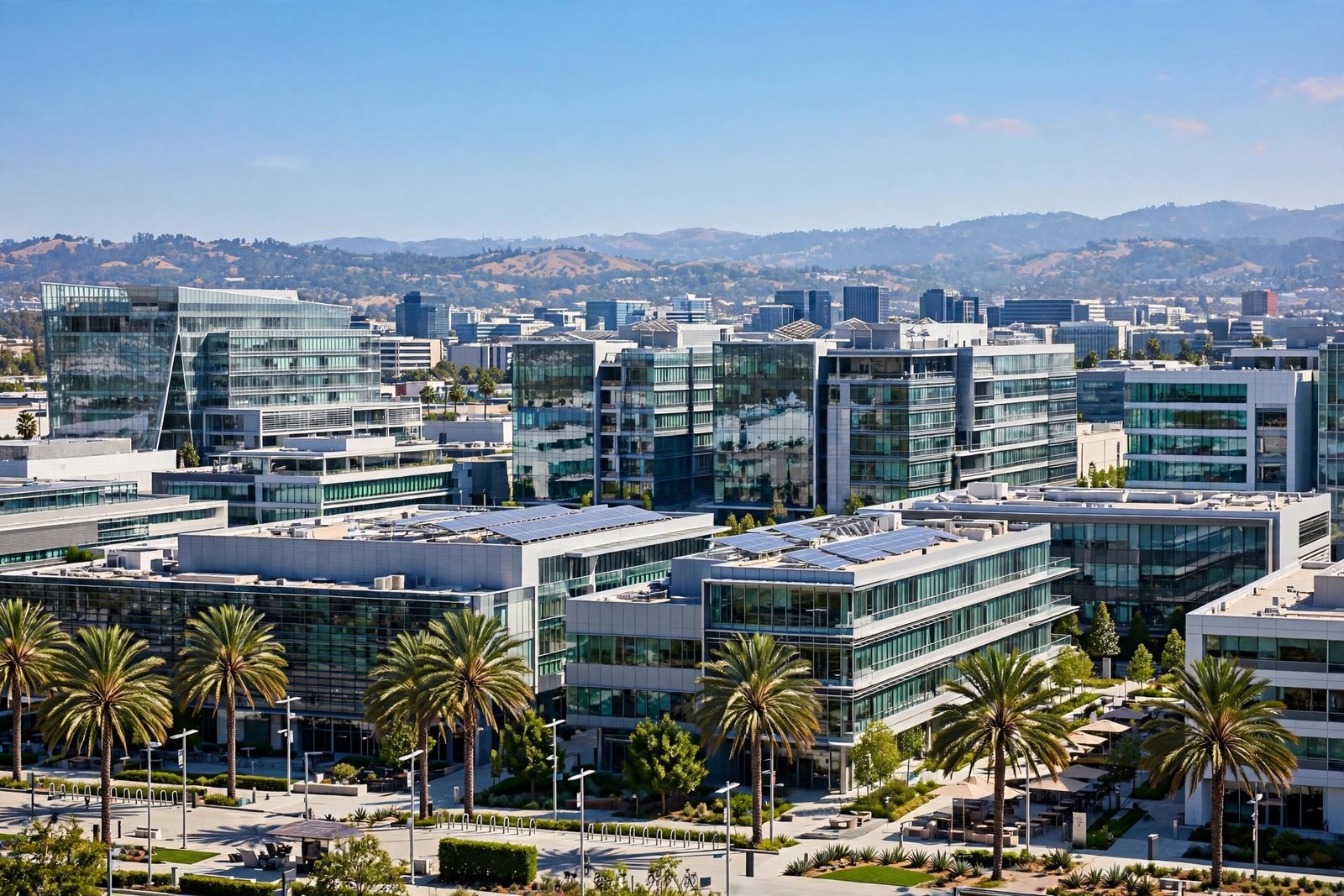
There is a stretch of land in Northern California, roughly between San Francisco and San Jose, that changed how the entire world communicates, works, shops, learns and plays. It does not look particularly dramatic from the road: office parks, university buildings, suburbs and hills. But from that place, known as Silicon Valley, came the tools that now sit in nearly every pocket, on nearly every desk, and inside nearly every part of modern life.
Silicon Valley was not built by accident, and it was not built overnight. It grew out of a particular combination that America, at a particular moment, made possible: a great university willing to work closely with industry, talented engineers willing to leave secure jobs to start risky companies, investors willing to fund ideas that did not yet exist, and government research spending that pushed electronics forward during and after World War II. Understanding that combination explains not only where your phone came from, but also how America became a leader in the digital age.
This is the story of how a farming valley, once known for orchards, became the center of the digital world, and what its rise can teach us about innovation, risk and the American idea that a good idea should be given a chance, even if it starts in a garage.
Before Silicon: Stanford and the Valley of Orchards
Long before anyone talked about chips or software, the Santa Clara Valley was known for fruit orchards, not electronics. The region’s transformation began with education. Leland Stanford and his wife, after losing their only child at a young age, turned their Palo Alto estate land into a university, which opened to students in 1891. Stanford University would become the anchor of everything that followed.
Early electronics work in the area grew out of radio. In 1909, engineer Cyril Elwell established the business that became the Federal Telegraph Company in Palo Alto, and in its laboratories, early work on vacuum tube amplifiers helped launch a local electronics tradition. Those early companies were small by today’s standards, but they established a pattern: Stanford-trained engineers staying in the area, starting companies, and working on practical problems in communications.
The most important early figure in turning that pattern into a system was Frederick Terman, who became Stanford’s Dean of Engineering in 1946. Terman believed Stanford should not simply train engineers for jobs on the East Coast. Instead, he encouraged his students and faculty to start companies near campus, and he personally invested in some of them. He understood that if talented people stayed, they would attract more talented people, and a cluster would form.
Terman’s most famous students were William Hewlett and David Packard, who had studied under him at Stanford. With Terman’s encouragement, they stayed in California and started a company of their own, a decision that would become the founding myth of Silicon Valley. Without Stanford’s willingness to blur the line between university and industry, that story might never have happened.
The Garage That Became a Legend
In January 1939, Hewlett and Packard established their partnership in a garage behind a rented house on Addison Avenue in Palo Alto. Their first product was an audio oscillator, a device used for testing sound equipment, built with care and sold at a price that undercut competitors. It was not glamorous, but it worked, and it found customers, including, in the stories told about the company, Walt Disney’s studios.
That garage is now a California Historical Landmark, often called the birthplace of Silicon Valley. The label is partly symbolic, because many people and companies contributed to the valley’s rise, but it captures something real: Hewlett-Packard showed that two young engineers, with little money and a good product, could build a serious company without moving to an established industrial center.
Hewlett and Packard also built a company culture that later became famous in its own right. They emphasized trust, respect for employees, open communication and a rejection of rigid hierarchy, ideas that were unusual for American manufacturing at the time. That management style, often called the HP Way, influenced a generation of later founders who wanted to build companies that felt different from the old industrial giants.
More importantly, HP proved that the valley could support a homegrown technology company over the long term. It grew from a garage workshop into a major electronics firm, and its success encouraged other Stanford graduates to try the same path. The garage became a symbol, and symbols matter, because they tell the next generation that starting something is possible.
Terman’s Industrial Park and the University-Industry Loop
In 1951, Stanford created the Stanford Industrial Park, later renamed Stanford Research Park, leasing university land to technology companies. Varian Associates moved in first, Hewlett-Packard followed, and other firms, including divisions of larger companies, set up nearby. The park created a tight loop between academic research and commercial products that became a defining feature of Silicon Valley.
The loop worked like this: Stanford trained engineers and conducted research, companies near campus hired those graduates and funded further research, and the success of those companies attracted more students, faculty and investment to the area. Each part reinforced the others, and the cluster grew stronger with each cycle. It was not a plan imposed from above so much as a system that Terman and others nurtured over years.
Government spending also played a role, especially during the Cold War, when defense and space programs created demand for advanced electronics. Companies in the valley worked on communications, radar, guidance and other technologies that required ever smaller, more reliable components. That demand helped push the region toward semiconductors, the tiny devices that would eventually give the valley its name.
By the 1950s, the valley was no longer just a place with a university and a few electronics firms. It was becoming an ecosystem, a place where an engineer could leave one company on Friday and start another on Monday, where suppliers, lawyers, accountants and investors understood technology startups, and where failure was treated as experience rather than disgrace. That ecosystem would prove decisive in the next decade.
Shockley, Fairchild and the Silicon Revolution
The transistor, invented at Bell Labs in 1947, replaced bulky vacuum tubes and made modern electronics possible. Its co-inventor, William Shockley, brought that expertise to California in 1956, when he founded Shockley Semiconductor Laboratory in Mountain View. He recruited some of the brightest young semiconductor engineers in the country, including Robert Noyce, Gordon Moore, Jean Hoerni, Julius Blank, Victor Grinich, Eugene Kleiner, Jay Last and Sheldon Roberts.
Shockley’s management style drove those engineers away. In September 1957, the eight resigned together and, with financial backing arranged through investment banker Arthur Rock and Fairchild Camera and Instrument, founded Fairchild Semiconductor. The group became known as the traitorous eight, a nickname that sounds like betrayal but turned out to be remarkably productive.
Fairchild’s technical achievements were extraordinary. Jean Hoerni developed the planar process in 1959, which made manufacturing integrated circuits practical. Robert Noyce independently co-invented the integrated circuit, packing multiple transistors onto a single silicon chip, alongside Jack Kilby at Texas Instruments. The integrated circuit shrank electronics dramatically, making computers, and eventually personal devices, far smaller, cheaper and more powerful.
Fairchild’s greatest output, however, may have been people. Dozens of companies trace their lineage directly to Fairchild employees, earning the group the nickname Fairchildren. The most important spin-off came in 1968, when Noyce and Moore left Fairchild to found Intel, with funding from Arthur Rock. Intel would go on to become a giant of the semiconductor industry, and its microprocessors would power the personal computer revolution.
How Silicon Valley Got Its Name
The name Silicon Valley itself came from the material at the heart of the semiconductor industry: silicon, the element used to make chips. Journalist Don Hoefler helped popularize the term in 1971 through a series of articles titled Silicon Valley USA, describing the region’s growing semiconductor industry. The name stuck, even as the valley’s companies moved far beyond chips into computers, software, the internet and beyond.
That broadening is part of the valley’s story. In the 1970s, the personal computer began to take shape, with hobbyists, engineers and young founders building machines that ordinary people could use. Apple, founded by Steve Jobs and Steve Wozniak, grew out of that culture, with Jobs himself having once worked a summer job at HP as a high school student. When Apple went public in December 1980, it made headlines and turned many of its early employees into millionaires, a story that captured the public imagination.
In the decades that followed, the valley reinvented itself again and again, roughly once a decade, according to the Computer History Museum: semiconductors, then personal computers, then software and the internet, then mobile devices and social media, then cloud computing and artificial intelligence. Each wave built on the previous one, using the same ecosystem of universities, venture capital, skilled workers and risk-tolerant culture.
Venture capital deserves special attention here, because it was part of what made the valley different. Eugene Kleiner, one of the traitorous eight, left Fairchild to help form Kleiner Perkins, a venture capital firm that funded new companies with equity investment rather than loans. That model, backing risky ideas in exchange for a share of the company, allowed founders without personal wealth to try ambitious projects, and it became a template copied around the world.
The Internet Age and the Valley Goes Global
The internet transformed Silicon Valley from a regional electronics hub into a global center. Companies that built search engines, online marketplaces, social networks and mobile platforms grew out of the same ecosystem that had produced chips and computers, and they scaled to audiences of billions. The valley’s products were no longer just components inside other companies’ machines; they were services people used every day, in every country.
That global reach brought enormous wealth and influence, but also new questions. How should large technology companies handle privacy, competition, misinformation and the social effects of their products? Those debates continue today, and they are part of the valley’s story too, because a place that builds the world’s tools inevitably shapes how the world talks, works and thinks.
At the same time, the valley’s success created challenges at home. Housing costs rose sharply, traffic grew, and the gap between highly paid technology workers and other residents widened. Those problems are real, and they remind us that innovation does not automatically solve every social problem, even in the place where innovation is most concentrated.
Yet the valley’s core idea endures: that talented people, given freedom, funding and a community of peers, can build things that change the world. That idea has been copied in tech hubs from Austin to Bangalore to Tel Aviv, but Silicon Valley remains the original model, the place other places measure themselves against.
What America Built, and What Comes Next
Silicon Valley’s story is, in the end, an American story about several ideas working together. It is about a university that chose to partner with industry rather than stand apart from it. It is about engineers who chose to build companies rather than simply take jobs. It is about investors who chose to fund unproven ideas. And it is about a country that, through defense research, education funding and an open, competitive economy, created conditions where those choices could pay off.
None of those ingredients alone would have been enough. Stanford without entrepreneurs would have been just a good school. Entrepreneurs without capital would have struggled to scale. Capital without talent would have had nothing to fund. It was the combination, in one place, over decades, that made the difference, and that combination is hard to replicate by simply building office parks and hoping for the best.
The next chapter is already being written, in artificial intelligence, biotechnology, clean energy and other fields that draw on the same ecosystem. Whether Silicon Valley remains the center of that next wave, or whether leadership spreads more widely across America and the world, is an open question. What is not in doubt is that the valley’s past has already shaped the present in ways we live with every day, every time we send a message, search for an answer, or navigate with a phone in our hand.
For visitors, the garage on Addison Avenue is a quiet reminder of how it all started: not with a grand plan, but with two young men, a rented house, and a belief that they could build something better. That belief, multiplied by thousands of founders over decades, is how America built the digital world.
FAQ
Why is it called Silicon Valley?
The name comes from silicon, the material used to make semiconductor chips. Journalist Don Hoefler popularized the term in 1971 in a series called Silicon Valley USA, and it stuck even as local companies moved into computers, software and the internet.
What was Hewlett-Packard’s role?
Founded in a Palo Alto garage in 1939 by William Hewlett and David Packard, HP was the valley’s first major homegrown success. It showed that Stanford graduates could build a lasting technology company locally, and its culture influenced later founders.
Who were the traitorous eight?
They were eight engineers who left William Shockley’s semiconductor laboratory in 1957 to found Fairchild Semiconductor, including Robert Noyce and Gordon Moore. Fairchild’s spin-offs, including Intel in 1968, shaped the semiconductor industry.
Did Stanford create Silicon Valley on its own?
No. Stanford was essential, especially through Frederick Terman and the Stanford Industrial Park created in 1951, but the valley also grew from defense spending, venture capital, talented engineers and a culture that tolerated risk and job-hopping.
Related reading
Explore more American power and innovation on Eng Post Now: GPS, the American satellite system that powers the world, American freight railroads and the power of the economy, and Small businesses and the power of the American economy.
Learn more from the sources: the Computer History Museum on a century of Silicon Valley innovation, a detailed history of Silicon Valley, and the History Cooperative’s history of the valley.