
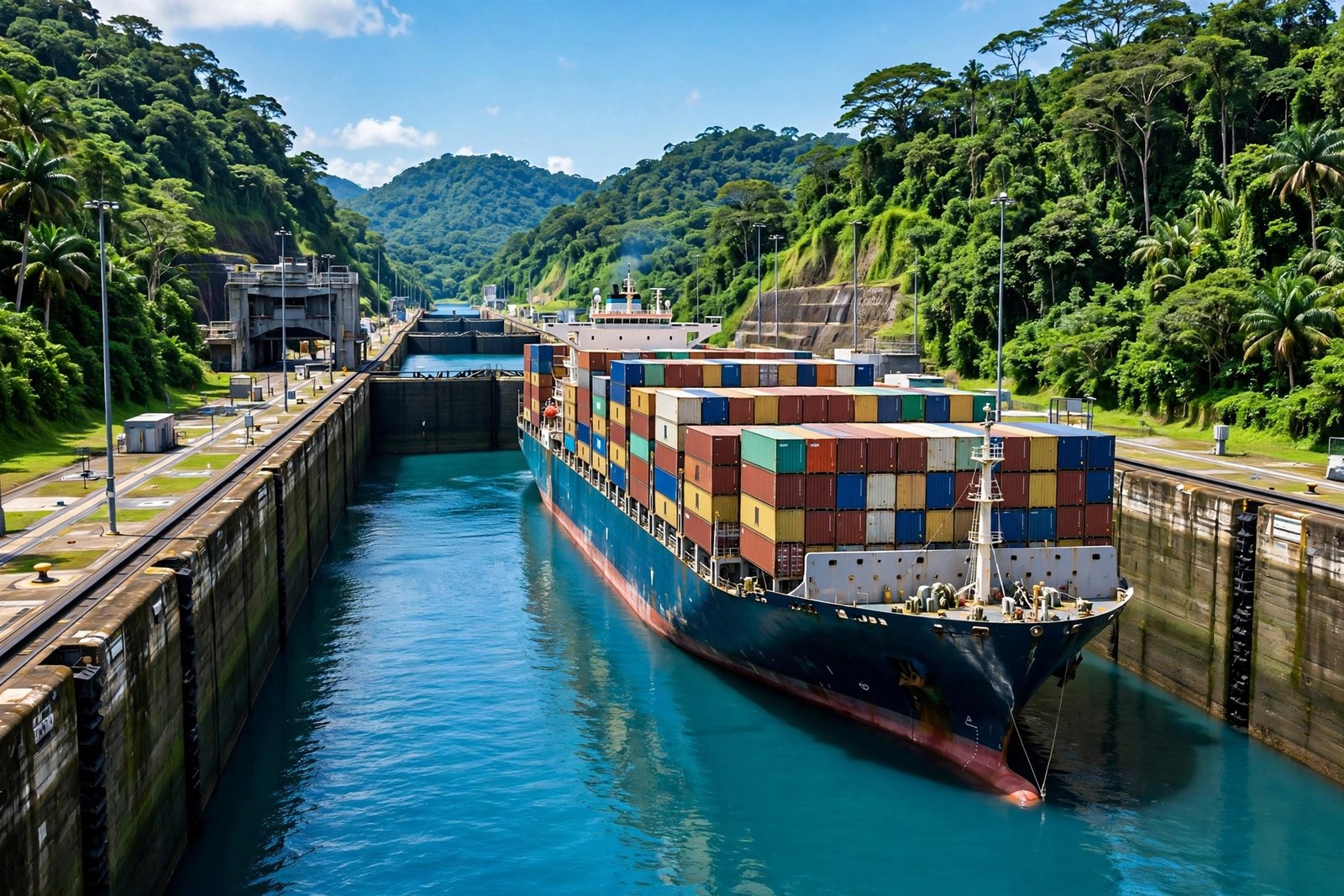
There is a place on Earth where a ship can sail uphill. It climbs eighty-five feet above sea level, crosses a man-made lake in the middle of a jungle, threads a narrow cut through a mountain range, and then descends back to the ocean on the other side, all without ever leaving the water. That place is the Panama Canal, and it is one of the greatest things America ever built.
When the canal opened on August 15, 1914, it changed the map of world trade overnight. Before it existed, a ship traveling from New York to San Francisco had to sail all the way around the southern tip of South America, a voyage of roughly 13,000 miles that could take months. The canal cut that journey to about 5,000 miles. It was, in the words of one historian, the moment the United States became a two-ocean power in fact as well as in name, able to move its navy and its commerce between the Atlantic and the Pacific in days instead of months.
The canal also tells a larger American story: ambition, engineering genius, terrible mistakes, and a long, complicated ending. The United States did not build it alone, and it did not keep it forever. On December 31, 1999, at noon, Panama took full control of the waterway, and the Panama Canal Authority has run it ever since. More than a century after it opened, the canal still carries a significant share of world trade, and it still matters to the American economy every single day. Here is how it was built, how it works, and why it still matters.
Why the World Needed a Shortcut
The idea of a canal across Central America is older than the United States itself. Spanish explorers in the 1500s dreamed of a waterway through the narrow Isthmus of Panama, the strip of land that joins North and South America. For centuries it remained a dream, because the terrain was brutal: dense jungle, steep hills, swamps, and a climate that killed outsiders with yellow fever and malaria. The alternative was the long sea voyage around Cape Horn, at the bottom of South America, through some of the roughest waters on Earth.
By the late 1800s, the need for a shortcut had become urgent. The California Gold Rush had sent tens of thousands of Americans across Panama by foot, mule, and the Panama Railroad, which opened in 1855. Trade between the Atlantic and Pacific coasts of the United States was growing fast, and so was trade between Europe and Asia. Whoever controlled a canal across Panama would control one of the most valuable shipping routes in the world. The question was who would build it, and at what cost in money and lives.
The first serious attempt came from France. Ferdinand de Lesseps, the builder of the Suez Canal in Egypt, launched a French company in 1881 to cut a sea-level canal across Panama. It was a disaster. The French plan underestimated the mountains, the rainfall, and the disease. Yellow fever and malaria killed thousands of workers. The company ran out of money and collapsed in 1889, leaving behind rusting machinery, half-dug channels, and a warning that Panama would not be tamed by confidence alone. The French effort began in 1881 and failed, but it left behind excavations, a railroad, and hard lessons that the Americans would later use.
How America Took Over and Changed the Plan
The United States took over the project in 1904, after Panama broke away from Colombia with American support in 1903 and signed an agreement giving the United States the right to build and operate a canal. The American effort began under President Theodore Roosevelt, who saw the canal as essential to American power and commerce, and it started very differently from the French attempt. The first chief engineer, John Stevens, spent his first years rebuilding the railroad, housing, and supply lines, because he understood that a project this size would fail without logistics. Then he made the decision that saved the canal: abandon the sea-level plan and build a lock canal instead.
The lock plan was the key insight. Instead of cutting a channel all the way down to sea level through the mountains, the Americans would dam the Chagres River to create a vast artificial lake, Gatun Lake, eighty-five feet above sea level, and lift ships up to the lake with locks on each side. That meant far less digging through rock, and it turned the worst obstacle, the mountains, into an advantage: the lake would do much of the work. Stevens persuaded Roosevelt to accept the lock design, and his successor as chief engineer, George Washington Goethals, who took charge in 1907, carried it through to completion.
Cutting Through the Continental Divide
The hardest digging was at the Culebra Cut, also known as the Gaillard Cut, where workers had to slice through the continental divide itself, the spine of hills that separates the Atlantic and Pacific watersheds. At its deepest, the cut is hundreds of feet down through rock and earth, and it was a constant fight against landslides. Heavy tropical rain turned the slopes to mud, and tons of earth would slide back into the excavation overnight, undoing weeks of work. Steam shovels, railroads, and dynamite were used on a scale never seen before, and at the peak of construction, thousands of trainloads of spoil were hauled away every day.
The locks themselves were an engineering marvel. The original locks are 110 feet wide and 1,000 feet long, built of concrete poured on a massive scale, with steel gates weighing hundreds of tons each. Building them required the first concrete laid at Gatun in August 1909, and years of work by thousands of laborers. The whole project cost the United States nearly 500 million dollars by some accounts, an enormous sum in 1914, and it took a decade of American construction, from 1904 to 1914, to complete. When the French crane boat Alexandre La Valley made the first full transit in January 1914, and construction was formally completed that spring, the world knew that the impossible had been done.
Opening Day: August 15, 1914
The Panama Canal officially opened to commercial traffic on August 15, 1914, with the transit of the SS Ancon, a cargo and passenger ship piloted by Captain John A. Constantine, the canal’s first pilot. There was no grand celebration. World War I had broken out in Europe that same month, and the planned opening ceremonies were cancelled. The canal simply went to work, quietly, in the middle of a world war, and it has been working ever since.
How the Locks Work: A Ship That Sails Uphill
The Panama Canal is an 82-kilometer, or 51-mile, waterway that connects the Caribbean Sea and the Atlantic Ocean with the Pacific Ocean. The genius of the design is that ships do not sail through a flat ditch. They are lifted up and lowered down again, like an elevator made of water, and the whole system runs on gravity.
A ship entering from the Atlantic side sails about seven miles from the harbor at Cristobal to the Gatun Locks. There, three chambers in a flight lift the ship, step by step, a total of eighty-five feet up to the level of Gatun Lake. Each chamber fills with water from the lake, fed by gravity through culverts in the lock walls, and the ship floats upward as the water rises. Electric locomotives called mules, running on tracks along the lock walls, guide the ship through the narrow chambers and keep it centered. The gates close behind it, the next chamber fills, and the ship rises again.
Once the ship reaches Gatun Lake, it sails across the lake and through the Gaillard Cut, the narrow channel through the continental divide, for about thirty-one miles. On the Pacific side, the Pedro Miguel Lock lowers the ship about thirty-one feet to Miraflores Lake, and then the two chambers of the Miraflores Locks lower it the remaining fifty-four feet to the level of the Pacific Ocean. The whole transit takes about eight to ten hours, and the canal handles dozens of ships a day. The original locks are used in pairs, so ships can pass in both directions at once, and the water used in the locks comes entirely from Gatun Lake, which is why rainfall and the health of the lake’s watershed matter so much to the canal’s operations.
The Long Road to Panamanian Control
For most of the twentieth century, the canal was run by the United States, and the surrounding Canal Zone was American-administered territory. That arrangement became increasingly resented in Panama, where the canal was seen, understandably, as a national asset under foreign control. Tensions came to a head in 1964, when riots broke out over the flying of the Panamanian flag in the Canal Zone, and over the following years, negotiations began over the canal’s future.
The turning point came on September 7, 1977, when President Jimmy Carter and Panamanian leader Omar Torrijos signed the Torrijos-Carter Treaties. The treaties set out a twenty-year transition period, during which Panama would gradually take over operation of the canal, and provided for the complete handover at noon on December 31, 1999. The treaties were controversial in the United States, and they were debated fiercely in the Senate before ratification, but they passed, and the transition went ahead. On October 1, 1979, the treaties came into force, and the Canal Zone was formally abolished.
The Expansion: Bigger Ships, a Bigger Canal
By the early 2000s, the canal faced a problem: ships had gotten bigger than the original locks. The largest ships that could fit through the 1914 locks, known as Panamax ships, were limited to a beam of about 106 feet and a length of about 950 feet, and a growing share of the world’s container ships and bulk carriers were too large to pass. Panama held a national referendum in 2006 approving an expansion, and construction began in 2007 on a third, wider lane of locks.
The expansion opened to commercial traffic on June 26, 2016, with the new Agua Clara Locks on the Atlantic side and the Cocoli Locks on the Pacific side. The new locks are much larger than the originals, and they use water-saving basins that recycle much of the water used in each transit, an important innovation in a canal that depends on fresh water from Gatun Lake. The expanded canal can handle Neopanamax ships, far larger than the original Panamax vessels, and it has allowed the canal to serve the giant container ships that now dominate trade between Asia and the East Coast of the United States.
Why the Panama Canal Still Matters to America
More than a century after it opened, the Panama Canal remains one of the most important waterways in the world, and it matters to the United States as much as ever. A large share of the cargo that passes through the canal is bound to or from the United States, including containerized goods from Asia headed for East Coast and Gulf Coast ports, grain and agricultural products from the American Midwest, liquefied natural gas from the Gulf Coast, and energy, minerals, and manufactured goods moving in both directions. When the canal runs smoothly, American shelves stay stocked and American exporters stay competitive. When it slows down, as it did during the 2023 drought, shipping costs rise and supply chains feel the strain.
The canal also matters strategically. It is still the fastest way to move American naval vessels between the Atlantic and the Pacific, and it is a vital link in the global trading system that the United States helped build. That is why the canal periodically becomes a subject of American political debate, including renewed calls in recent years for the United States to reassert influence over it. The government of Panama has firmly rejected those calls, describing the canal as an inalienable part of the national patrimony, and the canal remains under Panamanian control. The debate is a reminder that the canal is not just a piece of engineering. It is a symbol, and symbols are rarely simple.
Frequently Asked Questions
When did the Panama Canal open?
The Panama Canal opened to commercial traffic on August 15, 1914, with the first official transit made by the SS Ancon. World War I had just broken out in Europe, so the planned grand opening celebration was cancelled, and the canal simply went to work.
How long is the Panama Canal?
The canal is 82 kilometers, or 51 miles, long, cutting across the Isthmus of Panama from the Caribbean Sea to the Pacific Ocean. A full transit takes about eight to ten hours, and the canal handles dozens of ships every day.
How do the Panama Canal locks work?
The locks work like water elevators. Ships entering from either side are lifted eighty-five feet up to Gatun Lake, an artificial lake created by damming the Chagres River, by filling lock chambers with water fed by gravity from the lake. After crossing the lake and the Gaillard Cut, the locks on the other side lower the ship back to sea level. Electric locomotives called mules guide ships through the chambers.
When did the United States hand the canal to Panama?
Under the Torrijos-Carter Treaties, signed on September 7, 1977, the United States handed full control of the canal to Panama at noon on December 31, 1999. The Panama Canal Authority, an autonomous Panamanian agency, has operated the canal ever since.
What is the Panama Canal expansion?
The expansion added a third, wider lane of locks, the Agua Clara Locks on the Atlantic side and the Cocoli Locks on the Pacific side, which opened on June 26, 2016. The new locks can handle much larger Neopanamax ships that are too big for the original 1914 locks, and they use water-saving basins to recycle water.
Related reading
The canal is one of America’s great infrastructure stories. Keep exploring with us: read about how American freight railroads power the economy, discover how the American GPS satellite system powers the world, and learn how small businesses power the American economy.
Sources: Panama Canal Authority, Weekly Update on Transits Through the Panama Canal; Embassy of Panama, The Panama Canal; Travelermania, Panama Canal: History and How It Works.