
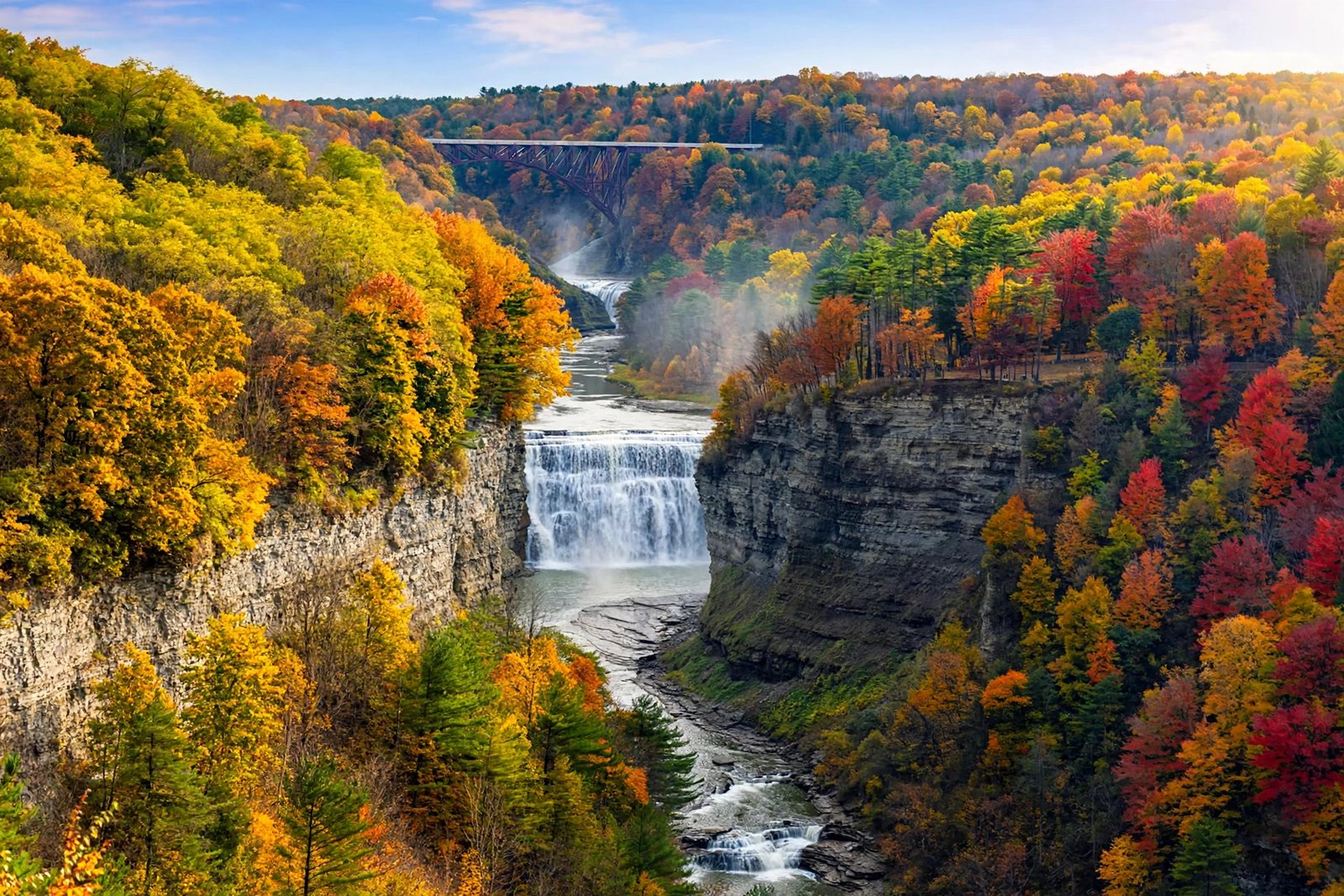
Deep in western New York, the Genesee River has spent thousands of years carving a gorge so dramatic that visitors have called it the Grand Canyon of the East for more than a century. Letchworth State Park protects that gorge: a wild, 17-mile canyon lined with cliffs as high as 600 feet, threaded by more than 66 miles of trails, and crowned by three great waterfalls that tumble through the heart of the park. It is one of the most beautiful places in the eastern United States, and it is also one of the most surprising. Many Americans have never heard of it, yet in 2015 it was named the best state park in the entire nation.
Letchworth State Park covers about 14,350 acres along the Genesee River in Livingston and Wyoming Counties, roughly 35 miles southwest of Rochester and 60 miles southeast of Buffalo. The park is long and narrow, following the river as it flows north through the gorge, and it rewards visitors who take their time. You can drive the park road and stop at the overlooks, hike the gorge trail past all three waterfalls, stay overnight at the historic Glen Iris Inn, or float above it all in a hot air balloon at sunrise. In autumn, when the forests turn gold and red, the park is at its most spectacular, but every season has its own reason to visit. Here is the full guide to New York’s Grand Canyon of the East.
What Makes Letchworth the Grand Canyon of the East?
The nickname comes from the gorge itself. The Genesee River, flowing north toward Lake Ontario, has cut a deep canyon through the rock of western New York, creating cliffs that rise as high as 600 feet above the river in places. The gorge winds for about 17 miles through the park, and at its narrowest the rock walls close to about 400 feet apart. Standing at an overlook like Inspiration Point, with the river far below and forested cliffs stretching in both directions, the comparison to the Grand Canyon feels earned, even at a smaller scale. The eastern canyon is greener, wetter, and more wooded than its Arizona namesake, but the sense of depth and drama is the same.
What makes the gorge so photogenic is the combination of water, rock, and forest. The river does not just flow through the canyon; it falls through it, dropping over three major waterfalls in the southern section of the park known as Portage Canyon. Between the falls, the river runs fast and rocky, and dozens of smaller waterfalls spill from tributary streams down the gorge walls. In spring, when snowmelt swells the river, the falls thunder. In autumn, the hardwood forests that line the cliffs turn brilliant shades of red, orange, and gold, and the whole gorge becomes a corridor of color. In winter, the falls freeze into curtains of ice, and the park takes on a quiet, stark beauty that few visitors ever see.
The park’s official description from New York State Parks calls it a 14,350-acre masterpiece, and the numbers support the praise. The park protects a 17-mile gorge, cliffs as high as 600 feet, three major waterfalls, and more than 66 miles of trails. It was named the best state park in the nation in 2015 in the USA Today Readers’ Choice Awards, chosen from more than 6,000 state parks across the country. That recognition put Letchworth on the map for travelers who had never heard of western New York’s canyon country, and the park has been drawing growing crowds ever since, especially in the fall.
The Three Waterfalls: Upper, Middle, and Lower Falls
The heart of Letchworth is its three major waterfalls, all on the Genesee River in Portage Canyon, the southern section of the park. Each has its own character, and each is worth visiting on its own. The Upper Falls is the first you reach from the southern end of the park, near the Portageville entrance. It is a broad, powerful fall, and it is crossed by a high railroad trestle bridge that adds drama to every photograph. A short walk from the Portageville entrance brings you to a viewing area, making the Upper Falls the most accessible of the three for visitors who want a quick stop.
The Middle Falls is the star of the park. At 107 feet high and 285 feet wide, it is the tallest and widest of the three, and many visitors consider it the most impressive waterfall in New York State. The best views come from Inspiration Point, one of the park’s great overlooks, and from the grounds of the Glen Iris Inn, which sits on the gorge’s edge above the falls. In the evening, the Middle Falls is illuminated, and the lit waterfall glowing against the dark gorge is one of the park’s signature sights. A trail leads down toward the base of the falls, where the mist and the roar of the water give you a sense of its power that no overlook can match.
The Lower Falls is the most adventurous of the three to reach. A stone staircase and a trail descend into the gorge, and a footbridge crosses the river near the base of the falls, giving you a close, eye-level view of the water crashing through the narrow canyon. The descent is steep, with many steps, and the climb back up is a workout, but the reward is the most intimate waterfall experience in the park. Together, the three falls make Letchworth one of the great waterfall destinations in the eastern United States, and the Gorge Trail, which runs about seven miles along the river, passes all three in a single hike.
Trails, Overlooks, and the Best Ways to Explore
Letchworth has more than 66 miles of trails, ranging from easy paved overlook paths to rugged gorge hikes, and the best way to experience the park depends on how much time you have. If you have only a few hours, drive the park road and stop at the major overlooks. Inspiration Point, near the Middle Falls, is the single best viewpoint in the park, with a sweeping view of the falls, the gorge, and the river below. The Great Bend Overlook, farther north, shows the river curving through the canyon in a wide arc. The Archery Field Overlook and the Tea Table Overlook each offer a different angle on the gorge, and the drive itself, winding along the canyon rim through the forest, is part of the pleasure.
If you have a full day, hike the Gorge Trail, also known as Trail 1, which runs about seven miles along the Genesee River and passes all three major waterfalls. It is a moderate trail, with some steep sections and stairs, and it takes most hikers several hours. Shorter options include the trails around the Upper Falls and the paths near the Glen Iris Inn, which offer waterfall views without a long commitment. The park also has trails for horseback riding, cross-country skiing, and snowshoeing in winter, and a separate network of paths through the quieter northern section of the park, where the gorge widens and the crowds thin out.
For a completely different perspective, consider a hot air balloon ride. Letchworth is one of the few state parks where ballooning is a signature activity, and sunrise flights drift over the gorge as the morning light fills the canyon. The park also offers whitewater rafting on the Genesee River below the falls, guided tours, and a swimming pool and playgrounds for families near the campgrounds. The park’s visitor center, near the Mount Morris entrance, is a good first stop for maps, trail conditions, and advice from rangers, and it is worth checking in there before setting out, since trail closures and river conditions change with the weather.
The Glen Iris Inn and the Man Who Saved the Gorge
One of the most charming places to stay in any American state park is the Glen Iris Inn, a historic stone inn perched on the edge of the gorge above the Middle Falls. The inn was once the home of William Pryor Letchworth, the Buffalo businessman and philanthropist for whom the park is named. Letchworth bought the land around the gorge in the 1800s, built his estate there, and became determined to protect the canyon from the dams and development that threatened it. In 1906, he donated his roughly 1,000-acre estate to the State of New York, creating the park that now bears his name.
The Glen Iris Inn still operates as a restaurant and lodging, and dining on its terrace with the Middle Falls in view is one of the great experiences of the park. The inn’s dining room serves lunch and dinner, and its rooms, many with views of the gorge, book up well in advance in the fall. Even if you are not staying overnight, stopping for a meal or a drink at the inn is worth the time, and the grounds around it offer some of the best waterfall views in the park. The nearby Letchworth Museum, housed in a building on the estate grounds, tells the story of the park, its founder, and the Native American history of the Genesee Valley.
Letchworth’s gift was an act of conservation ahead of its time. At the turn of the twentieth century, the gorge faced proposals for dams and industrial use, and the land could easily have been developed beyond recognition. Letchworth’s donation preserved the heart of the canyon, and the state expanded the park over the following decades to its present size of more than 14,000 acres. The park is also a designated National Natural Landmark, a recognition of the gorge’s geological significance. The Seneca people, whose homeland includes the Genesee Valley, have a much older connection to this land, and the park’s museum and interpretive signs acknowledge that history alongside the story of its founder.
When to Visit and How to Plan Your Trip
Autumn is the most popular time to visit Letchworth, and for good reason. The hardwood forests that line the gorge turn brilliant shades of red, orange, and gold, usually peaking in mid-October, and the combination of fall color, waterfalls, and canyon walls is unforgettable. But autumn is also the busiest season, and the park’s campgrounds, cabins, and the Glen Iris Inn book up early. If you plan a fall visit, reserve lodging well in advance, arrive early in the day to beat the crowds at the overlooks, and consider visiting on a weekday rather than a weekend.
Spring is the best season for waterfalls. Snowmelt and spring rains swell the Genesee River, and the falls run at their fullest and loudest. The forests are fresh green, the wildflowers are out, and the crowds are smaller than in autumn. Summer brings warm weather, swimming, camping, and rafting, and the park’s campgrounds and cabins are at their busiest. Winter is the quietest season, and the most dramatic in its own way: the falls freeze into ice formations, the gorge is dusted with snow, and the park feels almost private. Some facilities close in winter, and trails can be icy, so check conditions before you go.
Practically, the park has several entrances, with the main ones at Mount Morris, Perry, Castile, and Portageville. There is a vehicle entrance fee, and the park is open year-round, though hours and facility availability vary by season. The nearest cities are Rochester, about 35 miles to the northeast, and Buffalo, about 60 miles to the northwest, and the park makes an easy day trip from either. From New York City, the drive is about five hours, which makes Letchworth a good weekend destination. Bring sturdy shoes, water, and layers, since the gorge can be cooler and windier than the surrounding countryside, and cell service can be spotty in the canyon.
Frequently Asked Questions
Where is Letchworth State Park?
Letchworth State Park is in western New York, in Livingston and Wyoming Counties, about 35 miles southwest of Rochester and 60 miles southeast of Buffalo. The park follows the Genesee River for about 17 miles through a deep gorge.
Why is Letchworth called the Grand Canyon of the East?
The nickname comes from the park’s 17-mile gorge, carved by the Genesee River, with cliffs as high as 600 feet. The deep canyon, the three major waterfalls, and the forested cliffs reminded early visitors of the Grand Canyon, and the name stuck.
What are the three waterfalls at Letchworth?
The three major waterfalls on the Genesee River are the Upper Falls, the Middle Falls, and the Lower Falls, all located in Portage Canyon in the southern section of the park. The Middle Falls, at 107 feet high and 285 feet wide, is the largest and most photographed.
How big is Letchworth State Park?
The park covers about 14,350 acres, according to New York State Parks, and has more than 66 miles of trails. The gorge runs about 17 miles through the park, with cliffs as high as 600 feet.
When is the best time to visit Letchworth State Park?
Autumn, usually peaking in mid-October, is the most popular time for fall color, but it is also the busiest. Spring offers the fullest waterfalls, summer is best for camping and rafting, and winter brings frozen falls and quiet trails.
Related reading
Discover more of America’s hidden natural wonders with ENG Post Now: Hocking Hills, Ohio: A Hidden Gem of Waterfalls, Carlsbad Caverns: New Mexico’s Underground Hidden Gem, and Valley of Fire: Nevada’s Oldest State Park. For official park information, see the official Letchworth State Park page, New York State Parks’ Genesee Region page and America’s State Parks’ Letchworth guide.