
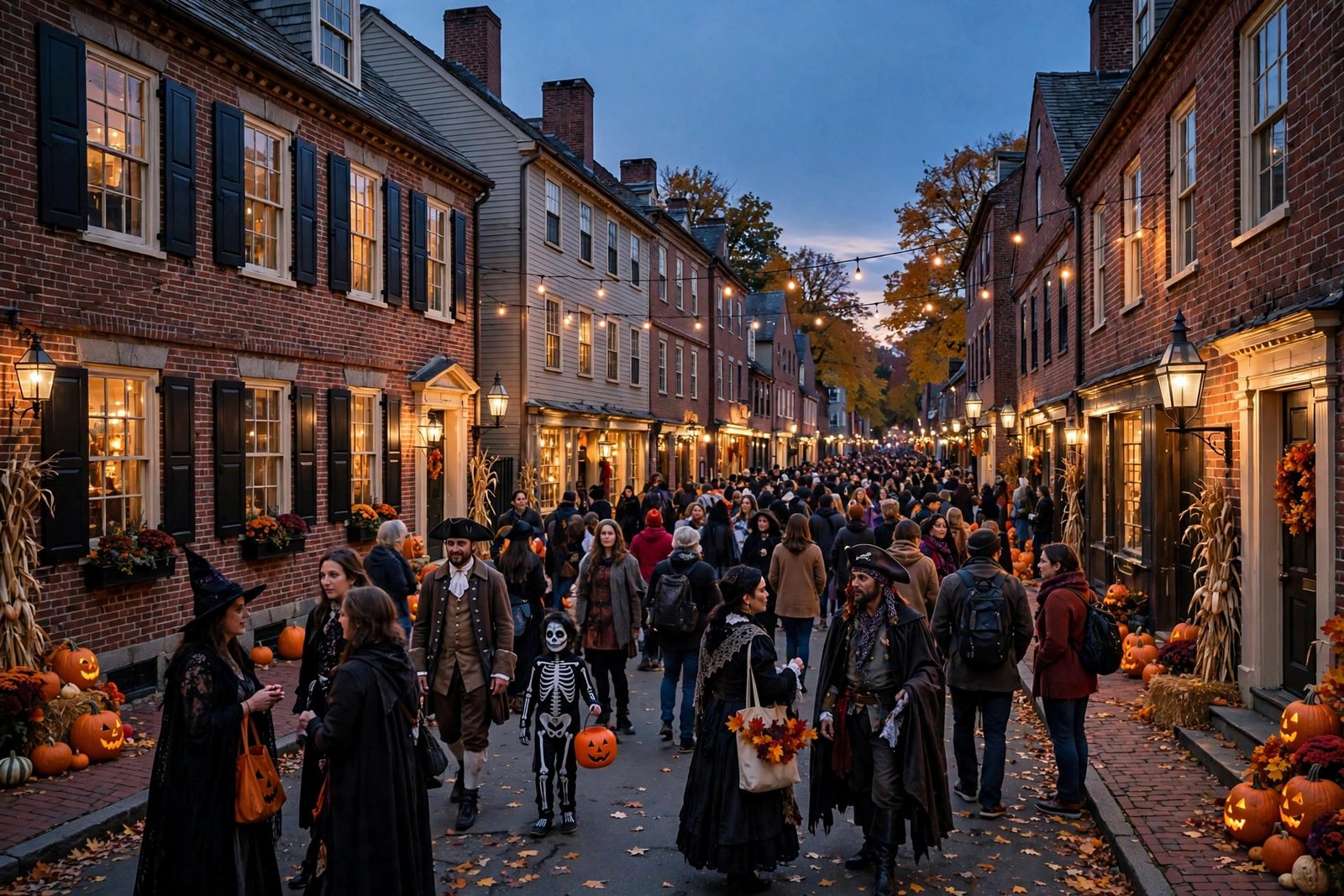
There is a small city on the Massachusetts coast, home to roughly 44,000 people, that will host more than a million visitors this month. Not this year — this month. By the time Halloween night ends tomorrow, Salem will have welcomed, in the space of 31 days, a crowd roughly twenty-five times its own population. And somehow, every October, the Witch City pulls it off again.
With Halloween 2026 falling on a Saturday — and Salem in the middle of its 400th anniversary year — this October may be the biggest test yet. Here is how Salem became America’s Halloween capital, and the machinery that keeps a month-long street party from tipping into chaos.
The Numbers Are Staggering
Start with last year’s scorecard, because 2025 set the bar. Destination Salem, the city’s official destination marketing organization, reported approximately 1.1 million unique visitors to downtown Salem during October 2025, generating about 1.4 million total visits. Halloween Day alone drew 96,600 visitors — up 7.2 percent from 2024 — into a city whose entire population would fit into a mid-sized football stadium.
October 2025 also came with headwinds: nine days of rain, including several soggy weekends, and a federal government shutdown that briefly threatened the National Park Service visitor center. Visitation held level with the previous year’s records anyway. That resilience tells you something about Salem’s pull — this is no longer a fad destination. As one detailed breakdown of Salem’s Halloween crowd data notes, October visitation has climbed from 782,000 visitors in 2019 to the 1.1 million plateau of the last two years, a six-year run of strength almost no other small American city can match.
It Starts With a Dark and Real History
Salem’s fame rests on something genuinely grim. In 1692 and 1693, amid a panic that swept Essex County, more than 200 people were accused of witchcraft in and around Salem. Twenty of them were executed — nineteen hanged on Gallows Hill, and one, Giles Corey, pressed to death under heavy stones — while others died in jail awaiting trial. The trials remain one of the most studied episodes of injustice in American history, and the city has spent generations reckoning with them.
That reckoning is a large part of what visitors actually come for. The Salem Witch Museum, the Witch House (the home of trial judge Jonathan Corwin), the Witch Trials Memorial beside the Old Burying Point Cemetery, and the Peabody Essex Museum’s archive of original trial documents all anchor the season in real history. Modern Salem is also home to a substantial community of practicing Wiccans and modern witches, for whom Samhain — the ancient Celtic festival on October 31 — is a genuine religious observance, adding a layer of living tradition on top of the tourism.
Haunted Happenings: A Month Disguised as a Holiday
The engine of the season is Haunted Happenings, the umbrella festival that effectively runs all October: a grand parade to open the month, psychic fairs, haunted-house attractions, harbor cruises, ghost tours by lantern light, vendor markets on the pedestrian mall, costume balls, and street performers on every corner of the downtown. What began decades ago as a modest weekend of events has become a month-long season that many locals simply call “October,” the way ski towns talk about winter.
This year carries a bonus. Salem was founded in 1626, making 2026 the city’s 400th anniversary, and the season is folding quadricentennial celebrations into the Halloween machinery. Reports on this year’s finale describe a planned Halloween-night drone show — 400 drones over the North River, one for each year of the city’s history — to close out the season tomorrow night.
How a Small City Absorbs a Million Guests
The logistics are where Salem quietly impresses. Moving a million people through a colonial street grid designed for horses requires a choreographed system that the city refines every year:
- Trains over cars: The MBTA runs expanded commuter rail service from Boston throughout October, and the city aggressively steers visitors to the train and the ferry. Downtown parking is limited, expensive and often sold out by mid-morning on peak weekends.
- Street closures: Core downtown streets close to vehicles on the busiest days, converting the center into a walkable festival zone and keeping emergency lanes clear.
- Staggered ticketing: Major attractions sell timed-entry tickets, flattening the worst surges. The city and Destination Salem urge visitors to book everything in advance — walk-up availability in late October is a gamble.
- Safety staffing: Police, fire and medical details scale up dramatically for the final weekends, with mutual aid from surrounding communities, and the city publishes detailed visitor guidance — including hefty fines for public drinking and disorderly behavior — before the season starts.
- Spreading the calendar: Perhaps the smartest move: marketing the whole month, not just Halloween weekend. Weekday and early-October visits are promoted as the insider’s Salem — same haunted houses, a fraction of the crush.
The Resident’s-Eye View
None of this is frictionless. Ask a Salem resident about October and you will hear the full spectrum: pride in a world-famous hometown, gratitude for the seasonal income that carries local shops through winter, and deep, specific knowledge of which side streets to avoid until November 1. The influx supercharges small businesses — tour companies, restaurants, bakeries and shops can earn a decisive share of their annual revenue in these weeks — while also testing trash pickup, sidewalk space and patience.
The city’s balancing act has become a case study in what tourism researchers call the overtourism puzzle: the visitors come precisely because Salem is a real, lived-in place with real history, and the challenge is keeping it one. Salem’s answer, refined over decades, is management rather than resistance — plan for the million, price the parking, run the trains, and remind guests, cheerfully and constantly, that people actually live here.
Salem the Other Eleven Months
Here is the secret regular visitors know: Salem is not a Halloween theme park that sleeps the rest of the year. It is one of the oldest seaports in America, a city whose maritime trade once reached China and the East Indies, and its year-round anchor is the Peabody Essex Museum — one of the oldest continuously operating museums in the United States, holding a world-class collection of Asian export art and maritime history, including an entire 18th-century Chinese merchant’s house reassembled inside the building. The Salem Maritime National Historic Site preserves the wharves, customs house and tall ship that recall when Salem’s codfish and pepper fleets sailed the globe.
Summer Salem is a different pleasure: harbor cruises, the Willows park across the water, seafood on Pickering Wharf, and historic house tours without a single line. Many October visitors say the same thing on the train home — they want to come back and see the real city underneath the festival. The wisest ones do.
What Salem Asks of Its Guests
After decades of October fame, the city has developed a clear, good-humored code for visitors, promoted by Destination Salem and echoed by residents every season. Book before you come, because the spontaneous trip is where disappointment breeds. Use the train, because the car is where October goes to die. Stay on the sidewalks and out of the private yards — the photogenic colonial house is somebody’s home, and its owner is trying to get to work. Treat the Witch Trials Memorial and the cemeteries as what they are: places where real people suffered and are buried. And spend money with the local shops and restaurants whose year depends on this month, rather than treating the city as a free backdrop.
It is, in the end, a fair trade: a million guests get the greatest Halloween show in America, and a small city gets to stay itself. The places that fail at this bargain either barricade themselves against visitors or dissolve into pure kitsch. Salem, four centuries old and counting, has threaded the needle — honoring a painful history, throwing a magnificent party, and sweeping up afterward, every single year.
Thinking of Going Tomorrow?
If this article has you eyeing a last-minute Halloween run to the Witch City, the local wisdom is consistent: take the train, book any ticketed attraction before you leave home, arrive early, expect lines for everything from museums to coffee, and wear comfortable shoes — you will walk miles on brick and cobblestone. Respect the memorials and the cemeteries; they are historic sites, not photo props. And tip your ghost-tour guide.
One last piece of perspective before you go: Salem’s October crowds are not an accident of virality. The city has been building toward this for forty years, expanding events weekend by weekend and season by season, learning from every overwhelmed October and planning the next one before the jack-o’-lanterns of the last had cooled. Other American towns with a spooky claim to fame study Salem the way startups study Silicon Valley. The Witch City did it first, does it biggest, and — judging by the reservation calendars — will be doing it long after this year’s million have gone home.
Or take the other insider tip and put a pin in it for next year — early October, midweek, when the jack-o’-lanterns are already lit but the million have not yet arrived. Either way, Salem will be ready. It has had 400 years of practice at being looked at, and exactly one month a year when the whole world comes to look.