
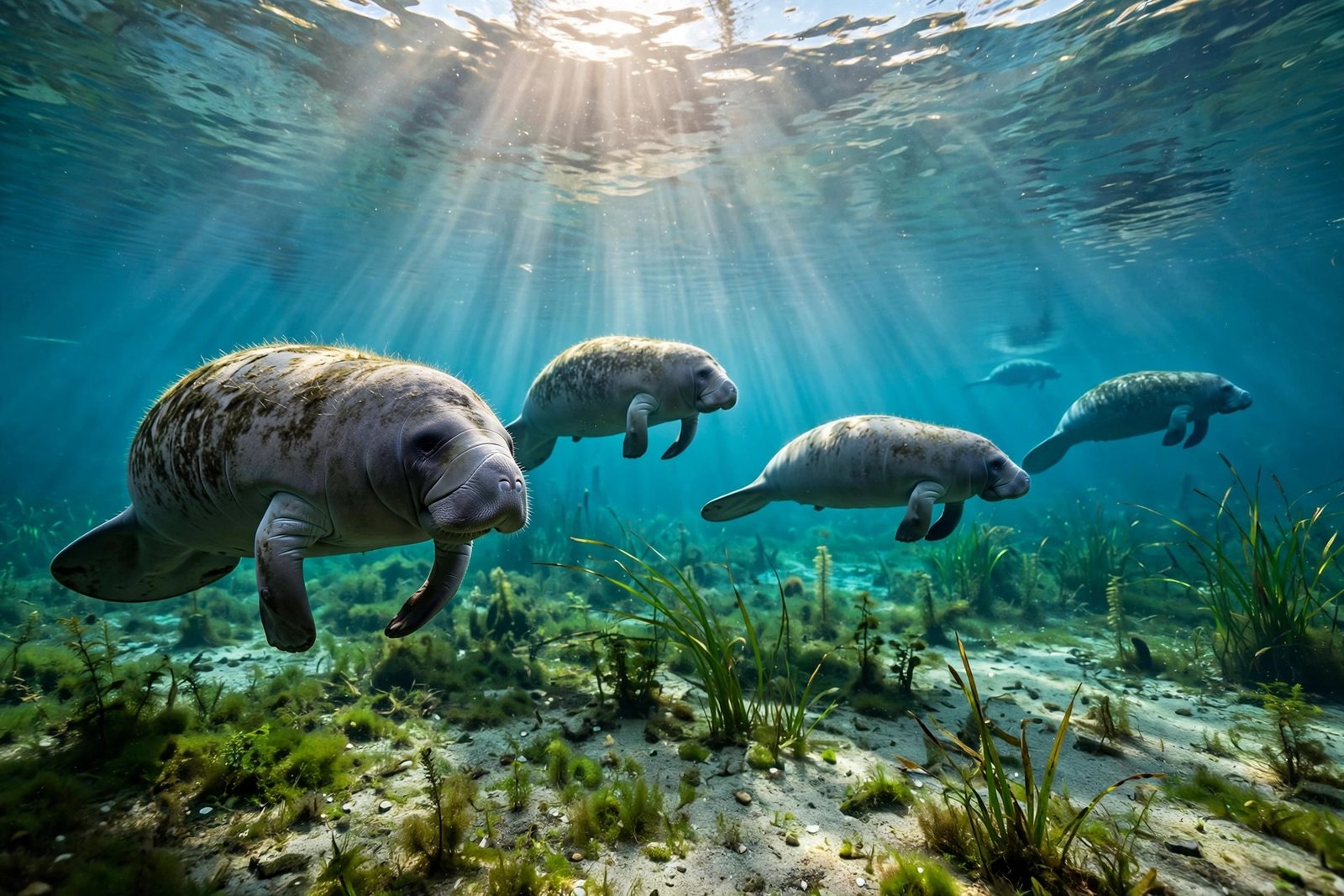
Every winter, as cold fronts sweep down the Florida peninsula and the water turns chilly, one of the gentlest wildlife spectacles in America quietly assembles. Hundreds of manatees — thousand-pound, whiskered, slow-gliding “sea cows” — crowd into Florida’s natural springs, where the water flows at a constant 72 degrees Fahrenheit all year long. In the clearest of those springs you can stand on a boardwalk and watch mothers nuzzle calves, bachelors roll lazily in the current, and whole herds drift in a living carpet below your feet.
Winter is manatee season, and it is about to begin again: manatee season at Florida’s biggest refuges officially runs from mid-November through the end of March. If you have ever wanted to see these animals in the wild — responsibly, and in numbers you will never forget — this is your window. Here is where to go, what happened to Florida’s manatees in the terrible die-off of 2021, and why the recovery story now unfolding is one of American conservation’s most hopeful chapters.
Why winter is everything
Manatees are tropical animals at the edge of their range in Florida, and they have almost no body fat to insulate them. The rule of survival is simple and unforgiving: prolonged exposure to water below about 68 degrees Fahrenheit causes cold stress, a potentially fatal condition in which the animal’s body begins to shut down. When a cold front drops river and Gulf temperatures into the 50s and 60s, manatees must find warm water or die.
Florida’s artesian springs solve the problem. Fed by underground aquifers, they discharge water at 72 degrees year-round, and on the coldest mornings the springs steam as manatees pack in by the hundreds. Power-plant cooling-water outflows serve as artificial refuges too, and manatees have learned to use both. The whole winter pattern — visible, predictable, spectacular — is built on that single fact of physiology. As the National Geographic’s reporting on Florida’s manatees explains, these warm refuges are the reason winter gatherings happen at all.
Where to see them: the two great springs
Three Sisters Springs, Crystal River
If there is a capital of manatee watching, it is Crystal River, on Florida’s Gulf coast — famously the only place in the United States where you can legally swim with manatees, under strict rules and only with licensed guides in designated areas. The jewel of the system is Three Sisters Springs, a cluster of spring vents within the Crystal River National Wildlife Refuge, managed by the U.S. Fish and Wildlife Service.
On cold mornings, manatees rest inside the spring basin in extraordinary density — sometimes hundreds of animals in a space smaller than a football field. Most visitors experience it from the boardwalk that rings the springs, looking down into water so clear the manatees look suspended in air. The springs themselves are closed to water entry during manatee season (mid-November to late March, with dates that can shift in cold springs), precisely so resting animals are not disturbed; guided swimming and kayaking happen in the surrounding Kings Bay, where rules require passive observation — no touching, no chasing, no diving down to them. Manatees, famously, often approach people out of their own curiosity; the ethics are simple: let them come to you, or not at all.
Blue Spring State Park, Orange City
On Florida’s east side, the champion gathering place is Blue Spring State Park in Orange City, about 35 miles north of Orlando. Blue Spring is the largest spring on the St. Johns River, discharging tens of millions of gallons of 72-degree water a day into a short, crystal-clear spring run — and its manatee story is the stuff of conservation legend.
When researchers began counting manatees here in the 1970s, they found only a few dozen animals — one account puts the early count at just 36. Protection of the spring run, better boating rules and decades of patient work by researchers like Save the Manatee Club’s Wayne Hartley, who has studied and individually identified Blue Spring’s manatees for about 40 years, changed everything. In 2025, counters recorded the largest aggregation ever documented at the park: 736 adults and 80 calves in the run on a single count. As the Save the Manatee Club’s Blue Spring updates describe, in one recent bitterly cold season nearly 800 individuals were documented using the spring, including close to 80 new calves. Statewide, the Fish and Wildlife Service has estimated Florida’s manatee population at roughly 8,350 — up from about 1,267 in 1991.
At Blue Spring, swimming in the spring run is prohibited from November 15 to March 15 for the manatees’ benefit, and visitors watch from a boardwalk that runs the length of the run — close enough to hear a manatee surface and exhale. Go on the coldest morning you can manage: the colder the river, the fuller the spring.
More places worth the trip
- Manatee Lagoon, Riviera Beach: an FPL eco-discovery center beside a power-plant outflow where manatees gather in winter; free admission and an observation deck.
- TECO Manatee Viewing Center, Apollo Beach: another power-plant refuge near Tampa, with boardwalks, a tidal walk and seasonal viewing when the plant is running.
- Homosassa Springs Wildlife State Park: a state park built around a spring where manatees are present year-round, with an underwater observatory.
- Weeki Wachee and the Nature Coast springs: quieter spring runs along the Gulf coast where kayakers regularly encounter winter manatees.
The crisis: the 2021 die-off
For all the hope at Blue Spring, Florida’s manatees have just come through the darkest years in their recorded history. Beginning in late 2020, manatees on Florida’s Atlantic coast started dying in shocking numbers — not from boats or cold, but from starvation.
The epicenter was the Indian River Lagoon, the 156-mile estuary system along the central Atlantic coast. Decades of nutrient pollution — from fertilizer runoff, septic systems and sewage — had fueled repeated algae blooms that blocked sunlight and killed the lagoon’s seagrass, the manatee’s essential food. By some estimates, the lagoon lost more than half its seagrass, and in the northern lagoon the losses were far worse. Manatees crowded into warm-water refuges near the lagoon in winter found warmth but no food, and they starved in place. A veterinarian’s summary from the time captured the horror: manatees will choose starvation over freezing, remaining in warm water even as their bodies waste away.
The numbers remain staggering. According to the Florida Fish and Wildlife Conservation Commission, 1,101 manatees died in Florida in 2021 — by far the worst year ever recorded, shattering the previous record of 830 deaths set in 2013, and amounting to roughly a tenth of the state’s entire manatee population in a single year. Hundreds more died in 2022 as the crisis continued (669 deaths were recorded that year), and federal and state officials formally declared an Unusual Mortality Event. A Stetson University exhibit on the 2021 mortality event documents how the disaster unfolded county by county along the lagoon.
The response was unprecedented. In the winters of 2021–22 and 2022–23, state and federal teams undertook something never tried before: an emergency feeding program, distributing romaine lettuce to starving manatees gathered at a power-plant site on the lagoon — hundreds of thousands of pounds of it — while rescue teams rehabilitated emaciated animals at critical-care facilities around the state. It was controversial, labor-intensive, and, by the agencies’ assessment, necessary to keep the Atlantic-coast population from collapsing.
The recovery — real, fragile, unfinished
Since then, the trajectory has bent toward hope. Deaths fell substantially in 2023 and 2024 compared with the crisis years, calves have been born in encouraging numbers, and the emergency feeding program was stood down after the winter of 2022–23 as conditions improved. Seagrass restoration projects in the Indian River Lagoon — replanting, water-quality upgrades, septic-to-sewer conversions and muck removal — have begun to show regrowth in parts of the system, though scientists stress the lagoon is nowhere near its former health.
The manatee’s legal status reflects the long arc: listed as endangered in the early years of the Endangered Species Act, the West Indian manatee was reclassified as threatened in 2017 after the population rebounded — a decision that remains debated, and one that Florida’s die-off has kept under scrutiny ever since. Manatees remain fully protected under both the Endangered Species Act and the Marine Mammal Protection Act, and the everyday threats have not gone away: in a typical year, watercraft collisions alone kill around a hundred manatees, and most adult carcasses examined show scars from multiple boat strikes.
How to watch like a conservationist
- Time it right: mid-November through March, and pick the coldest morning after a front — that is when the springs fill.
- Keep your distance: never touch, chase, feed or ride a manatee. It is illegal, and resting animals burn precious energy when disturbed.
- In the water, be a statue: float quietly at the surface in designated areas, let manatees approach if they choose, and follow your guide’s instructions in Crystal River.
- Boaters: obey idle-speed and slow-speed zones, wear polarized sunglasses to spot the tell-tale swirl of a surfacing manatee, and post a lookout in manatee habitat.
- Report trouble: if you see an injured, dead or tagged manatee, call the FWC Wildlife Alert Hotline at 1-888-404-3922.
Standing on the Blue Spring boardwalk on a frosty morning, watching 700 manatees breathe and drift in the steam, you are looking at two stories at once: what nearly went wrong, and what patient protection can still achieve. Florida’s manatees are not saved — but they are, once again, worth traveling for, and worth fighting for. Winter is coming. The springs are waiting.