
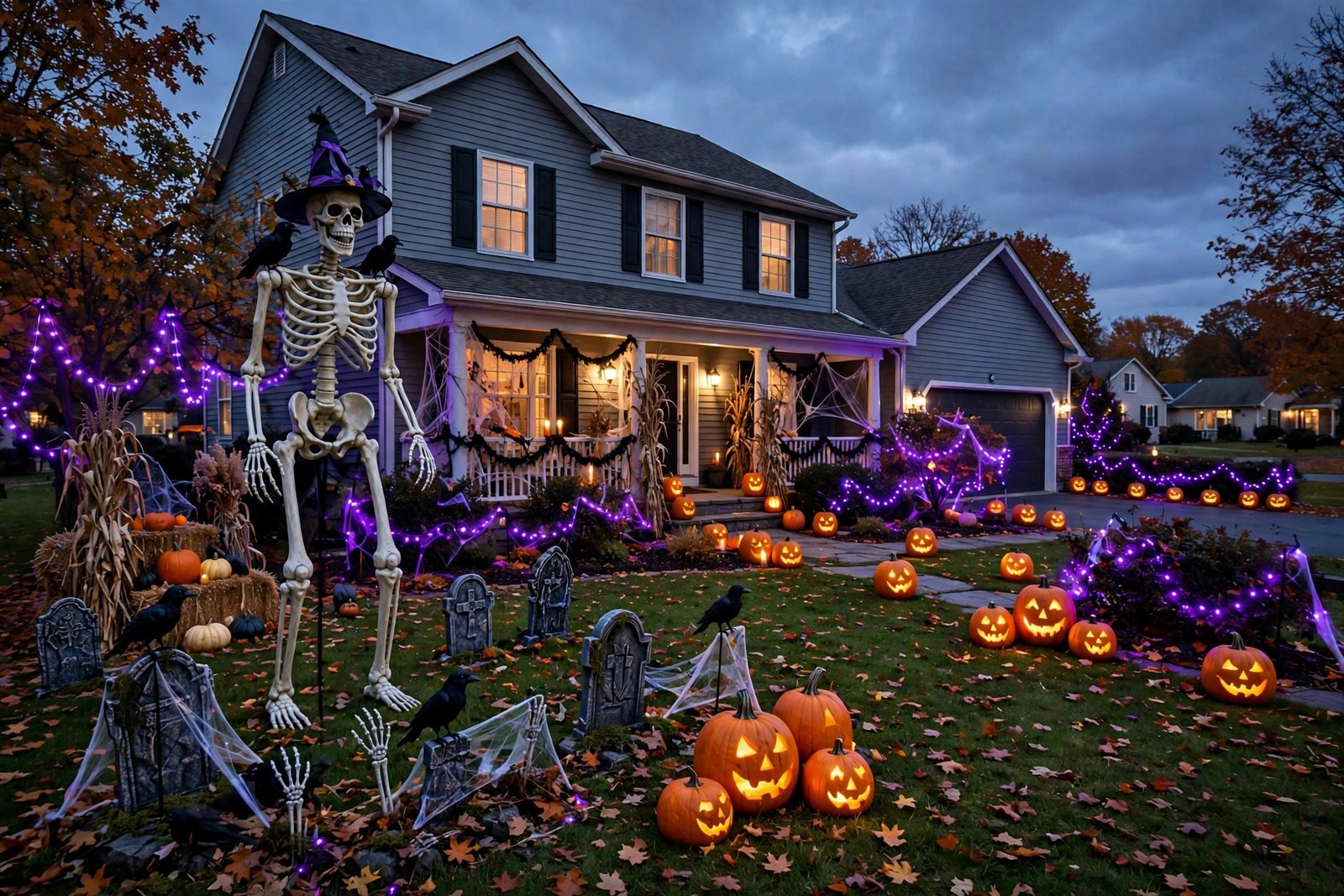
There was a time when carving a pumpkin and taping a cardboard ghost to the window made you the festive house on the block. That time is over. Across suburban America, Halloween decorating has escalated into a full-blown front-yard arms race — animatronic witches dueling across cul-de-sacs, projection-mapped haunted houses, synchronized light shows, and, towering over it all, a 12-foot skeleton named Skelly. Nobody declared this war. Everybody is fighting it. Here’s how America’s front yards became a competitive sport.
The Spark: A Skeleton the Size of a Giraffe
Every arms race has a first shot, and this one’s was fired in the summer of 2020. Home Depot released a product that seemed like a joke: a 12-foot-tall skeleton lawn decoration — roughly as tall as a basketball hoop, nearly 100 pounds in its box — priced at $299. Its official name was the ’12-Foot Giant-Sized Skeleton.’ America named it Skelly.
The timing turned a gag into a phenomenon. In the first Halloween of the COVID-19 pandemic, families were stuck at home, trick-or-treating was in doubt, and a decoration visible from half a block away was a way to celebrate at a distance — and to give the neighborhood something to smile at during a grim year. Skelly sold out. Resale prices reportedly soared. Photos flooded social media. And something unexpected happened: owners refused to take him down. Skelly got dressed for Christmas. Skelly wore a bikini in July. Skelly held flags on the Fourth. The 12-foot skeleton became less a Halloween decoration than a year-round neighborhood character.
Home Depot leaned in hard. Skelly returned each year with upgrades — glowing LCD ‘LifeEyes’ in 2024, a smaller 6.5-foot sibling, a skeleton dog, and for 2026 an app-connected version that moves its head and speaks with your recorded voice. What began on a single endcap has grown into seasonal displays covering hundreds of square feet of store floor, with rival retailers answering with their own giants. As one Home Depot holiday merchant quoted in coverage of the trend put it, the giant skeleton had become ‘the ultimate American decoration.’
From Décor to Display: The Escalation Ladder
Skelly was the headline, but the arms race runs on a hundred technologies that got cheap all at once:
- Animatronics for the driveway: Motion-activated witches, reapers and clowns that lunge, cackle and follow passersby with their eyes — props once exclusive to professional haunted houses, now sold at big-box stores.
- Projection mapping: A good projector turns a house’s whole facade into singing pumpkins, crawling ghosts and collapsing walls. The house itself becomes the decoration.
- Inflatables: Ever bigger, ever stranger — 15-foot dragons, haunted pirate ships, whole pumpkin families that rise in minutes and dominate a lawn by dusk.
- Lighting and fog: LED spotlights, laser projectors, fog machines and synchronized musical light shows migrated from Christmas displays to October.
- Social media as scoreboard: The real competition isn’t the neighbor across the street — it’s the viral house three states away, racking up millions of views and setting the bar for everyone.
The result is a decorating calendar that creeps earlier every year. Halloween merchandise that once appeared in September now lands in midsummer at some retailers, and dedicated decorators plan months ahead — sketching layouts, haunting Facebook groups with names like the ’12 Ft Skeleton Halloween Club’ (tens of thousands of members strong, as Mental Floss reported), and treating restock alerts with the seriousness of concert tickets.
Why October? The Sociology of the Spooky Yard
It’s fair to ask why Halloween, of all holidays, became America’s decorating arms race. Part of the answer is position: retailers and decorators alike describe Halloween as second only to Christmas in decorating enthusiasm — but with a fraction of Christmas’s obligations. There are no Halloween gifts to buy, no Halloween dinner to cook for fourteen relatives, no travel. The entire holiday’s creative energy funnels into two outlets: costumes and yards.
Halloween also licenses something Christmas doesn’t: mischief. A Christmas display aims for wonder; a Halloween display can aim for a jump scare. That creative freedom — spooky, funny, gross, glamorous — invites one-upmanship. Add the modern neighborhood audience: front yards are now stages, evaluated by trick-or-treat traffic, drive-by gawkers, local news crews and the occasional viral video, and the incentive structure is complete. Homeowners describe the same arc again and again: one inflatable the first year, a fog machine the second, and by year four they’re the house the neighborhood’s kids plan their routes around — a title no one surrenders lightly.
There is a softer truth underneath the competition, too. Elaborate displays are labor-intensive gifts to strangers. The houses people remember building memories around — the one with the full haunted garage, the one handing out king-size bars beneath a 12-foot skeleton — are doing the oldest neighborhood magic there is: giving kids a story they’ll tell for years. The arms race is real, but so is the generosity fueling it.
When Yards Go Viral — and Streets Become Attractions
The modern arms race has produced a new American folk institution: the destination Halloween house. In town after town, certain displays grow so elaborate — walk-through haunted garages, full pirate battles in the yard, block-long synchronized shows — that they draw lines of cars, local TV segments and spots on crowd-sourced Halloween maps that route families from spectacle to spectacle like a parade route. Some hosts hand out thousands of pieces of candy in a single night and treat it as a point of pride; a few collect donations for local charities at the gate, converting their hobby into a fundraiser with a fog machine.
This is also where the arms race shows its friendly face. The ‘competition,’ decorators will tell you, is mostly collaborative: Facebook groups trade build tutorials and restock alerts, neighbors loan each other extension cords and storage space, and yesterday’s rival becomes tonight’s technical consultant when a 12-foot werewolf refuses to stand. The scoreboard is real, but so is the community — which may be the most American thing about the whole phenomenon: fierce rivalry, freely shared secrets, and absolutely everybody invited to walk the sidewalk and enjoy the show.
Living With the Arms Race: A Survival Guide
If your street has gone competitive, a few hard-won rules from the front lines:
- Start with one anchor piece. A single giant — skeleton, reaper, dragon — makes a small display look intentional. Scatter looks accidental; scale looks like a statement.
- Light it properly. Half of every great display is lighting after dark. Cross-light from below; it’s cheap and doubles the drama.
- Mind the neighbors and the HOA. Sound effects on a timer, strobes pointed away from bedroom windows, and sidewalks kept clear will keep your masterpiece a neighborhood treasure instead of a complaint file. A few communities do regulate inflatables and noise — check before you build the fog wall.
- Store smart. The unglamorous secret of the arms race is January: giants need garage space, original boxes and dry storage. Buy with your storage, not just your lawn, in mind.
- Know your finish line. The healthiest competitors pick a theme and complete it. The race only becomes miserable when it’s against everyone, forever.
The Economics of Going Big
Nobody publishes an official census of front-yard ambition, and honest numbers are hard to pin down — but the commercial signals are unmistakable. Halloween has grown into one of the biggest seasonal retail events of the American year, with décor a major driver; decorations that once merited a single store endcap now fill aisles by midsummer, and manufacturers plan ‘giant’ lines years ahead because the giants keep selling through. Decorators talk casually about displays costing as much as a used car — and about the far larger investment no store sells: weekends of ladder work, engineering problems solved with zip ties and prayer, and storage units rented for the other eleven months.
Why spend it? Ask, and most display builders give the same answer in different words: for the kids on the sidewalk, for the neighbors who plan their October walks around the route, for the one night a year their house is famous. In an era when front porches sit empty and neighbors wave from car windows, the Halloween arms race has quietly become one of the last great excuses to build something for the street. The escalation isn’t really about skeletons. It’s about being seen — and making sure the neighborhood sees something wonderful.
The Verdict From the Sidewalk
Will the escalation ever peak? The industry keeps betting no — bigger figures, smarter animatronics, earlier launches. But drive through any American suburb this Halloween and the arms race stops looking like a retail trend and starts looking like folk art: hundreds of thousands of households, each spending their own money and weekends to make their street a little more magical for one night.
Skelly, still standing in yards across the country — possibly wearing a Santa hat by now — approves. The race has no finish line, and honestly, that’s the fun of it.