
Halloween falls on a Saturday in 2026, and that single fact changes the whole night. October 31 lands on a weekend, which means more families out at once, more cars on neighborhood streets, and more excitement running ahead of common sense. Police departments across the country have been publishing their plans early this year, and the message is remarkably consistent: pick a route, stay visible, keep kids with an adult, and respect the hours your town sets. Trick-or-treating is one of America’s most beloved traditions precisely because whole neighborhoods take part in it together. A little planning is what keeps it that way.
This guide brings together the safety guidance police departments and child-safety experts are sharing for Halloween 2026, the hours towns have actually announced, and the practical habits that make the biggest difference. It is not a list of scary warnings. It is a plan you can use in an evening: what to check before you leave the house, what to teach your kids on the walk, and what to do when the candy bag comes home.
Why Halloween night needs a plan
The risk on Halloween night is not the stuff of urban legends. It is traffic. Children in dark costumes, crossing streets between parked cars, excited and distracted, are simply harder for drivers to see. A federal analysis of pedestrian deaths cited by the Centers for Disease Control and Prevention found that childhood pedestrian deaths were far higher on Halloween evenings than during the same hours on other evenings, with nighttime conditions, dark costumes, and crossings away from intersections among the contributing factors. Researchers writing in JAMA Pediatrics reached a similar conclusion, finding a spike in pedestrian deaths on Halloween that was largest for young children.
That is why almost every police department’s Halloween message leads with the same three things: visibility, supervision, and crossing safely. The good news is that these are all things a family can control. A strip of reflective tape costs almost nothing. A flashlight fits in a small hand. A rule about crossing only at corners takes thirty seconds to explain and can last a child for years. Halloween safety is mostly about slowing down — kids slowing down at curbs, drivers slowing down on residential streets, and adults slowing down long enough to check the route before the fun starts.
What hours towns set for trick-or-treating in 2026
There is no national trick-or-treat hour in the United States. Hours are set locally, usually by a city or county, and they vary more than most people expect. In 2026, many towns have settled on a two- or three-hour evening window. The city of Thibodaux in Louisiana set trick-or-treating from 6:00 p.m. to 8:00 p.m. on Saturday, October 31, 2026, with increased patrols during those hours. The Lafourche Parish Sheriff’s Office in Louisiana announced its annual Blue Light Special patrol for the same 6 p.m. to 8 p.m. window, with deputies patrolling with their overhead lights on to remind drivers to slow down. Natchitoches, Louisiana, set its hours from 5 p.m. to 8 p.m., while Phenix City, Alabama, recommended 6 p.m. to 8 p.m. Eastern time.
In central Illinois, the picture shows how local the rules really are. Champaign County, including the cities of Champaign and Urbana, set trick-or-treating from 5 to 7 p.m., following established county rules. Danville chose 5 to 8 p.m., Effingham and Mattoon chose 6 to 8 p.m., Charleston chose 5 to 8 p.m., and Springfield chose 4:30 p.m. to 8 p.m. On the Fort Leonard Wood military installation in Missouri, trick-or-treating in housing areas was scheduled from 6 to 8 p.m. The lesson is simple: do not assume your town’s hours match your neighbor’s town, and do not assume they match last year’s. Check your city or police department’s website or social media page before Halloween night, and plan to finish within the posted window, when patrols are heaviest and porch lights are on.
Hours matter because the posted window is when patrols are heaviest, the most houses are participating, and drivers are most alert. Arriving very early or lingering late means fewer lit porches and fewer other families around. If your town has not published hours, the widely used evening window of roughly 5:30 to 8:30 p.m. is a sensible guide — but checking your local police department’s announcements is always better than guessing.
How police keep Halloween streets safe
Police departments do more than publish hours. Many run visible patrol operations designed to change driver behavior for one night. The Blue Light Special in Lafourche Parish, where more than 100 deputies patrol neighborhoods with overhead lights activated, is a good example: the lights themselves are the message, telling every driver that children are on the streets and that slowing down is expected. Thibodaux police announced a similar approach, with officers patrolling with blue cruise lights activated during trick-or-treat hours. At Fort Leonard Wood, additional law enforcement officers were scheduled throughout housing areas, joined by soldiers on walking patrols.
Some departments also run Halloween compliance checks involving registered sex offenders, who in many jurisdictions face restrictions on wearing masks or handing out candy on holidays. Lafourche Parish deputies announced such checks, and Phenix City police recommended checking the state sex offender registry before choosing a route. None of this should make Halloween feel policed — visible patrols make drivers slow down and put help close at hand if a child gets separated.
If your child does get separated, police advice is consistent and worth rehearsing before you leave home. Take a photo of your child in costume before you set out, so you can show officers exactly what they are wearing. Make sure younger children know your first name and phone number, or carry a card inside a pocket with that information. Tell children to approach a uniformed officer, a patrol car, or a trusted neighbor’s lit porch if they feel lost, and never to accept a ride from a stranger, even someone offering to help them find their family.
The costume and visibility checklist
Most Halloween injuries are not dramatic. They are trips, falls, and bumps — a hem that catches on a step, a mask that blocks side vision at a curb, shoes that do not fit the walk ahead. Start with fit. Costumes should be short enough to walk in without tripping, and shoes should be comfortable and sturdy, not the slippery or oversized pair that came in the package. Face paint and makeup are widely recommended over masks, because masks can block a child’s vision and hearing at exactly the moment they need both, at a street crossing. If your child insists on a mask, make sure the eye holes are large and the mask stays put.
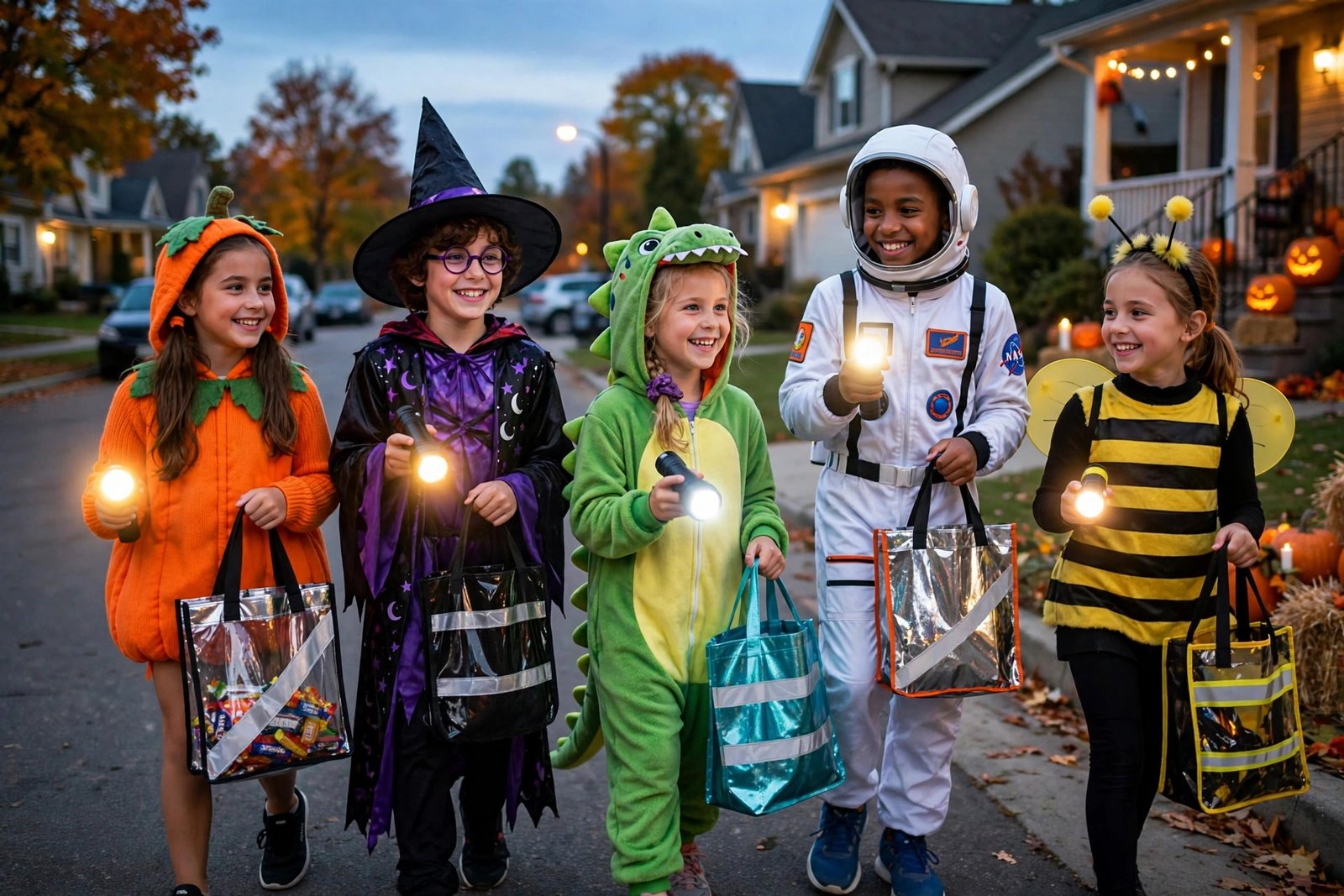
Visibility is the single most valuable upgrade you can make to any costume. Add reflective tape or stickers to the costume and the treat bag, choose light colors where you can, and give every child a flashlight or glow stick. The CDC’s Halloween safety guidance uses the memorable phrase that swords, knives, and other costume accessories should be short, soft, and flexible, and that children should fasten reflective tape to costumes and bags and hold a flashlight so others can see them. Glow bracelets are cheap, children love them, and drivers notice them. For very young children, a strip of reflective tape on a stroller or wagon helps drivers see the whole group, not just the older kids.
Fire safety belongs on the same checklist. Choose costumes labeled flame resistant, and keep children away from lit candles and luminaries. Battery-operated lights inside jack-o’-lanterns are the safer choice, and many police departments recommend them directly. Test makeup on a small patch of skin before the big night, and remove it before bedtime to avoid skin and eye irritation. Decorative contact lenses, which some older teens ask about, carry a real risk of serious eye injury and are best skipped.
Street smarts for kids and teens
Walk through the rules once, out loud, before the first house. Young children should always trick-or-treat with a trusted adult, and children under twelve should not be out alone at night. Older kids who are mature enough to go without an adult should stay in a group, stick to familiar and well-lit streets, and carry a phone with a charged battery. Everyone should walk, not run, from house to house, stay on sidewalks where they exist, and cross only at corners and crosswalks, looking both ways and making eye contact with drivers before stepping off the curb. If there is no sidewalk, walk on the far edge of the road facing traffic.
Two porch-light rules cover most of the rest. Only visit homes with a porch light on, which signals that the household is participating, and never enter a stranger’s house, even if invited inside. Children should stay on the porch or at the door, never go around to a back door or into a garage, and never accept a ride from a stranger. These rules sound strict on paper, but children accept them easily when they are framed as part of the game: lit porch means yes, dark porch means skip it, and the group stays together the whole route.
For teenagers, the conversation shifts slightly. Teens are more likely to be out later, in smaller groups, and in darker areas. Remind them that drivers may not see a dark costume until the last moment, that phones and headphones distract at crossings, and that a teen supervising younger siblings should know the route, the meeting point if the group splits, and a parent’s phone number.
Candy, allergies, and the treat check
When the bags come home, the ritual matters as much as the rules. Wait until you are home, in good light, and check everything before anyone eats. Discard anything unwrapped, opened, or homemade from a household you do not know, and throw away anything with torn packaging or signs of tampering. The CDC’s guidance is blunt on this point: only eat factory-wrapped treats. Wash hands before eating, and sort treats by child, so a younger child does not end up with hard candy, gum, peanuts, or small toys that pose a choking hazard.
Food allergies deserve their own plan. Read labels for the specific allergen, not just the brand, since fun-size versions can differ from full-size bars. If your child has a severe allergy, carry their epinephrine and make sure the supervising adult knows how to use it. Many neighborhoods take part in the Teal Pumpkin Project, where a teal pumpkin signals non-food treats are available — worth knowing whether your child has allergies or you want to be the house that offers them.
Advice for drivers on Halloween night
If you are driving on October 31, assume a child could step out at any moment. Slow down in residential neighborhoods, well below the posted limit, and be especially alert during the local trick-or-treat window, roughly the early evening hours when foot traffic peaks. Watch for children between parked cars, at curbs, and on medians, and remember that a child in a dark costume is visible much later than you expect. Turn on your headlights early, even before full dark, and put the phone away completely — a moment of distraction at neighborhood speed is enough to miss a small pedestrian.
Advice for homeowners handing out candy
Hosts have a safety role too. Keep your walkway, steps, and porch well lit and free of tripping hazards: extension cords, loose decorations, wet leaves, and low props that a small ghost cannot see. Keep candle-lit jack-o’-lanterns away from doorsteps, walkways, and curtains, or switch to battery-operated lights. Clear a path wide enough for a group, and if you have a dog, keep it secured away from the door, since even friendly dogs can startle children in costumes or slip out when the door opens repeatedly.
A lit porch is the universal signal that you are participating, so turn it on at the start of local hours and off when you are done. That simple signal helps children follow the route safely instead of knocking on dark houses, and teens in costume are still kids enjoying a tradition — a kind word costs nothing.
Trunk-or-treat and other safer alternatives
Not every family trick-or-treats door to door, and the alternatives have grown into traditions of their own. Trunk-or-treat events, where families decorate car trunks in a parking lot and children collect candy in one contained area, remove the street-crossing risk almost entirely and are popular with schools, churches, and community groups. Many towns also run Halloween festivals, haunted houses, and costume parades earlier in the day, which let younger children celebrate in daylight. If your neighborhood has heavy traffic, poor lighting, or long distances between houses, a trunk-or-treat or a daytime event may simply be the better fit — and there is no rule that says a family must choose only one.
Whatever format you choose, the same basics apply: stay in a group, stay visible, and know the plan for getting separated. The events that feel safest are the ones where adults planned the route, the lighting, and the ending time in advance — the fun is spontaneous, but the safety is not.
Frequently asked questions
What time is trick-or-treating in 2026?
There is no national time. Hours are set by your city or county, and in 2026 most announced windows fall between 5 p.m. and 8 p.m. on Saturday, October 31, with exact hours varying by town. Check your local police department or city website before Halloween night.
Do police really patrol on Halloween night?
Yes. Many departments run extra patrols during trick-or-treat hours, including operations where deputies patrol with overhead lights on to remind drivers to slow down. Extra patrols also mean help is nearby if a child gets separated.
Should children wear masks or face paint?
Face paint is the safer choice, because masks can block peripheral vision and hearing. If a child wears a mask, make sure the eye holes are large, the mask fits well, and it does not slip while walking.
Is it safe to eat candy collected while trick-or-treating?
Yes, once an adult has checked it. Eat only factory-wrapped treats, discard anything unwrapped, opened, or homemade from an unknown household, and check labels carefully if your child has food allergies.
Related reading
If you enjoy Halloween season in America, keep exploring. Our guide to Sleepy Hollow, New York, and the Headless Horseman follows the legend to its hometown, and our look at Salem, Massachusetts, in October explains how the town handles its famous Halloween crowds. For a quieter autumn trip, discover Bisbee, Arizona, and the Queen Mine, a genuine hidden gem.
Sources for this article include the Lafourche Parish Sheriff’s Office Halloween 2026 announcement, the Thibodaux Police Department’s 2026 safety tips, the U.S. Army’s Halloween safety guidance from Fort Leonard Wood, and the central Illinois 2026 trick-or-treat hours.