
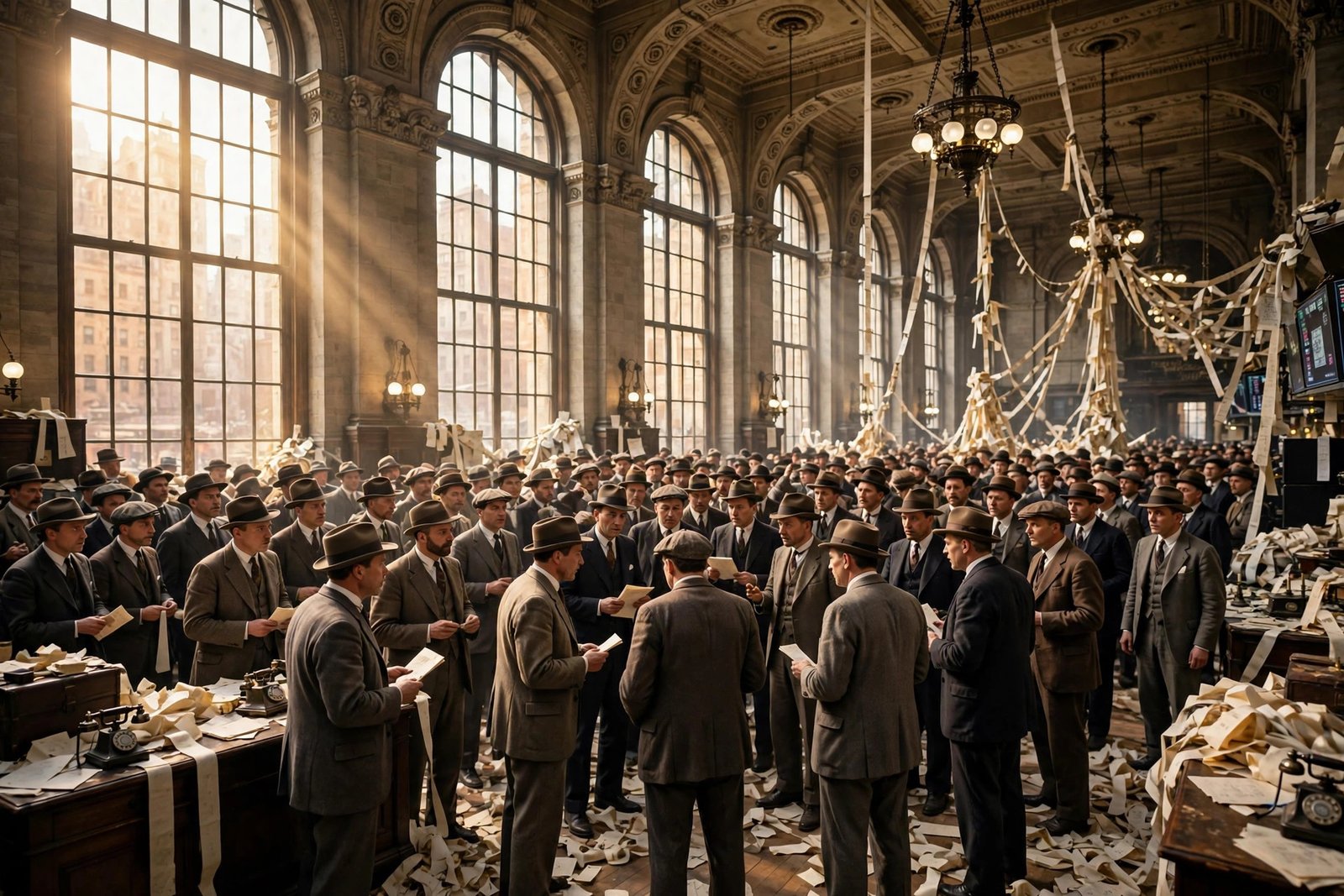
On Tuesday, October 29, 1929, the floor of the New York Stock Exchange turned into a scene Americans would remember for generations. Orders to sell poured in faster than anyone could handle them, prices fell in sickening lurches, and by the closing bell the day had earned a name that still sounds like a warning: Black Tuesday. It was not the first bad day of that terrible week, and it was not the last, but it became the shorthand for the whole crash. When people today say the market crashed in 1929, this is usually the day they mean.
Black Tuesday matters for a reason that goes beyond one day of trading. It marked the end of a decade of easy optimism and the beginning of the Great Depression, the deepest and longest economic downturn in modern American history. It also forced the country to rethink how markets should work, how banks should be supervised, and how ordinary savers should be protected. To understand what actually happened, it helps to separate the panic itself from the longer story around it, because the crash was both a dramatic event and a symptom of weaknesses that had been building for years.
The Roaring Twenties: A Boom Built on Confidence
The 1920s looked, from the outside, like a golden age. Factories were turning out cars, radios, and household appliances at a pace previous generations could hardly have imagined. Cities grew, wages for many workers rose, and new forms of entertainment, from jazz to the movies, filled American life with energy. The stock market became part of that story. Where investing had once seemed like a pursuit for the wealthy, it began to feel like something ordinary people could join, and newspapers carried daily market reports the way they carried sports scores.
That confidence was real, but it was also fragile. Share prices rose far faster than the underlying earnings of many companies could justify, and the higher prices climbed, the more people wanted in. Success bred imitation. Neighbors, coworkers, and friends talked about gains at the dinner table, and staying out of the market began to feel like missing out. Economists still debate exactly how much of the rise was speculation and how much reflected genuine growth, but there is little doubt that by the late 1920s, optimism itself had become a powerful force in the market.
Beneath the surface, warning signs were easy to miss if you were not looking for them. Farm prices had been weak for years, leaving many rural families struggling even while cities prospered. Housing and car sales had begun to soften by mid-1929, and steel production was cooling as well. None of that made a crash inevitable on its own. Together, though, these signs suggested that the economy was not as uniformly strong as the soaring stock market implied, and that a sharp correction would hurt more than it might have in healthier times.
Buying on Margin: How Ordinary Investors Took on Extraordinary Risk
One of the most important features of the 1920s market was margin buying, and it is essential to understanding why the fall was so violent. Buying on margin meant borrowing money from a broker to buy shares, putting up only a fraction of the purchase price yourself. If prices rose, the gains were magnified, because you controlled more stock than your own money could have bought. If prices fell, the losses were magnified in exactly the same way, and that is where the trouble began.
When prices dropped, brokers issued margin calls, demanding that investors deposit more money to cover their loans. Investors who could not pay were forced to sell, often at depressed prices, and those forced sales pushed prices down further, triggering more margin calls for other investors. It was a chain reaction. What began as a decline in a market full of borrowed money quickly turned into a scramble for cash, and the scramble itself became part of the crash. Understanding margin helps explain why Black Tuesday felt less like an orderly repricing and more like a stampede.
From Black Thursday to Black Tuesday: A Week of Panic
The crash did not arrive all at once. The market had peaked on September 3, 1929, when the Dow Jones Industrial Average closed at 381.17, and prices had already begun to slip in the weeks that followed. The real panic began on Thursday, October 24, known as Black Thursday, when a record of about 12.9 million shares changed hands on the New York Stock Exchange and prices plunged at the open. A group of leading bankers stepped in to buy shares above market prices in an effort to restore confidence, and the market recovered much of its early loss by the close. For a brief moment, it looked as though the worst might be over.
It was not. When trading resumed on Monday, October 28, the selling returned with even greater force. The Dow fell by about 12.8 percent that day, a record loss at the time, as margin calls and fear fed on each other. There was no coordinated rescue this time that could hold the line. Investors who had hoped Thursday was a one-day scare now faced the possibility that the decline was something larger, and many decided to sell while they still could. That decision, repeated by thousands of people at once, made the decline worse.
Then came Black Tuesday, October 29, 1929. About 16.4 million shares were traded, shattering the previous record, and the Dow fell by about 12 percent, roughly 30.6 points. Contemporary estimates put the paper wealth lost that day at more than 14 billion dollars, an enormous sum in 1929. The ticker tape, which reported trades, fell hours behind, leaving investors in the dark about the prices their orders were actually getting. By the end of the day, the sense that the market had broken was unmistakable, even if the full economic consequences would take months and years to unfold.
Why a Market Crash Became a Depression
It is tempting to say that the stock market crash caused the Great Depression, but historians are careful about that claim, and for good reason. The crash destroyed wealth and shattered confidence, but the Depression that followed was driven by a chain of additional failures. Banks, many of which had lent heavily or invested in securities, came under pressure as loans went bad and depositors rushed to withdraw their money. When a bank failed, its depositors often lost their savings outright, because there was no federal deposit insurance yet. Each failure made the next panic more likely.
As banks failed and credit dried up, businesses cut back, factories slowed, and workers lost jobs. With less income, families spent less, which hurt businesses further, and the cycle deepened. International trade also contracted sharply in the early 1930s, partly because countries raised tariffs to protect their own producers, a policy that ended up shrinking markets for everyone. The Smoot-Hawley Tariff Act, passed in 1930, is often cited in this context, not as the sole cause of the Depression, but as an example of how defensive policies can make a bad downturn worse.
The Federal Reserve’s role remains one of the most debated parts of the story. Critics argue that the central bank tightened policy too much in the late 1920s and then failed to provide enough support to banks in the early 1930s, allowing deflation and bank panics to spread. Defenders note the constraints the Fed faced at the time, including the gold standard and a limited set of tools. What is clear is that the crash exposed how little protection the financial system offered ordinary people when panic took hold, and that lesson shaped the reforms that followed.
What Black Tuesday Actually Changed
If Black Tuesday changed anything permanently, it changed the rules of American finance. Before the crash, federal regulation of securities markets was minimal, and disclosure by companies issuing stock was inconsistent at best. After the crash and the Depression, Congress moved, step by step, to build a framework that still shapes Wall Street today. The Securities Act of 1933 required better disclosure when securities were offered to the public, so investors could judge what they were buying on more than rumor and enthusiasm.
The Banking Act of 1933, better known as the Glass-Steagall Act, separated commercial banking from investment banking and created the Federal Deposit Insurance Corporation, or FDIC. The idea was straightforward: a bank that holds ordinary people’s deposits should not be gambling those deposits on speculative securities deals. Deposit insurance, which began with a modest limit and grew over time, was meant to stop the bank runs that had turned local failures into national panics. The Securities Exchange Act of 1934 then created the Securities and Exchange Commission, the SEC, to police the markets, enforce disclosure, and punish fraud.
The New Deal went further, with programs aimed at relief for the unemployed, recovery for the economy, and reform of the institutions that had failed. Social Security, public works, and new labor protections all belong to this broader response, even though they were not direct answers to the crash itself. Together, these changes reflected a new assumption: that markets need rules, that savers deserve protection, and that the government has a role in steadying the economy when private confidence collapses. That assumption, debated ever since, was born in the wreckage of 1929.
Myths About Black Tuesday Worth Letting Go
Popular memory has added a few myths to Black Tuesday that deserve a second look. One is that the crash instantly made the whole country poor overnight. In reality, the Depression deepened gradually, with unemployment and hardship rising over the following years rather than appearing in a single day. Another is that everyone in America owned stocks and lost everything. In fact, stock ownership in 1929 was far less widespread than it is today, concentrated among wealthier households, though the economic damage spread far beyond shareholders through bank failures, job losses, and falling incomes.
A related myth is that the market never recovered, or that the crash proved investing itself was a fool’s game. The market did eventually recover, though it took a long time: the Dow did not regain its September 1929 peak until the mid-1950s, and it fell to about 41.22 in July 1932, roughly 89 percent below its peak. That long road back is itself a lesson. Markets can fall much further, and stay down much longer, than impatient investors expect, which is why diversification, patience, and an honest assessment of risk matter more than chasing the hottest stock of the moment.
Lessons That Still Matter Today
Black Tuesday still gets taught in schools and cited in news coverage of market sell-offs because its lessons have not expired. Borrowed money magnifies both gains and losses, and leverage that feels harmless in a rising market can become dangerous very quickly when prices turn. Crowd psychology matters too: when everyone is selling at once, prices can fall far below what any calm analysis would suggest, and the fear of being last out the door can be self-fulfilling. Modern safeguards such as circuit breakers, which pause trading after sharp falls, and margin requirements, which limit how much investors can borrow, were designed with episodes like 1929 in mind, even if they cannot prevent every decline.
Perhaps the most durable lesson is about the difference between a market event and an economic event. A crash is measured in points and percentages. A depression is measured in lost jobs, closed banks, shuttered farms, and families cutting back on necessities. Black Tuesday became historic because it connected those two worlds: a panic on a trading floor helped set in motion years of hardship far from Wall Street. Remembering that connection is a reminder to look past the daily market headlines and ask what is happening in the real economy underneath them, and who bears the cost when confidence breaks.
Frequently Asked Questions
What exactly was Black Tuesday?
Black Tuesday was October 29, 1929, the worst day of the 1929 Wall Street crash. About 16.4 million shares were traded on the New York Stock Exchange, and the Dow Jones Industrial Average fell by about 12 percent. It followed sharp falls on Black Thursday, October 24, and Black Monday, October 28, and it became the popular symbol of the crash that preceded the Great Depression.
Did Black Tuesday cause the Great Depression?
The crash helped trigger the Depression, but it did not cause it alone. Bank failures, a contraction in credit, falling spending, deflation, and policy mistakes in the United States and abroad all deepened and prolonged the downturn. Historians generally describe the crash as a catalyst that exposed and worsened weaknesses already present in the economy and the financial system.
How far did the stock market fall after 1929?
The Dow Jones Industrial Average peaked at 381.17 on September 3, 1929, and fell to about 41.22 on July 8, 1932, a decline of roughly 89 percent from the peak. It did not regain its 1929 high until the mid-1950s, which shows how long a severe bear market can last even after the initial panic passes.
What reforms followed the crash?
Congress passed the Securities Act of 1933, the Banking Act of 1933, known as Glass-Steagall, which created the FDIC and separated commercial and investment banking, and the Securities Exchange Act of 1934, which created the SEC. Together with broader New Deal programs, these reforms aimed to improve disclosure, protect depositors, and police fraud in the securities markets.
Related reading
If you enjoy American history, keep exploring stories from this site:
- The Great Molasses Flood of 1919 in Boston
- The Pony Express and its short, legendary run
- The Tuskegee Airmen and the Red Tails of World War II
For further reading, see the Investopedia explainer on Black Tuesday, the Federal Reserve History account of the Banking Act of 1933, and the overview of the Wall Street crash of 1929.