
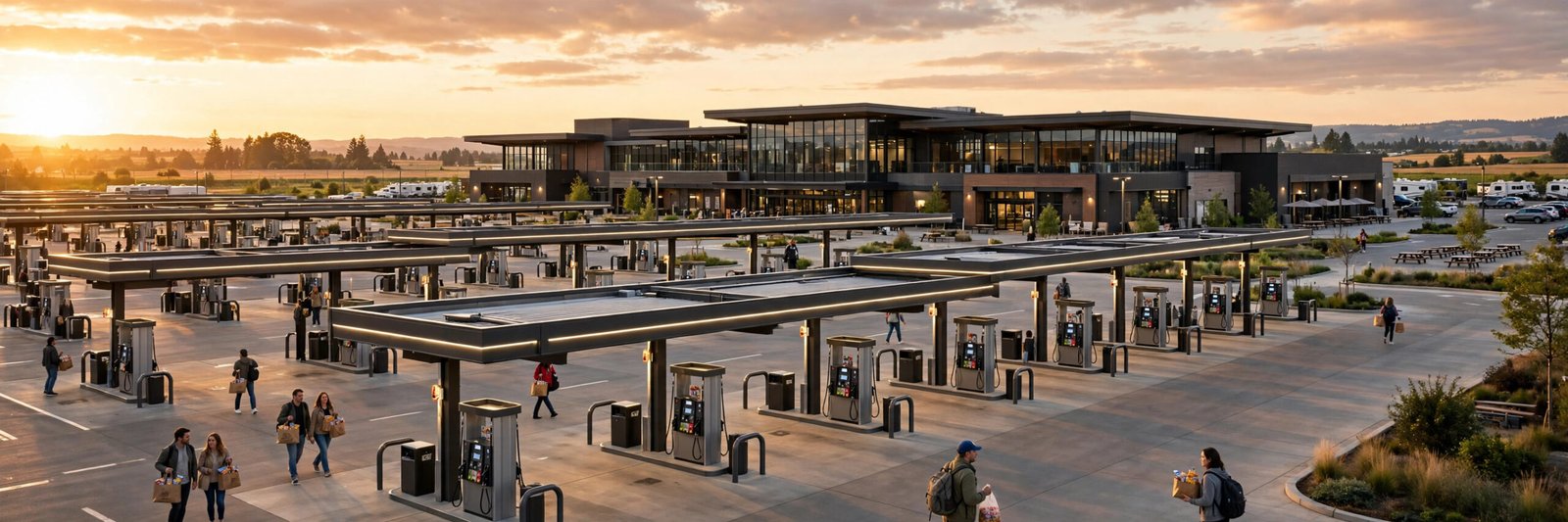
Ask Americans about their great road trips and they will not start with the Grand Canyon. They’ll start with a gas station: the jerky wall in Texas, the boiled peanuts steaming in a crockpot somewhere off a Georgia two-lane, the cheese curds from a Wisconsin dairy case, the moment a road-weary family first walked into a Buc-ee’s and realized the bathroom had more stalls than their high school. The great American road trip runs on snacks — and the culture around them says more about this country than any souvenir stand. Buckle up. We’re making a few stops.
Stop One: The Regional Snack Map of America
America’s highways are a patchwork of snack loyalties, and locals can navigate by them. Road food scholars — a title every road-tripper earns eventually — know the map by heart:
- The South: Boiled peanuts sold from roadside stands and gas station crockpots, pork rinds, fried pies, and sweet tea by the gallon. In Texas, add a jerky counter and kolaches — the Czech-Texan pastries that became a highway staple.
- The Midwest: Cheese curds (squeaky or it doesn’t count), puppy chow, caramel corn, and in convenience-store country, the breakfast pizza and roller-grill taquitos that fuel a thousand commutes.
- The Northeast: Whoopie pies in Maine and Pennsylvania, salt water taffy near the shore, and coffee — always coffee — from the region’s beloved chains.
- The Mountain West and Southwest: Green chile everything in New Mexico, piñon candy, dried chile mango, and jerky in flavors from teriyaki to ghost pepper.
- The Pacific Coast: Dried fruit and nuts from orchard stands, sourdough, and roadside espresso shacks in the Northwest that turned gas-station coffee into an art form.
Layered over the regionals is the universal canon: sunflower seeds for the driver (spitting shells into a cup is a genuine road skill), beef jerky for the long empty stretches, a fountain soda the size of a toddler, and the sacred front-seat compromise bag — something sweet, something salty, something nobody admits to liking that somehow vanishes first.
Stop Two: The Beaver Empire — Buc-ee’s Changes the Game
Then there is the phenomenon that rewired the whole culture: Buc-ee’s, the Texas-born chain whose mascot is a grinning beaver and whose travel centers operate less like gas stations than like snack theme parks.
The origin story is pure Texas. In 1982, Arch ‘Beaver’ Aplin III opened the first Buc-ee’s near Lake Jackson, Texas — the name blending his childhood nickname with his Labrador, Buck. For two decades it was a well-loved regional convenience store chain. The transformation came in 2003, when Buc-ee’s opened its first full travel center in Luling, Texas, and discovered the formula: enormous stores, armies of fuel pumps, spotless restrooms as the headline attraction, no 18-wheelers, and food worth stopping for.
The numbers now strain belief. The current Luling store — a replacement that opened in June 2024 on the same site as the 2003 original — spans 75,593 square feet with 120 fueling positions, making it the largest convenience store in the world, a title it reclaimed from Buc-ee’s own Sevierville, Tennessee location (74,707 square feet); the chain’s New Braunfels store runs 66,335 square feet, as KSAT reported at the Luling opening. Inside: a jerky wall with dozens of varieties, a fudge counter, roasted nuts glazed in-store, kolaches, a brisket station where the call of ‘Fresh brisket on the board!’ rings out as sandwiches are carved to order — and the signature snack, Beaver Nuggets, sweet caramel-coated corn puffs that fans buy by the armload. The chain has grown to around 50 locations across Texas and the South and Southeast, each opening treated by locals as a civic event.
What Buc-ee’s understood is that on a long drive, the stop is not an interruption of the trip. Done right, it’s a highlight of it — a clean, bright, faintly ridiculous palace of snacks where a family can stretch, refuel everything, and leave with a bag of things they didn’t know they needed. Critics note you can lose an hour in there. Fans consider that the point.
Stop Two-and-a-Half: The Cult Chains
Buc-ee’s is the loudest phenomenon, but not the only one. America’s highways are dotted with regional chains whose snack stops inspire denominational loyalty. In the Mid-Atlantic, Wawa devotees and Sheetz loyalists argue about made-to-order hoagies and touch-screen food counters with the energy of sports fans. In Iowa, Casey’s built an empire partly on gas-station pizza so beloved it became one of the country’s notable pizza sellers by location count. In Wisconsin, Kwik Trip’s fresh donuts, bananas and bargain milk have made it a wholesome regional treasure. Out West, Maverick and Jacksons compete on fountain drinks and adventure branding.
These loyalties look silly from the outside and feel entirely rational from the driver’s seat. On a thousand-mile drive, a known clean restroom, a known good sandwich and a known snack shelf at 2 a.m. are not trivial comforts — they are infrastructure for morale. The chains that earn cult status all cracked the same code Buc-ee’s cracked at mega-scale: take the stop seriously, respect the traveler, and sell at least one thing people will cross the street — or the state — to get.
Stop Three: What the Snack Run Says About America
Step back and the gas-station snack run reveals itself as a small, perfect piece of American folk culture. The interstate highway system — authorized in 1956 — created the road trip as mass experience, and the convenience store grew up alongside it, evolving from an afterthought pump and a Coke machine into today’s travel centers. The ritual, though, has stayed constant across generations: the driver scans the aisles like a general, kids negotiate treat treaties, somebody always buys the novelty candy, and the car pulls out smelling faintly of jerky and anticipation.
It also captures something true about American regional identity in an age of sameness. Chain stores may look alike from Maine to California, but the snack aisle keeps stubborn local accents — boiled peanuts only in the South, squeaky curds only in dairy country, green chile only where green chile belongs. Tasting your way across the map is the cheapest culinary tour in America, available at every exit.
And there is the Buc-ee’s lesson, which the whole industry has absorbed: travelers reward anyone who takes the humble pit stop seriously. Clean bathrooms, hot food, local flavor and a little theater turned a chore into a destination — and turned a beaver into one of the most beloved mascots in American retail. As The Sun reported, even running the Luling mega-store costs a fortune in electricity alone; the crowds keep coming anyway.
The Rules of the Road Snack (Unofficial, Universally Enforced)
- The driver picks the music; the passengers pick the snacks. Democracy ends at the steering wheel and resumes at the chip aisle.
- Never trust a road trip with no crumbs. A clean car at the border means somebody didn’t live.
- Buy the local thing. If the snack exists only in this state, it goes in the bag. This is not shopping; it is field research.
- The weird flavor is mandatory. Limited-edition pickle-chili-churro chips exist for exactly one purpose: group debate at 70 miles per hour.
- One emergency snack stays sealed. Traffic jams, detours and closed exits respect the traveler who kept a reserve bag.
Even Buc-ee’s famously spotless restrooms are part of the legend — the chain built its reputation by treating the highway bathroom, historically the lowest moment of any road trip, as a headline attraction, with attendants, art on the walls and stalls by the dozen; one of its stores was even honored in a national best-restrooms contest years before the mega-stores arrived. Travelers plan fuel stops around it. That is the deepest shift in the culture: the gas station is no longer where the trip pauses. Increasingly, it’s where the trip poses for photos.
One more quiet revolution deserves a line: the fountain drink. Somewhere along the way, the road-trip soda grew from a can to a cup to a refillable thermos the size of a fire extinguisher, priced to encourage loyalty and sized to survive two states. Regional chains compete on ice — the good crunchy kind has passionate defenders — and on proprietary drink names their fans order like passwords. It is a small thing, a cup of soda. But watch a family emerge from a travel center at dusk, drinks sweating, snack bags rustling, a fresh bag of ice thumping into the cooler, and you are watching the American road trip in its natural habitat: provisioned, optimistic, and still a hundred miles from anywhere.
The Last Word From the Passenger Seat
Every road tripper has a hierarchy: the snacks they’d drive out of the way for, the regional treat they stockpile when passing through, the gas station they’d defend in an argument. That loyalty — fierce, specific and only half-ironic — is the real story here. America’s highways were built to move people from place to place. The snack culture that grew along them turned the spaces in between into places of their own.
So on your next long drive, take the exit. Try the thing you’ve never heard of. The destination will wait — it always does. Dinner is at the end of the road, but the memories are increasingly at the gas station.