
America’s national park count just changed. On October 20, 2026, Chiricahua National Monument in southeastern Arizona was officially redesignated as Chiricahua National Park, bringing the total number of national parks in the United States to 64. It is the country’s first new national park in six years, since New River Gorge in West Virginia joined the list in December 2020, and it is Arizona’s fourth national park, alongside the Grand Canyon, Saguaro, and Petrified Forest. If you have been saying America has 63 national parks, it is time to update the number — and to meet the park that changed it.
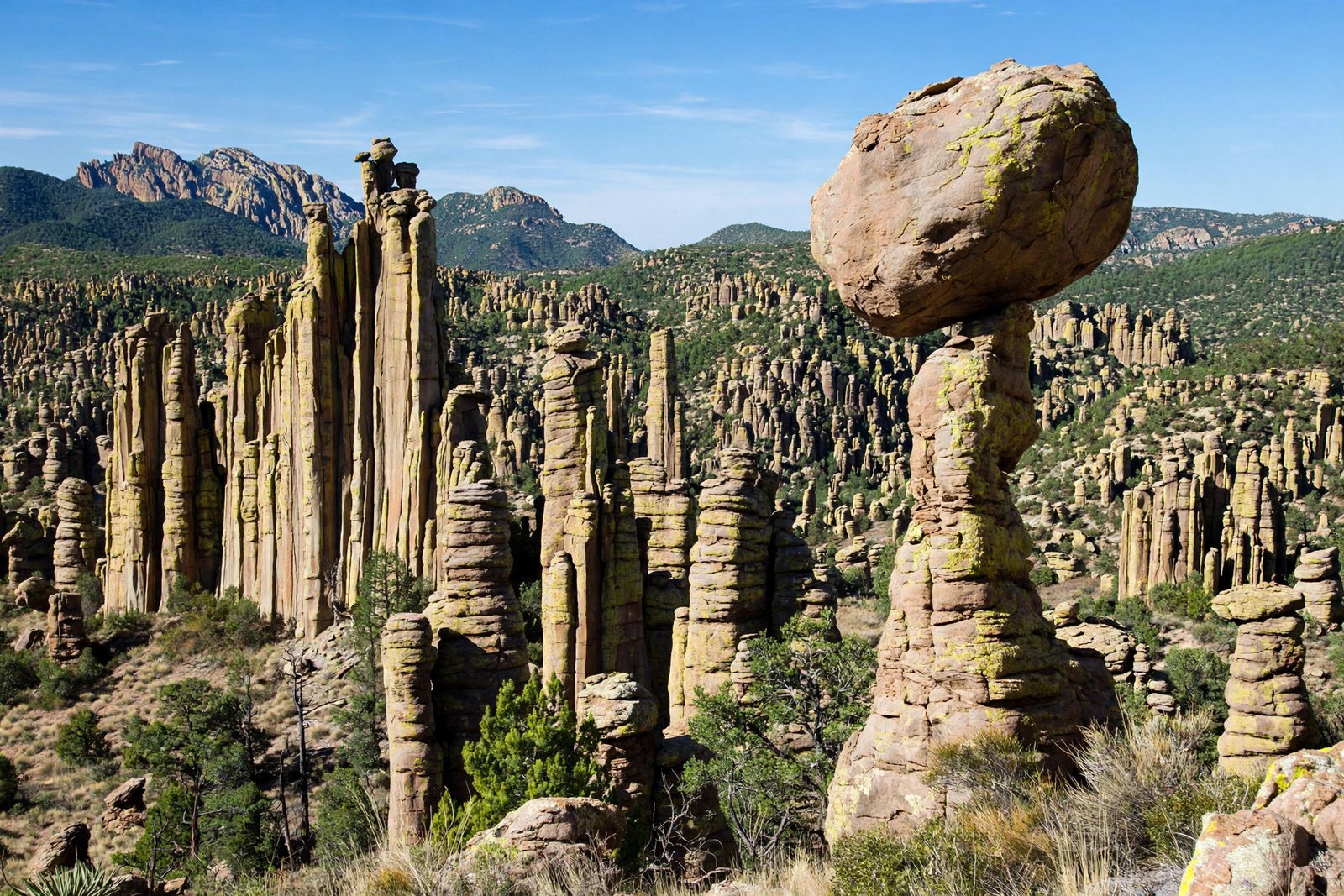
Chiricahua is nicknamed the Wonderland of Rocks, and the name fits. The park protects a landscape of towering rhyolite pinnacles and balanced rocks, formed by an ancient volcanic eruption and sculpted by millions of years of erosion into spires, columns, and impossible-looking stacks. It has been a national monument since 1924, so the land itself is not new to protection — what changed is its status, its profile, and, local businesses hope, its visitor numbers. In 2025, the monument welcomed about 70,400 visitors, a modest figure that ranks it far below the giants of the system. National park status is expected to change that.
What Chiricahua actually is
Chiricahua sits in the Chiricahua Mountains, one of the Southwest’s sky islands — isolated mountain ranges that rise from the surrounding desert of southeastern Arizona and northern Mexico. The park covers about 12,000 acres, and its elevation range creates a remarkable meeting of worlds: desert, grassland, and mountain forest stacked on top of each other, with species from Mexico reaching their northern limits and species from the Rocky Mountains reaching their southern ones. That mixing is why the park’s biodiversity stands out far beyond its size.
The park is home to nearly 200 species of birds, which makes it a pilgrimage site for birdwatchers, and its plant and animal life reflects thousands of years of human history too. People have lived in and moved through these mountains for millennia, and the park protects that heritage alongside its geology. The National Park Service describes the landscape as a collection of rhyolite pinnacles and balanced rocks, and the most famous formations have names that hint at their shapes: the Organ Pipes, the balancing rocks of the Echo Canyon area, and the towering spires along the Heart of Rocks loop.
The legislation making Chiricahua a national park, the Chiricahua National Park Act, was signed into law on October 20, 2026. The redesignation changes the park’s title and its standing in the system, but it keeps everything else the same: the same boundaries, the same trails, the same campground. That is normal for redesignations. What changes is attention. National parks are the most famous tier of the National Park System, and the title alone draws travelers who might never have heard of a national monument.
Why the number matters
The National Park System is much larger than the national parks alone. It contains more than 430 units covering over 85 million acres, including national monuments, historic sites, recreation areas, seashores, and battlefields. Only the units carrying the National Park title — now 64 of them — sit in the top tier that most travelers mean when they say national park. The 63 number held from December 2020, when New River Gorge was upgraded, until October 2026, and it became a familiar fact in guidebooks, trivia games, and road-trip checklists.
The parks are spread across 30 states and two territories, with California holding the most at nine. The newest park before Chiricahua was New River Gorge, preceded by White Sands and Indiana Dunes in 2019 and Gateway Arch in 2018. Chiricahua breaks a six-year gap, and it does so as a redesignation rather than a brand-new unit — the same path that White Sands and Indiana Dunes took from monument and lakeshore to national park. Redesignation is a recognition that a place already protected deserves the system’s highest profile.
For travelers, the count is more than trivia. The national parks are the system’s biggest draws, and their popularity shapes everything from gateway town economies to reservation systems. In 2025, the top parks drew staggering numbers: Great Smoky Mountains, shared by Tennessee and North Carolina, led with 11,527,939 recreation visits, more than double any other park, followed by Zion at 4,984,525, Yellowstone at 4,762,988, Grand Canyon at 4,430,653, and Yosemite at 4,278,413. Chiricahua, with its roughly 70,400 visitors in 2025, enters the list at the other end of the scale — which is exactly why now is a good time to visit, before the crowds catch up.
What to do at Chiricahua
The park’s signature experience is hiking among the rock formations. The Echo Canyon Loop, about three and a half miles, winds through grottos, balanced rocks, and narrow passages between towering pinnacles, and it is the best single introduction to the Wonderland of Rocks. The Heart of Rocks Loop, longer and more strenuous, reaches the park’s most famous balanced formations. The Massai Point overlook, accessible by car, gives a sweeping view of the rock sea below and is the easiest way to grasp the scale of the place.
Chiricahua is also an International Dark Sky Park, which means its night skies are protected and spectacular. The National Park Service suggests stargazing from Massai Point and the Echo Canyon trailhead, and the park’s remote location in southeastern Arizona keeps light pollution low. If you visit in November, the same dark skies that make the Beaver Supermoon and the Leonid meteor shower special elsewhere are on full display here, with the Milky Way and the winter constellations rising over the pinnacles.
Birdwatching is the park’s quiet superpower. Nearly 200 bird species have been recorded here, and the park’s position at the meeting of desert and mountain ecosystems draws species that are rare or absent elsewhere in the United States. Spring and fall migration are the best times, but the park rewards patient birders year-round. Bring binoculars, walk quietly on the lower trails at dawn, and check the visitor center for recent sightings.
Planning a visit before the crowds
Chiricahua’s practical details have not changed with its new title, and that is part of its current charm. The park has a single campground with 26 sites, which means overnight stays require planning, especially once national park status brings more visitors. There is no lodge inside the park, and the nearest towns are small, so visitors typically base themselves in Willcox, about 35 miles away, or in the surrounding Cochise County communities. The park is remote by design: the drive in, through desert grassland and up into the mountains, is part of the experience.
The best times to visit are spring and fall, when temperatures are mild and the trails are at their best. Summer brings heat at lower elevations and afternoon thunderstorms, though the higher trails stay cooler. Winter can bring snow to the upper elevations, which makes the rock formations even more photogenic but can close the higher roads and trails. Check the park’s current conditions before you go, and carry more water than you expect: desert mountain hiking is deceptive, and the dry air hides how much you are losing.
Local businesses, outdoor groups, and politicians have hoped for years that national park status would bring more visitors, and the designation is expected to deliver exactly that over time. The park service has not published a forecast for the increase, and the park’s single small campground is one reason some observers urge caution: Chiricahua is not yet built for Great Smoky Mountains numbers, and its appeal depends partly on its quiet. Visiting soon, traveling lightly, and respecting the park’s limits is the best way to enjoy the newest national park while it is still a discovery.
The bigger picture: how parks are made
Chiricahua’s story is a useful reminder of how America’s national parks actually come to be. Few parks are created from scratch. Most begin as national monuments, protected by presidential proclamation, or as other units of the system, and earn the national park title later, when Congress decides they deserve the system’s highest recognition. The title brings funding, staffing, and attention, but the land and its protection usually predate the title by decades — in Chiricahua’s case, by more than a century, since 1924.
That history also explains why the count changes slowly. Between 2020 and 2026, no new park was added, and the debate over which places deserve the title is always political as well as scientific. Supporters point to Chiricahua’s geology, biodiversity, and human history; skeptics of rapid expansion point to the Park Service’s maintenance backlog and the strain that popularity puts on fragile places. Both concerns are real, and both are part of the story of every new park. Chiricahua enters the list with both its wonders and its challenges intact.
For now, the fact stands: America has 64 national parks, and the newest one is a wonderland of rocks in southeastern Arizona that most Americans have never heard of. That is a good reason to learn its name, and a better reason to go and see it.
Frequently asked questions
How many national parks does the United States have now?
64. Chiricahua National Park in Arizona, redesignated on October 20, 2026, is the newest, bringing the total from 63 to 64. It is Arizona’s fourth national park.
What was America’s newest national park before Chiricahua?
New River Gorge in West Virginia, designated in December 2020. White Sands (2019), Indiana Dunes (2019), and Gateway Arch (2018) came just before it.
What is the most visited national park?
Great Smoky Mountains National Park, shared by Tennessee and North Carolina, with 11,527,939 recreation visits in 2025 — more than double any other park.
Has Chiricahua changed since becoming a national park?
No. The redesignation changes the park’s title and profile but keeps its boundaries, trails, and facilities the same. It still has one campground with 26 sites, and its 2025 visitation was about 70,400.
Related reading
For more American landscapes, read Hocking Hills, Ohio, and its waterfalls, the wild ponies of Assateague and Chincoteague, and where to see Florida manatees in winter.
Sources for this article include Smithsonian Magazine’s report on Chiricahua’s designation, EarthSky’s report on the 64th national park, and Fox Weather’s 2025 most-visited national parks list.