
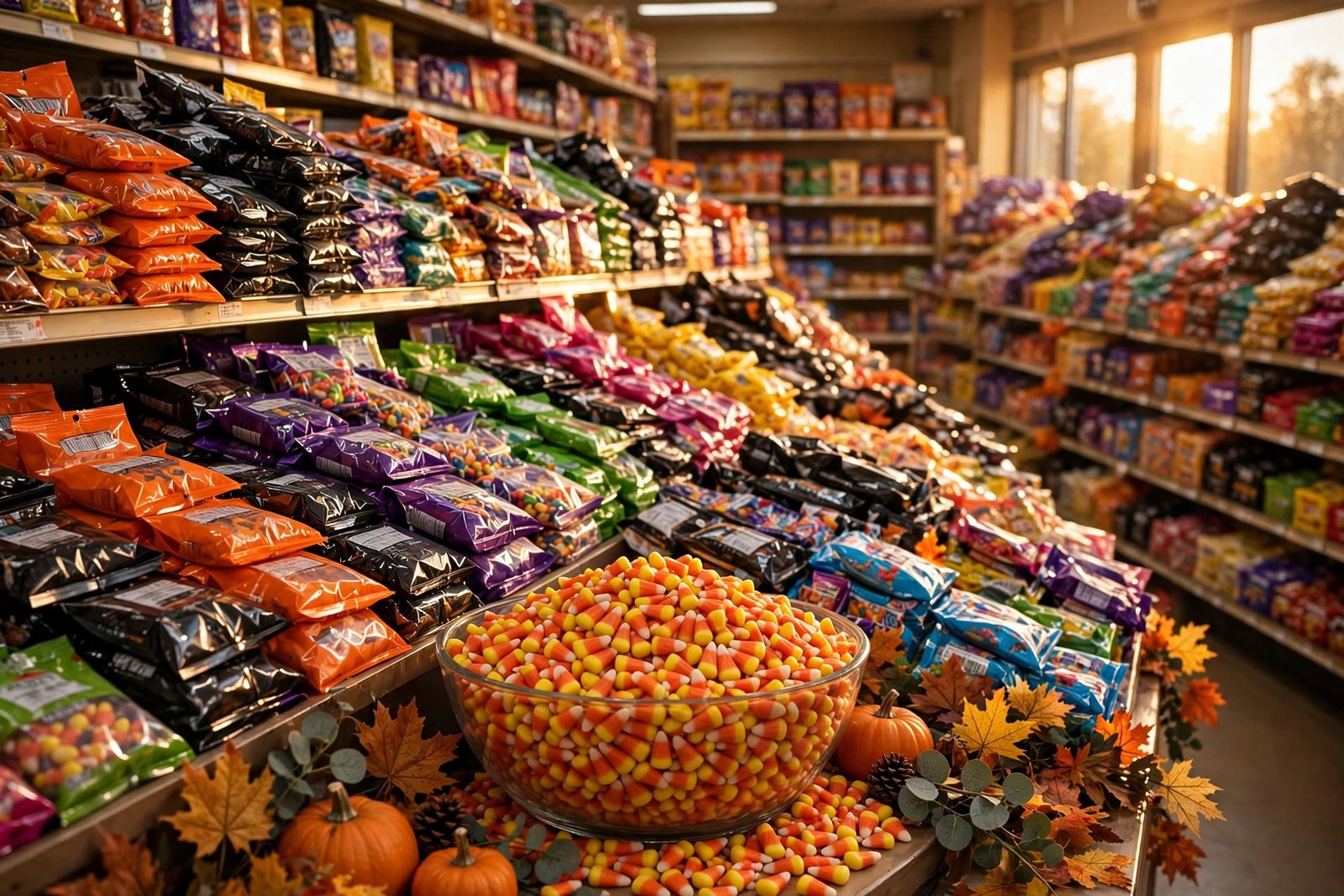
Today, October 30, is National Candy Corn Day — the one day of the year set aside for the most argued-about candy in America. Tomorrow night, millions of trick-or-treat bowls will fill up with chocolate bars, gummies and lollipops, but no single piece of candy will start more arguments than the little tri-colored kernel that half the country adores and the other half loves to complain about.
Behind the jokes sits a serious business. Halloween has grown into one of the biggest candy events on the American calendar, and candy corn — a candy invented in the 1880s — still moves by the tens of millions of pounds every single year. Here is the story of how a humble farm-themed candy became a Halloween institution, and what the numbers say about America’s sweet tooth in 2026.
A Record Year for Halloween Spending
The National Retail Federation’s annual Halloween survey, conducted by Prosper Insights & Analytics each September, projects that Americans will spend a record $13.5 billion on Halloween in 2026, up from $13.1 billion last year. The average person celebrating expects to spend $115.14, a small increase over 2025’s $114.45.
Candy is the beating heart of that total. The NRF expects candy sales of about $4.1 billion this season, and an overwhelming 96 percent of Halloween shoppers say they plan to buy candy — making it the most widely purchased category of the holiday, ahead of costumes ($4.4 billion) and decorations ($4.3 billion). You can read the full breakdown in the NRF’s 2026 Halloween survey announcement.
Shoppers are paying more for those treats than they used to. According to the Bureau of Labor Statistics, prices for candy and chewing gum were up 7.7 percent in September 2026 compared with a year earlier — roughly double the overall inflation rate. A standard 100-piece bag of assorted Halloween candy now averages around $16.96. Even so, surveys show most families are absorbing the higher prices rather than skipping the candy aisle, and many are hunting for coupons, warehouse-club deals and early-season sales to soften the bill.
The Strange History of Candy Corn
Candy corn is far older than Halloween trick-or-treating itself. According to candy historians, it was created in the 1880s by George Renninger, a candymaker at the Wunderle Candy Company in Philadelphia. Renninger worked in an era when American confectioners were fascinated with molded candies shaped like everyday objects — turnips, chestnuts, clover leaves and other farm imagery were all the rage in a still heavily agricultural nation.
His tri-colored kernel, with its broad yellow base, orange center and white tip, was designed to look like a kernel of corn. The Goelitz Confectionery Company — the firm known today as the Jelly Belly Candy Company — took up production around 1898 and carried the candy nationwide. In its earliest days it was not even called candy corn. It was sold as “Chicken Feed,” a name that made sense at a time when corn was widely regarded as food for livestock rather than people, and the boxes reportedly carried the slogan “Something worth crowing for.”
For decades, candy corn was a general autumn and harvest candy sold from spring through fall, not a Halloween exclusive. Its marriage to October 31 came in the mid-twentieth century, when trick-or-treating became a national tradition and candy companies began marketing their products directly for the holiday. A harvest-colored candy was a natural fit, and it has never left the Halloween lineup since. The Farmers’ Almanac’s candy corn history walks through more of the trivia, including how the original kernels were poured by hand, layer by layer, from large buckets.
35 Million Pounds of Kernels
The scale of candy corn production is genuinely astonishing for a candy so many people claim to dislike. The National Confectioners Association has long estimated that manufacturers produce roughly 35 million pounds of candy corn each year — the equivalent of about 9 billion individual kernels. Laid end to end, that is enough candy to circle the moon many times over.
Brach’s is the largest candy corn maker today, producing the majority of the supply sold in the United States, while Jelly Belly continues to make it using a recipe descended from the original. Modern machines pour the three layers into cornstarch molds at enormous speed, but the essential process — three separate pours, one for each color — would still be recognizable to Renninger’s generation. Production ramps up months before Halloween, because nearly all of those 35 million pounds sell in a few short autumn weeks.
The Great Candy Corn Debate
Few foods inspire opinions this strong. Candy corn regularly appears near the top of “favorite Halloween candy” polls conducted by candy retailers — and simultaneously near the top of “worst Halloween candy” lists. Both things are true at once, which is exactly why the debate never dies.
Team Candy Corn
- It tastes like childhood: a mellow, honey-vanilla sweetness unlike anything else in the candy aisle.
- It is only widely available for a few weeks a year, which makes it feel like a genuine seasonal ritual.
- Mixed with peanuts, it famously mimics the flavor of a salted nut candy bar — a combination with a devoted following.
- It is fat-free per serving, a point defenders raise with surprising frequency.
Team Never Again
- The texture strikes critics as waxy, chalky or stale, even when it is fresh.
- The flavor is, to detractors, simply “sweet” with nothing behind it.
- Its defenders cannot be trusted, because the same people often eat it one kernel layer at a time, which critics consider a red flag in itself.
There is even a secondary argument about the correct way to eat it: nibble the white tip first, or start at the wide yellow end? The candy was designed to be eaten like real corn in miniature, but polls on the question tend to end friendships rather than settle them.
How America Actually Buys Halloween Candy
Beyond candy corn, the way Americans stock up for October 31 has become a small economy of its own. Retailers now roll out Halloween candy displays as early as August, and industry groups note that the Halloween season, together with Christmas, Valentine’s Day and Easter, accounts for roughly two-thirds of all seasonal confectionery sales in the United States, according to the National Confectioners Association.
Chocolate remains the single most popular handout in most surveys, with candy corn, gummies and hard candies fighting for the next spots depending on the year and the poll. What has changed is the basket: variety bags keep growing, households increasingly buy a separate stash “for the house” in addition to the trick-or-treat supply, and a growing share of candy is bought online or through grocery delivery rather than in a store aisle.
How Candy Corn Is Made
For a candy with only three colors, candy corn is surprisingly labor-intensive — which is why it stayed a handmade specialty for so long. In Renninger’s day, workers called “stringers” walked backwards along rows of trays filled with cornstarch molds, pouring hot slurry from large buckets in three passes: white first, then orange, then yellow, building each kernel layer by layer. The molds were pressed into the cornstarch with a wooden board carved with kernel impressions, and a single worker might produce hundreds of pounds in a day of exhausting, repetitive labor.
Modern factories use machines based on the old “Mogul” starch-molding system, which performs the same three pours at industrial speed, but the fundamentals have barely changed in more than a century. The candy itself is what confectioners call a mellow creme — mostly sugar and corn syrup with a fondant-like body — which explains both its distinctive soft chew and its talent for dividing the population. The recipe’s keeping qualities were part of its genius: candy corn stayed fresh through a long selling season in an era before modern packaging, which helped it spread from Philadelphia to candy counters nationwide.
The Flavor Experiments
Success breeds spin-offs, and candy corn has had plenty. Brach’s and other makers have produced seasonal siblings over the years — red-and-white kernels for Valentine’s Day, pastel versions for Easter, red-and-green “reindeer corn” for Christmas, and autumn specialty flavors that lean into pumpkin spice and caramel apple. There is even a Thanksgiving-themed variant that has become a social-media punchline in its own right. Almost none of them dent the original’s dominance. The classic tri-color kernel, sold in the classic October window, remains the one that matters — a reminder that in the candy business, scarcity plus nostalgia is a flavor all by itself.
Why Candy Corn Is Not Going Anywhere
Here is the thing about the great candy corn debate: it is free advertising. Every October, the argument itself trends on social media, late-night hosts crack jokes about it, and millions of people who claim to hate candy corn buy a bag anyway — for a party table, for a baking project, for the nostalgia of it, or just to have something to argue about. A candy that has survived since the 1880s, outliving countless trendier sweets, is not surviving by accident.
So on this National Candy Corn Day, whether you eat it proudly, eat it secretly, or use it purely as a decorative mulch for your Halloween snack table, spare a thought for George Renninger’s little kernel. It has been part of American autumns for nearly 140 years, it anchors a slice of a $4.1 billion candy season, and tomorrow night it will be sitting in treat bowls from Maine to California — debated, defended and, yes, eaten by the billions.