
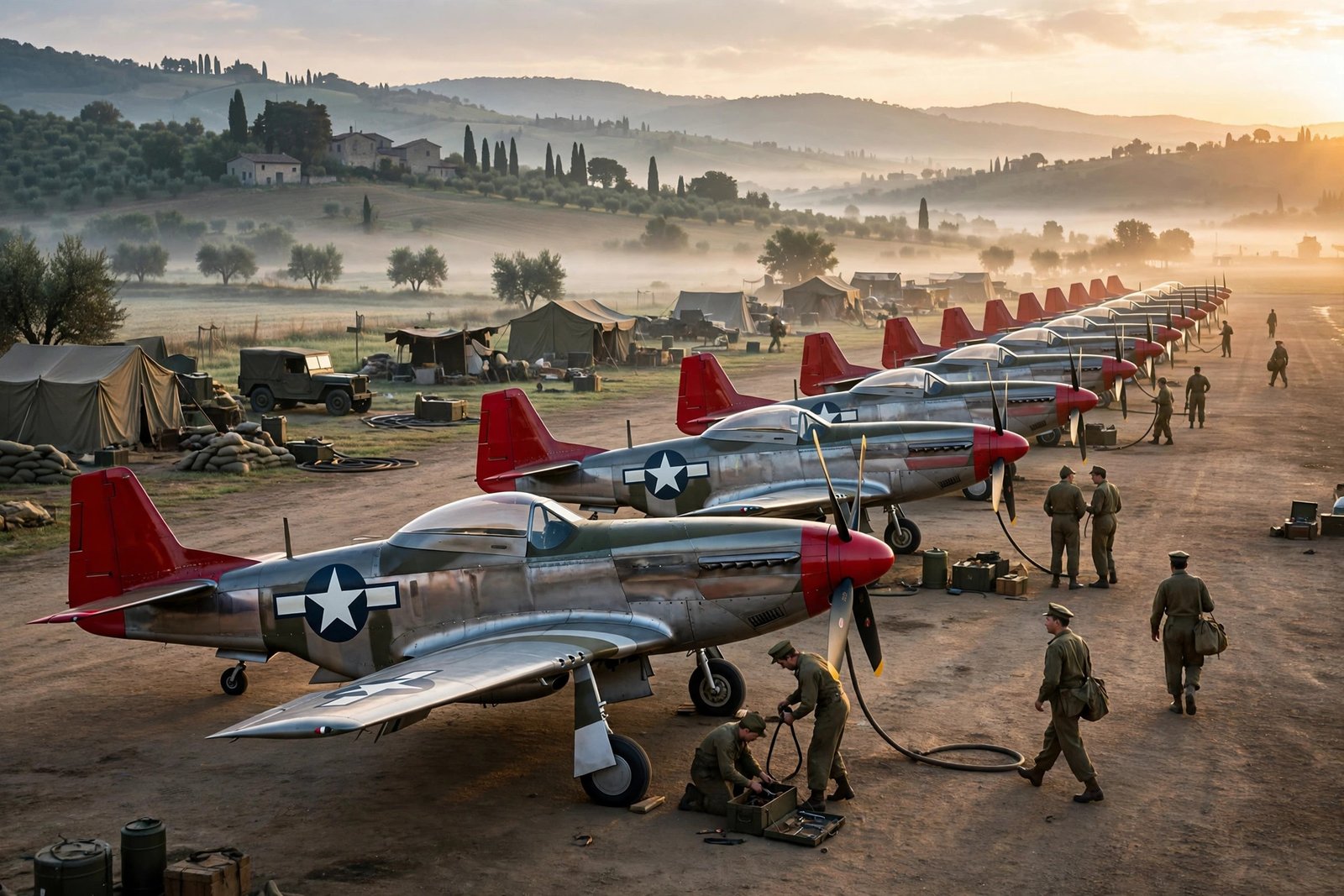
Before they ever saw combat, the Tuskegee Airmen had to win a battle at home — against the United States Army itself. In the early 1940s, official military thinking held that Black Americans lacked the aptitude to fly airplanes or lead men in battle. The young men who volunteered to prove otherwise trained in the segregated South, under commanders who often expected them to fail, and then flew to Europe and compiled one of the finest escort records of the Second World War. They were called the Red Tails. Bomber crews who once doubted them came to ask for them by name.
An Experiment Many Expected to Fail
The program began under pressure: civil rights organizations and the Black press had campaigned for years to open military aviation to African Americans. On March 22, 1941, the Army activated the 99th Pursuit Squadron — the first all-Black flying unit in American history — and built a training field at Tuskegee, Alabama, home of the famed Tuskegee Institute. The first class of pilot cadets began training that year; among its graduates in March 1942 was Benjamin O. Davis Jr., a West Point graduate who had endured four years of silence and isolation from white classmates, and who would go on to command the entire Tuskegee operation in combat.
The conditions carried a message. Tuskegee Army Air Field operated in the Jim Crow South, where the airmen faced segregated facilities and hostility in the surrounding towns. The training itself was rigorous and unforgiving — deliberately so, some airmen believed, with washout rates that reflected how little margin for error they were allowed. Between 1941 and 1946, about 992 pilots graduated from Tuskegee, according to the Department of Veterans Affairs, along with thousands of navigators, bombardiers, mechanics, radio operators and ground crew who made the flying possible. The ‘Tuskegee Airmen’ were never just pilots; they were an entire air force in miniature, built by Americans the military had tried to exclude.
Chief Anderson, Eleanor Roosevelt and the Road to Tuskegee
The program existed at all partly because of Tuskegee Institute itself, which had spent years lobbying to host aviation training and built Moton Field for primary instruction. Its chief instructor, Charles Alfred ‘Chief’ Anderson, a pioneering Black aviator who had taught himself to fly and earned a transport license when few Americans of any race held one, became the program’s founding legend. In March 1941, First Lady Eleanor Roosevelt visited Tuskegee and famously insisted on flying with Anderson — a photograph of the First Lady in his open cockpit did more for the program’s survival than a dozen official reports, signaling to Washington that the ‘experiment’ had powerful friends.
From Moton Field, cadets advanced to Tuskegee Army Air Field for military training. The pipeline produced not just fighter pilots but the 477th Bombardment Group’s B-25 crews, plus the mechanics, armorers, weather observers and clerks without whom no squadron flies. When people say ‘Tuskegee Airmen,’ the accurate picture is a small city of Black servicemen and servicewomen — including nurses and support personnel — running a complete air operation inside a segregated army that doubted they could.
Combat: North Africa, Italy and the Long Road In
The 99th Fighter Squadron shipped out in 1943, flying P-40 Warhawks over North Africa and Sicily. Their early combat drew an unfair share of scrutiny: after a slow start in a sector with few enemy aircraft, a senior commander complained the squadron lacked aggression — a judgment that nearly ended the whole experiment, until a formal review and the squadron’s improving performance settled the question. In early 1944, over Anzio, Italy, pilots of the 99th shot down 12 German fighters in two days. The argument was effectively over.
In February 1944, the 100th, 301st and 302nd Fighter Squadrons arrived in Italy, and together with the 99th they formed the 332nd Fighter Group under Colonel Davis. In the summer of 1944, the group traded its aircraft for P-51 Mustangs and took on the most demanding job in the air war: escorting the heavy bombers of the Fifteenth Air Force on deep raids into Romania, Austria, Czechoslovakia and Germany. For identification, their Mustangs’ tails were painted bright red. To bomber crews, they became the ‘Red-Tail Angels.’
The Record — and the Myth Inside It
Davis imposed a discipline that defined the 332nd: stay with the bombers. Other escort groups sometimes chased fleeing German fighters to build personal scores; Davis ordered his pilots to protect the bombers first, and the bombers noticed. A famous wartime claim grew up around them — that the Red Tails never lost a bomber they escorted. Like many legends, it is not literally true, and the truth is more impressive than the myth because it can be measured.
Air Force historian Daniel Haulman later examined the records mission by mission, as detailed by HISTORY: the Tuskegee Airmen lost bombers to enemy aircraft on only seven of their 179 escort missions between June 1944 and April 1945 — 27 bombers in total, against an average of 46 lost by each of the other escort groups in the Fifteenth Air Force. No group protected its bombers better. On March 24, 1945, the 332nd flew one of the longest escort missions of the war, to Berlin, where three of its pilots each shot down a German Me 262 jet — among the most advanced aircraft on Earth — and the group earned a Distinguished Unit Citation.
Across the war, Tuskegee Airmen flew more than 15,000 individual sorties, destroyed well over a hundred enemy aircraft in the air and on the ground, and earned more than 150 Distinguished Flying Crosses. Sixty-six of the pilots were killed in action; others spent time as prisoners of war. The 477th Bombardment Group, a Black bomber unit trained under the same Tuskegee umbrella, never deployed overseas before the war ended — but its officers made history at home in 1945, when more than a hundred were arrested for peacefully protesting a segregated officers’ club at Freeman Field, Indiana, an act of disciplined defiance that embarrassed the Army and hastened change.
Meet Some of the Men
Statistics honor the group; names honor the men. Charles McGee, who flew with the 332nd in Italy, went on to fly combat in Korea and Vietnam as well — 409 combat missions across three wars, one of the highest totals in American air history — and lived to be promoted to brigadier general on his 100th birthday. Roscoe C. Brown Jr., a squadron commander, was one of the three pilots who downed a German jet over Berlin in March 1945, then came home to earn a doctorate and lead a distinguished career in education. Lee Archer was credited during the war with multiple aerial victories and long celebrated as the program’s leading ace. And presiding over them all was Davis, whose iron rule — never abandon the bombers to chase glory — was both a tactic and a philosophy: the mission, and the men depending on you, come first. It is impossible to read the escort record without hearing his voice in it.
The Long Road to Recognition
The airmen came home to a segregated country and, for decades, a largely forgotten story. But their record had done its work inside the military itself. In 1948, President Harry Truman signed Executive Order 9981, desegregating the armed forces — a decision historians consistently link to the demonstrated excellence of Black servicemen, with the Tuskegee Airmen as the exhibit no one could argue with. In 1949, a team from the 332nd won the Air Force’s first nationwide gunnery competition outright — and then watched the trophy effectively disappear for decades before being found and their victory formally acknowledged. The story of that ‘lost’ trophy became its own parable: even in victory, the airmen’s achievements kept being misplaced by the institution they served, and kept being recovered by the men themselves, who preserved their own records, photographs and memories until the country was ready to look at them.
Broader honors came slowly, then all at once. Benjamin O. Davis Jr. became the first African American general in the U.S. Air Force. In 1998, surviving airmen finally saw a national historic site established at Moton Field in Tuskegee. And on March 29, 2007, more than 300 of the original airmen — elderly men in their eighties and beyond — gathered in the Rotunda of the U.S. Capitol to receive the Congressional Gold Medal, the highest civilian honor Congress can bestow, presented by President George W. Bush ‘in recognition of their unique military record, which inspired revolutionary reform in the Armed Forces.’
Their story now sits permanently in American memory — a major motion picture, museums, school curricula and a new generation of pilots who know exactly whose shoulders they stand on. The Red Tails set out to prove they could fly. They ended up proving something larger: that a nation fights better, and stands taller, when it lets all of its people serve. It took America more than sixty years to say thank you properly. The record they left behind made sure it eventually would.