
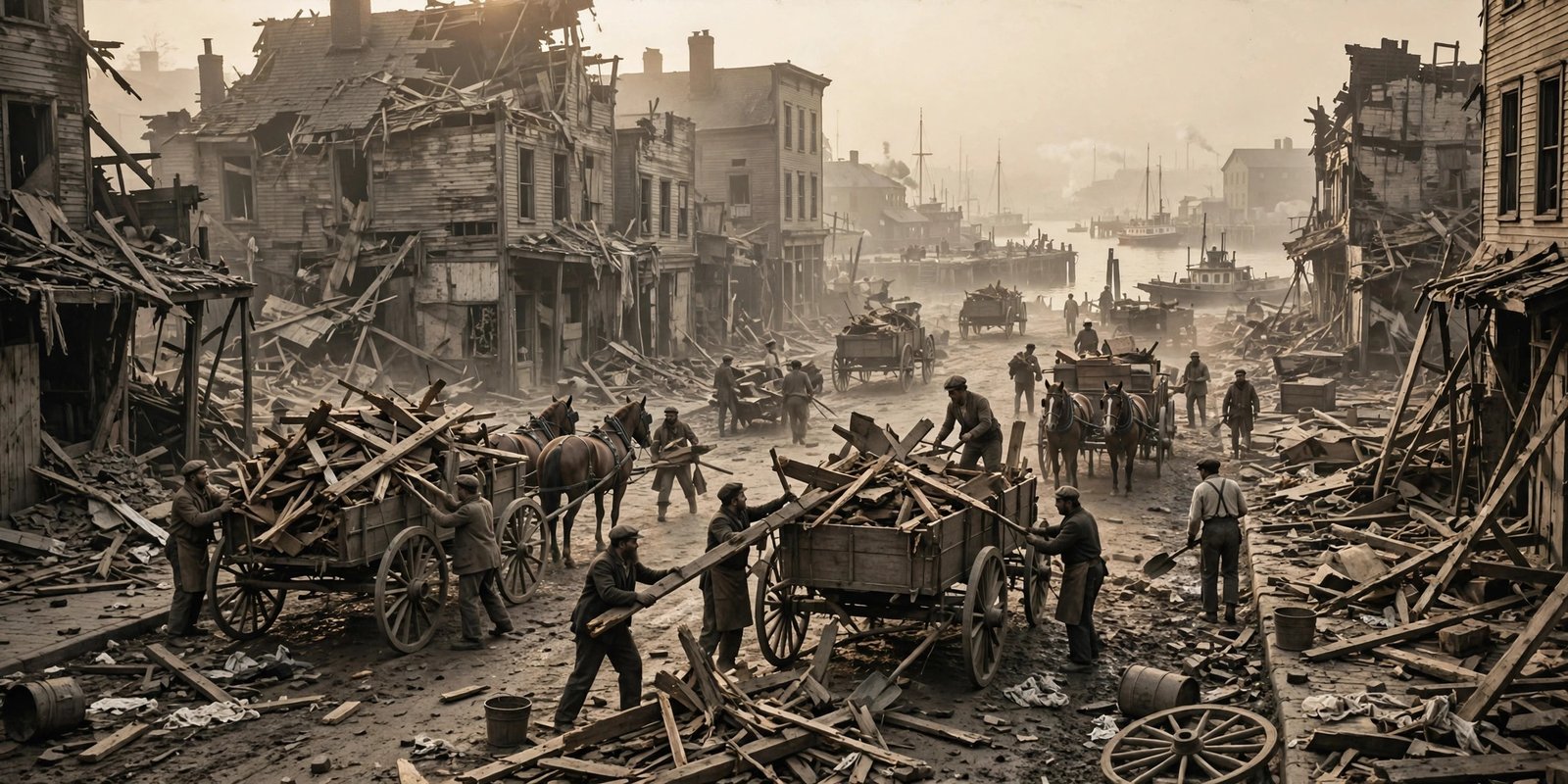
It sounds like a joke headline, the kind a newspaper would run on April Fool’s Day. But on January 15, 1919, one of the deadliest industrial disasters in American history arrived in Boston not as fire, floodwater or an explosion of dynamite — but as molasses. A giant storage tank in the city’s North End burst without warning and sent a wave of sweet, dark syrup through the streets at highway speed. Twenty-one people died. About 150 were injured. And the legal fight that followed changed how America builds things, forever.
More than a century later, the Great Molasses Flood remains almost unbelievable. This is what actually happened.
A Tank the Neighborhood Never Trusted
The tank stood on Commercial Street in Boston’s North End, a dense waterfront neighborhood of Italian immigrants, dockworkers and tenements. It was 50 feet tall and 90 feet across, built to hold up to 2.3 million gallons of molasses — roughly 13,000 tons of syrup. The Purity Distilling Company, a subsidiary of United States Industrial Alcohol, had rushed it up in 1915 so molasses could be piped straight off ships and distilled into industrial alcohol, much of it destined for munitions during the First World War.
The man put in charge of the project, Arthur Jell, was a company executive with no engineering training. Investigators would later find that the tank’s steel plates were thinner than the design specified, that its rivets were insufficient, and that it had been barely tested before being filled — no engineer had ever certified it, because in 1915 Boston, essentially no rules required one to. There were no meaningful building codes or inspections governing a structure like this.
The North End knew something was wrong long before January 1919. The tank groaned and leaked from the start. Molasses seeped from its seams so steadily that neighborhood children collected drips of it. Residents complained. The company’s response, a state auditor later determined, included painting the tank brown — the color of molasses — so the leaks would be harder to see.
Twelve-Thirty in the Afternoon
January 15, 1919 was unseasonably warm, with temperatures climbing after days of bitter cold. Workers were eating lunch. Longshoremen loaded freight near the waterfront. Children played in the street. At about 12:30 p.m., people nearby heard a sound witnesses compared to machine-gun fire — the tank’s rivets popping under stress — followed by a low roar.
The tank did not tip over. It disintegrated, its steel plates peeling apart as 2.3 million gallons of molasses escaped at once. The resulting wave was reported at 15 to 25 feet high, and it moved at an estimated 35 miles per hour — far too fast to outrun, and dense enough to crush. Molasses is roughly half again as heavy as water; a wall of it behaves less like a flood and more like wet concrete in motion.
The wave swept down Commercial Street and through the neighborhood. It crushed wooden buildings, lifted structures off their foundations, and buckled the steel girders of the elevated railway running above the street — a train motorman, seeing the track ahead give way, threw his train into reverse and saved his passengers. A firehouse was smashed and shoved toward the water. Horses, wagons, trucks and people were picked up and thrown. Many victims did not drown so much as suffocate, trapped as the syrup cooled and thickened around them in the January air.
When the wave finally spent itself, 21 men, women and children were dead, and around 150 people were hurt. It remains one of the most surreal casualty lists in American history: a city neighborhood destroyed by a food ingredient.
The Warning Signs Nobody Acted On
The final act began three days before the disaster, when a ship delivered a last great load of molasses into the tank — filling it nearly to capacity. The load had been warmed to make it flow, and witnesses later described the tank groaning and rumbling in the days that followed, sounds regulars around Commercial Street had learned to dread. Workers and residents had complained about the leaking tank for years; some accounts describe locals warning that it would burst someday, the way everyone in a neighborhood knows which building is dangerous long before officials do.
There was also a quieter, structural problem no one in authority ever examined: fermentation inside a giant sealed tank of molasses produces gas, and gas produces pressure, and the winter’s sudden warm spell after deep cold — temperatures swung from near zero to around 40 degrees in the days before the flood — only helped the contents expand. None of this required hindsight to understand. It required an inspector. Boston didn’t have one for tanks, and the company never hired an engineer to play the part. When the end came at lunchtime on January 15, it came for a structure that had been announcing its own failure, in groans and drips and painted-over stains, for three years.
The Cleanup That Took a Season
If the flood was fast, the cleanup was endless. Molasses does not wash away easily, especially not in winter, and especially not 2.3 million gallons of it. More than 300 workers labored around the clock for days just to clear the worst of the wreckage, cutting through debris and searching for victims in a mass that hardened as it cooled.
Fireboats pumped salt water from Boston Harbor onto the streets to dissolve the syrup. Rescuers, cleanup crews, and sightseers tracked molasses everywhere — onto sidewalks across the city, onto streetcar seats and public telephones, into homes and businesses. Boston Harbor stayed brown-tinged until summer. And for decades afterward, North End residents insisted that on hot days, the neighborhood still smelled faintly of molasses — a bit of local lore so persistent it became part of the district’s identity.
The Company Blamed a Bomb. The Evidence Said Otherwise.
United States Industrial Alcohol did not accept blame. In the Red Scare atmosphere of 1919, the company argued that anarchists or Bolshevik sympathizers had bombed the tank — pointing to the era’s genuine wave of political bombings and claiming sabotage, not bad engineering, caused the collapse.
The victims sued, in what became one of the first major class-action cases in American legal history. The court-appointed auditor, Hugh Ogden, sat through an extraordinary proceeding: the trial and hearings consumed years, testimony ran to thousands of witnesses and experts on both sides (the legal battle is often described as the longest and costliest in Massachusetts history to that point), and the company’s star metallurgists argued for weeks that the tank had been sound.
The evidence dismantled that defense piece by piece: steel thinner than specified, too few rivets, a supervising executive who could not read a blueprint, a tank that had never been properly tested, and a long, documented history of leaks ignored. In 1925 — six years after the flood — the court found United States Industrial Alcohol liable. The company paid out $628,000 in damages to the victims and their families, a substantial sum for the era, alongside more than a hundred out-of-court settlements.
How Boston Remembers
For a disaster that killed 21 people, the flood spent decades as something close to a punchline — ‘the Molasses Flood’ simply sounded too absurd to be tragic, and the immigrant neighborhood it devastated had little power to insist otherwise. That has changed in recent years. Historians, led by Puleo’s research, have restored the event’s gravity, and the centennial in 2019 brought ceremonies, exhibits and renewed attention to the victims — among them children, dockworkers, a fireman, a blacksmith and a mother whose family had only recently arrived in America.
Today a small plaque in the North End, near the former tank site at what is now Langone Park, tells the story to passing tourists, most of whom have never heard a word of it. The elevated railway is gone. The waterfront is parks and playgrounds. But stand there on a warm day and you are standing where one of the most improbable disasters in American history began — and where the modern idea that the public deserves engineered, inspected, accountable construction truly got its start.
The Flood That Rebuilt America’s Rules
The strangest disaster in Boston’s history left a legacy far larger than the North End. The hearings had exposed, in public and in detail, how a corporation could erect a 50-foot industrial tank in a crowded neighborhood without a single qualified engineer approving the design, without inspections, and without any agency able to say no.
Massachusetts responded by requiring certified engineers to sign and seal building plans, with real inspections to follow. The principle spread state by state across the country. As historian Stephen Puleo, author of Dark Tide, the definitive book on the flood, has put it in essence: the ordinary safeguards Americans now take for granted — licensed engineers approving construction, inspectors examining projects before they open — trace a direct line back to the molasses case. The disaster is still taught in engineering ethics courses today, a permanent case study in what happens when speed outranks safety and nobody’s job is to check.
There is no grand monument to the Great Molasses Flood in the North End — just a modest plaque near the site, in a neighborhood that now smells of garlic and espresso rather than syrup. But every stamped engineering drawing and every passed building inspection in America is, in a way, a memorial to the 21 people who died on a warm January afternoon in 1919, killed by a wave nobody believed could happen — until it did.