
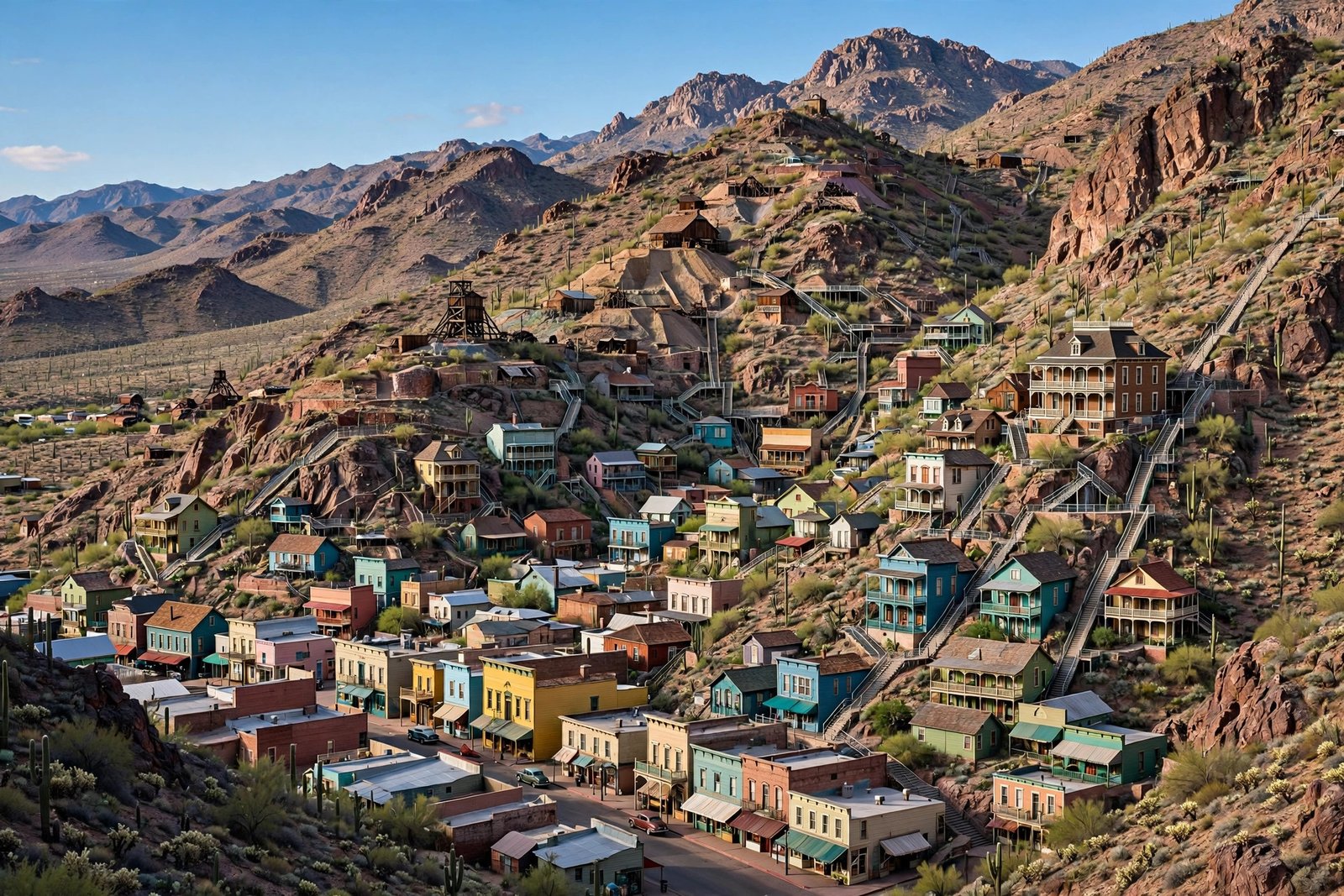
There is a town in the mountains of southeastern Arizona where the houses climb staircases instead of streets, where a street of perfect 1950s storefronts sits frozen in time, and where you can ride a train 1,500 feet into a mountain with a retired miner as your guide. It was once one of the richest mining camps on Earth. Then the mines closed, the crowds left, and the artists moved in. This is Bisbee — quite possibly the quirkiest small town in America.
Queen of the Copper Camps
Bisbee’s story begins in 1877, when a cavalry scout party tracking Apache raiders through the Mule Mountains noticed promising mineral signs instead. Prospectors flooded in, claims were staked, and in 1880 the town was founded and named for Judge DeWitt Bisbee, a San Francisco investor in the fledgling Copper Queen Mine — a man who, by the town’s favorite piece of trivia, never once visited the place that bears his name.
What followed was a boom for the history books. Bisbee’s mines ultimately produced more than 8 billion pounds of copper, along with millions of ounces of gold and silver and vast quantities of lead and zinc, according to the City of Bisbee’s Queen Mine history. At its peak in the early 1900s, Bisbee held more than 20,000 residents and could plausibly call itself the largest city in the Southwest between St. Louis and San Francisco. It had a stock exchange, an opera house, a famous brewery district — Brewery Gulch once packed in dozens of saloons — and the narrow, steep streets of a town clinging to a canyon a mile high in the desert sky (Bisbee sits at roughly 5,300 feet, which keeps its summers far cooler than Tucson or Phoenix).
The boom had a hard edge. In 1917, during a strike, armed deputies rounded up some 1,300 striking miners, loaded them into cattle cars and deported them to the New Mexico desert — the Bisbee Deportation, an episode the town now examines honestly in its museum rather than hiding from it. And in the 1950s, mining shifted to open-pit work: the Lavender Pit, named for Phelps Dodge executive Harrison Lavender, swallowed a whole neighborhood and left a terraced, rust-and-lilac canyon some 300 acres wide and around 900 feet deep, still gawked at from a highway overlook today.
The Crash — and the Artists
The underground mines closed for good in 1975, and Bisbee should have become a ghost town. Many did. Instead, something unexpected happened: the combination of dirt-cheap Victorian houses, mountain light and wide-open freedom drew artists, craftspeople and cheerful nonconformists, who bought the miners’ cottages and opened galleries, studios and cafés. The town reinvented itself without sanding off its edges.
The verdict arrived in 2016, when Bisbee won USA Today’s reader poll for Best Historic Small Town in America. Today its population is only around 5,000 — a quarter of its mining-era peak — but its cultural footprint is far larger.
Ride Into the Queen Mine
The essential Bisbee experience starts with a hard hat. The Queen Mine Tour, opened in 1976 by a mayor determined to keep miners employed after the closure, outfits visitors with slickers, helmets and miner’s lamps, then rolls them by train 1,500 feet into the mountain, where former miners explain how the ore was drilled, blasted and hauled in the mine’s working days. More than a million visitors have taken the tour since it opened, with roughly 50,000 a year still making the trip underground. As one visiting writer’s account of the Queen Mine Tour notes, the guides’ firsthand stories are the highlight. It is equal parts history lesson and time machine — and the city notes that Bisbee’s mines altogether honeycomb the mountains with more than 2,500 miles of tunnels.
Above ground, the Bisbee Mining & Historical Museum — housed in the old Phelps Dodge general office building — holds the distinction of being the first rural museum in America affiliated with the Smithsonian Institution. It is the best single stop for understanding how a copper camp actually worked, from the deportation to the dazzling mineral collection, including specimens of “Bisbee Blue,” the turquoise prized by collectors worldwide.
A Town Built on Staircases
Because Bisbee was built up steep canyon walls, its miners commuted on public staircases — dozens of them, some climbing hundreds of steps between streets. The town turned that necessity into its signature athletic event: the Bisbee 1000, a 5-kilometer race that threads 1,034 stairs through the hillsides, with musicians serenading runners along the route. Even outside race weekend, visitors treat the staircases as a self-guided tour — every flight delivers a new angle over the rooftops, the canyon and the mountains rolling off toward Mexico, just a few miles south.
Then there is Erie Street, in the old Lowell district: a commercial block preserved so perfectly in its mid-century form — vintage cars, period gas station, old storefronts — that it feels less like a street than a film set that forgot to wrap. It survives largely because the expanding Lavender Pit stopped just short of it, freezing the neighborhood in time.
Sleeping With the Ghosts
For the full Bisbee, stay the night — ideally somewhere haunted. The Copper Queen Hotel, completed in 1902 and billing itself as Arizona’s oldest continuously operating hotel, is the grande dame of Main Street, all four stories of early-1900s elegance. It is also, by long local tradition, home to resident spirits, most famously a lady of Brewery Gulch’s old demimonde said to favor a fourth-floor room; the hotel has been featured on paranormal television shows, and staff will happily tell the tales. Treat the ghost stories as exactly what they are — beloved folklore, unverifiable and half the fun. Around the hotel, former boarding houses and miners’ cottages now run as bed-and-breakfasts tucked up every side canyon, most within a staircase-climb of the cafés and galleries of Main Street and Brewery Gulch.
More Corners Worth Finding
Give yourself time for the details. In the Lowell district, not far from Erie Street, sits Warren Ballpark, built in 1909 and counted among the oldest professional baseball parks in America — Babe Ruth and other barnstorming legends are said to have played exhibitions in Bisbee’s rarefied air. The Evergreen Cemetery, on the road out of town, is a Victorian hillside of iron fences and weathered angels where miners, madams and mayors share the view. Back downtown, the Copper Queen Library, founded in the 1880s, claims the title of Arizona’s oldest continuously operating library, and St. Patrick’s Church watches over the canyon with stained-glass windows shipped from Europe in the mining era.
Brewery Gulch deserves its own slow evening. In its saloon-era prime it was the rowdiest few blocks in the territory; today its bars and live-music rooms carry the torch at a friendlier volume, and the gulch still feels like the town’s living room. Bisbee’s calendar leans into its personality — art walks, home tours of the stair-stepped neighborhoods, a homegrown music festival scene, and costumed, only-in-Bisbee events that locals guard with pride. Show up for any of them and you will understand quickly: this is not a town performing quirkiness for visitors. The quirk is load-bearing.
How to Visit
- Getting there: Bisbee is about 90 miles southeast of Tucson, near the Mexican border — an easy day trip, a better weekend.
- Book the mine: Queen Mine tours run daily and fill up; reserve ahead, and bring a jacket — it is cool underground year-round.
- Walk everything: The historic districts reward slow wandering. Comfortable shoes are non-negotiable; this town is vertical.
- Time it right: Spring and fall bring the best weather; the Bisbee 1000 and the town’s parade seasons add energy (and crowds).
- Slow down: Bisbee’s unofficial motto might as well be its pace. Galleries keep their own hours, cats hold seniority on porches, and nobody is in a hurry.
A Note on Bisbee Weather — and Mood
First-time visitors driving up from the border heat are usually startled twice: once by the temperature, and once by the town. At 5,300 feet, Bisbee evenings cool off even in summer, monsoon storms roll through the canyon in July and August with theatrical suddenness, and winter can dust the rooftops with snow while the desert floor an hour away stays mild. Pack layers, whatever the calendar says. The mood follows the weather’s example — unhurried, a little theatrical, entirely itself. Bisbee has been a refuge for miners, outlaws, soldiers, hippies, artists and retirees in turn, and it has absorbed every wave without surrendering to any of them. That may be the real hidden gem here: a town of 5,000 that contains multitudes, at the end of a canyon, at the edge of the map.
The Town That Refused to Die
Every mining town faces the same ending: the ore runs out. Bisbee looked at that ending and declined. It kept its mine open as a classroom, kept its museum honest, kept its staircases, its saloon district and its stubborn streak — and filled the empty houses with people who make things. The result is a hidden gem with a working-class heart and an artist’s eye, hiding in plain sight in the Mule Mountains. Go before everyone else figures it out — though at 145 years old, Bisbee has heard that warning before, and it is still gloriously itself.