
On the first two days of November, just as the last jack-o’-lanterns are blown out, another celebration lights up across the United States. Marigolds appear in grocery stores and front yards. Sugar skulls line bakery shelves. Community centers, museums, and schools build altars covered in photographs, candles, and favorite foods. This is Día de los Muertos, the Day of the Dead, a Mexican tradition that has grown over the past half century from a little-known observance into one of America’s most visible autumn celebrations, marked now in all fifty states.
It is not, as newcomers often assume, a Mexican version of Halloween. The two holidays sit side by side on the calendar and share costumes and color, but their hearts are different. Halloween plays with fear. Day of the Dead answers it. The belief at the center of the tradition is that the spirits of the dead return briefly to visit the living, and that the living should welcome them home with food, music, flowers, and memory. It is a holiday about grief made social, and about keeping the dead present in family life rather than hidden away.
What Day of the Dead actually celebrates
Día de los Muertos is observed on November 1 and 2. Traditionally, November 1 honors children who have died, a day sometimes called the Day of the Innocents, which coincides with the Catholic feast of All Saints’ Day. November 2 honors adults, coinciding with All Souls’ Day. According to tradition, the gates of heaven open at midnight on October 31, and the spirits of children rejoin their families for a day, followed by the spirits of adults on November 2. Families prepare for the visit as they would for honored guests: cooking favorite dishes, setting out drinks, lighting candles, and decorating graves.
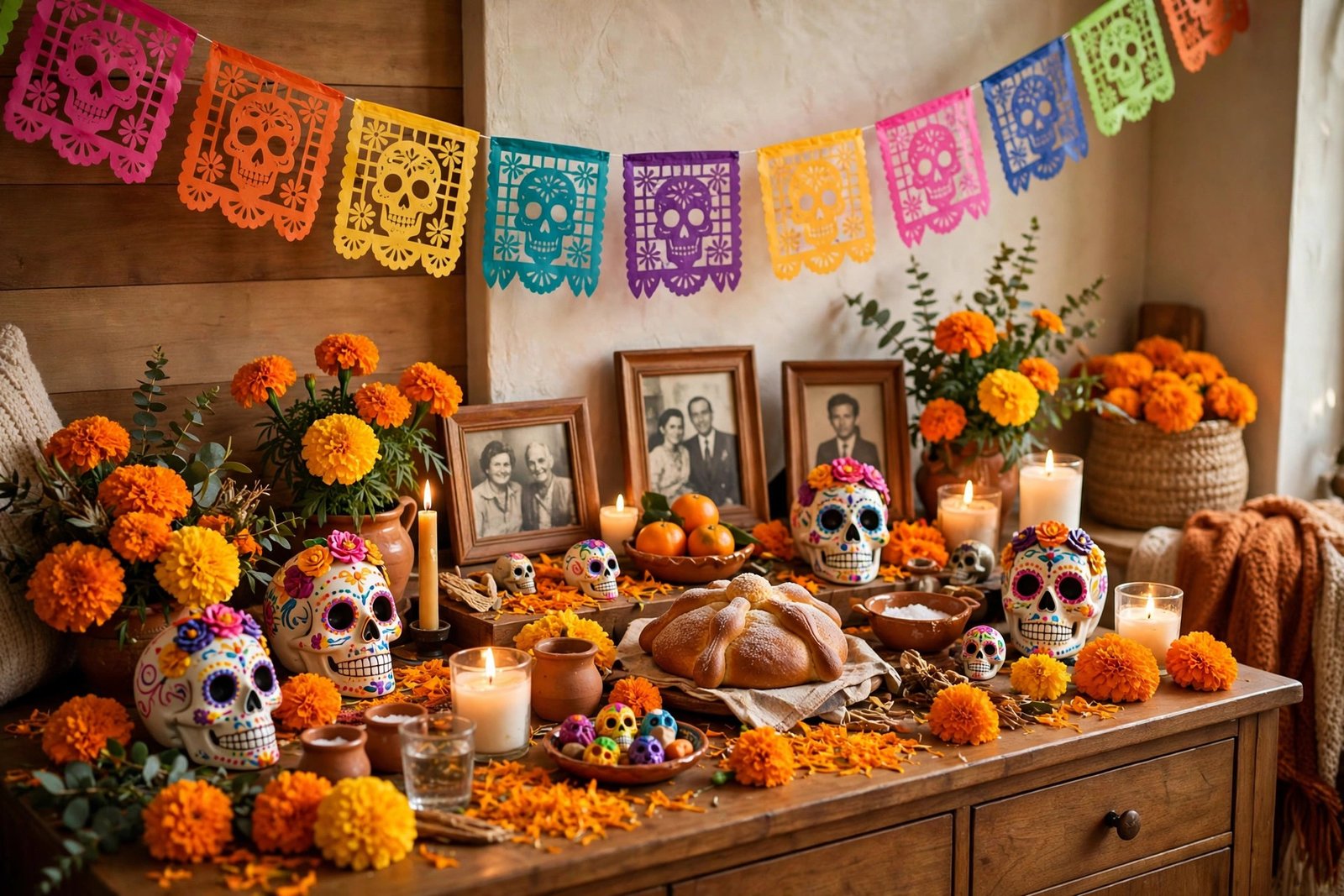
The celebration centers on the ofrenda, an altar built in a home or at a gravesite to welcome returning spirits. An ofrenda typically holds photographs of the departed, candles to light the way, marigolds whose color and scent are believed to guide spirits home, incense, water, and the favorite foods and drinks of the person being remembered. Pan de muerto, a sweet bread often decorated with dough shaped like bones, is baked for the occasion. Sugar skulls, known as calaveras, are often inscribed with the name of a departed loved one. Papel picado, delicate tissue paper cut into banners, flutters above the altar. Every item has a job, and every item tells a story about a specific person, which is what makes the holiday feel intimate even when it is celebrated in public.
The mood surprises first-time visitors. There is music, dancing, and laughter alongside tears, because the tradition treats death as a natural part of life’s cycle rather than as something to fear or hide. That attitude has deep roots. The festival originated thousands of years ago with Aztec, Toltec, and other Nahua peoples of central Mexico, who viewed death as a natural phase in life’s long continuum and honored their dead with offerings. When Spanish colonizers arrived, those rituals blended with the Catholic feasts of All Saints’ Day and All Souls’ Day, producing the holiday celebrated today: indigenous at its core, Catholic in its calendar, and unmistakably Mexican in its color and warmth.
How the holiday took root in the United States
Mexican American families have marked the Day of the Dead in the United States for generations, often privately, with home altars and cemetery visits. The public celebration Americans now recognize began in a different place: the Chicano art movement of the 1970s. As Regina Marchi, a professor at Rutgers University and author of Day of the Dead in the USA, has explained, Chicano artists born and raised in the United States began reclaiming indigenous Mexican roots that had long been overlooked in American culture, where Mexican identity was usually represented through Spanish traditions rather than Mesoamerican ones. These artists traveled to rural Mexico, studied indigenous rituals, and brought them home through visual art, public altar installations, street processions, craft workshops, and Aztec dance.
The Smithsonian’s American Art Museum tells a similar story. It traces the change in how the holiday is celebrated in the United States to Chicano artists and activists who launched large-scale public events during the holiday, seeking to build a new political and cultural consciousness among people of Mexican descent. Artists such as Carmen Lomas Garza began creating public altars and installations in museums and galleries, opening a family tradition to a wider public. Marchi’s research, based on two decades of observation and interviews, dates the first public, secular Day of the Dead celebrations in the United States to 1972. From that point, the holiday spread from galleries and community centers into city festivals, school programs, and Main Street shop windows.
The growth accelerated from the 1980s onward, alongside the growth and visibility of the Mexican American population. By the 2000s, Day of the Dead imagery had entered mainstream American retail, with calavera and catrina designs appearing on everything from clothing to coffee mugs. Marchi has observed that the holiday is on its way to being almost as widely known as Halloween, with celebrations now happening in all fifty states. The holiday also traveled back across the border: Chicano renditions of Day of the Dead influenced how it is celebrated in Mexico itself, including the large public parade in Mexico City, a spectacle that only began in recent years.
Why 2008 mattered for the tradition
In 2008, UNESCO inscribed Mexico’s indigenous festivity dedicated to the dead on its Representative List of the Intangible Cultural Heritage of Humanity. The recognition described the tradition as a blend of pre-Hispanic indigenous rites and Catholic feasts, and it drew international attention to a celebration that many Americans were only beginning to notice. UNESCO recognition does not change how families celebrate, but it changed how institutions talk about the holiday. Museums, schools, and city cultural departments could now present Day of the Dead as a heritage tradition of global significance, not a novelty, and that framing helped the holiday move into classrooms and civic calendars across the United States.
The same period brought the holiday to a much wider American audience through popular culture. Animated films, museum exhibitions, and school curricula introduced children who had never met a Mexican family to ofrendas, marigolds, and sugar skulls. For many families, that first encounter was decorative: a face-painting station at a fall festival, a skull-themed craft table, a display in a library. For others, it was the beginning of a deeper understanding. The tension between those two experiences — celebration and commercialization, appreciation and appropriation — has become part of the holiday’s American story, and it is worth understanding before attending an event.
How Day of the Dead is celebrated across America today
American celebrations now take many forms, and they vary by city and community. In Los Angeles, one of the largest celebrations in the country fills the Hollywood Forever Cemetery with altars, music, and processions, drawing families who build elaborate ofrendas beside the graves of loved ones. In San Antonio, Texas, the Day of the Dead has become a major civic festival, with a river parade and community altars. In Chicago, the National Museum of Mexican Art has hosted Day of the Dead exhibitions for decades, and its annual celebration is one of the city’s most attended cultural events. In Santa Fe and Albuquerque, New Mexico, the holiday blends with local Hispanic traditions that predate the United States itself. In smaller towns across the Midwest and Southeast, libraries, schools, and churches host altar-building workshops and community ofrendas where anyone can add a photograph.
Public celebrations usually share a few elements: a procession, often with participants in calavera face paint and catrina costumes; community altars where visitors can leave photos and notes; live music; food vendors selling pan de muerto, tamales, and hot chocolate; and craft activities for children, such as decorating sugar skulls and making papel picado. The best events are organized with or by the local Mexican American community, with quiet spaces for reflection alongside the music. Check your city museum, cultural center, or parks department for programs near you.
Home celebrations remain the heart of the holiday, and they are simpler than the big festivals suggest. A family ofrenda can be a single table with a photograph, a candle, a glass of water, a marigold, and a favorite dish. Families often add items that belonged to the person being remembered — a hat, a book, a tool — and children are encouraged to help, learning family stories as they arrange the altar. Cemetery visits on November 2 are a central tradition: families clean and decorate graves, share a meal beside them, and sometimes stay into the evening with candles lit. The point is presence, not perfection, and a modest altar built with care carries the same meaning as an elaborate one.
The symbols and what they mean
Each symbol of Day of the Dead carries a meaning that goes beyond decoration, and knowing them changes how you see a celebration. The marigold, or cempasúchil, is the holiday’s signature flower. Its bright orange color and strong scent are believed to guide spirits back to the altar, and families scatter its petals in paths from the street to the ofrenda. The calavera, or sugar skull, represents the dead with humor and affection rather than horror; sugar skulls are often inscribed with the name of a living person as a playful reminder that death comes for everyone. La Calavera Catrina, the elegant skeleton figure created by printmaker José Guadalupe Posada in the early twentieth century, began as political satire mocking the wealthy and is now the holiday’s most recognizable icon.
Pan de muerto, the bread of the dead, is a sweet, soft loaf often flavored with orange blossom and topped with dough shaped like bones and a tear drop. Copal incense clears and purifies the space around the altar. Candles light the way for returning spirits, and water quenches their thirst after a long journey. Papel picado, the perforated tissue paper banners, represents the wind and the fragility of life. Photographs anchor the altar to real people, not abstract ancestors. Taken together, the altar is not a shrine to death in general but a welcome table for specific people, built from the details of their lives.
Celebrating respectfully as a guest
Day of the Dead in the United States is a public celebration, and visitors of all backgrounds are generally welcome. Respectful participation starts with understanding what the holiday is not. It is not Halloween with different decorations, and it is not a costume party built around someone else’s grief. Face painting in the calavera style is widely accepted at public events, especially when it is offered by community organizers, but wearing a full costume that treats the tradition as a spooky theme can feel very different from joining a procession with a painted face and a candle.
A few habits make a visit welcome rather than intrusive. Treat altars as personal, not as photo backdrops: ask before photographing a family’s ofrenda, and never touch or rearrange its items. If a community altar invites visitors to add a photograph, bring one of your own departed loved one — many community ofrendas welcome this, and it is a meaningful way to take part. Listen to the stories attached to the altars; the holiday is built on storytelling, and families often welcome questions asked with genuine curiosity. Support the community hosting the event by buying food and crafts from local vendors rather than from mass-market stalls, and learn the names of the traditions you are enjoying, so that marigolds are not just pretty flowers but cempasúchil, and the altar is not just a display but an ofrenda.
For families who want to mark the holiday at home for the first time, the simplest path is the most respectful one: build a small ofrenda for someone you have lost, cook a dish they loved, and tell their stories at the table. You do not need to be Mexican to remember your own dead with food, flowers, and photographs, and many Mexican American organizers say that sincere remembrance is exactly what the holiday invites. What matters is the intention behind the altar, not its size or authenticity score.
A holiday that keeps growing
Day of the Dead’s growth in the United States shows no sign of slowing. Each November, more cities add it to their cultural calendars, more schools teach it alongside Halloween, and more families — Mexican American and otherwise — build an altar for the first time. The holiday has kept its core through all of that growth: a table, a photograph, a candle, a flower, and a meal shared in memory of someone who is gone. That simplicity is part of its power. In a country where grief is often private and hurried, Day of the Dead offers a public, joyful, and unhurried way to say that the dead are still part of the family.
Frequently asked questions
When is Day of the Dead celebrated?
Day of the Dead is celebrated on November 1 and 2 each year. November 1 traditionally honors children who have died, and November 2 honors adults. Many families begin preparations in late October, and some public events run across the weekend nearest those dates.
Is Day of the Dead the same as Halloween?
No. Halloween, on October 31, plays with fear and the supernatural. Day of the Dead, on November 1 and 2, is a family remembrance in which the spirits of the dead are welcomed home with food, flowers, music, and altars. The two holidays share color and costumes but have different origins and meanings.
What is an ofrenda?
An ofrenda is an altar built to welcome returning spirits. It typically holds photographs of the departed, candles, marigolds, incense, water, pan de muerto, and the favorite foods and drinks of the person being remembered.
Can anyone celebrate Day of the Dead?
Yes. Public celebrations across the United States welcome visitors of all backgrounds. The respectful way to take part is to learn what the symbols mean, treat family altars with care, ask before photographing them, and remember someone of your own with sincerity.
Related reading
Autumn in America is full of traditions worth exploring. Our guide to Salem, Massachusetts, in October shows how one town handles the Halloween season, and our Sleepy Hollow guide follows the Headless Horseman legend to its hometown. For more surprising American history, read U.S. state facts that sound fake but are true.
Sources for this article include the Smithsonian American Art Museum on the transformation of Día de los Muertos in the United States, Popular Science on how Day of the Dead took root in America, and National Geographic on the UNESCO-recognized tradition.