
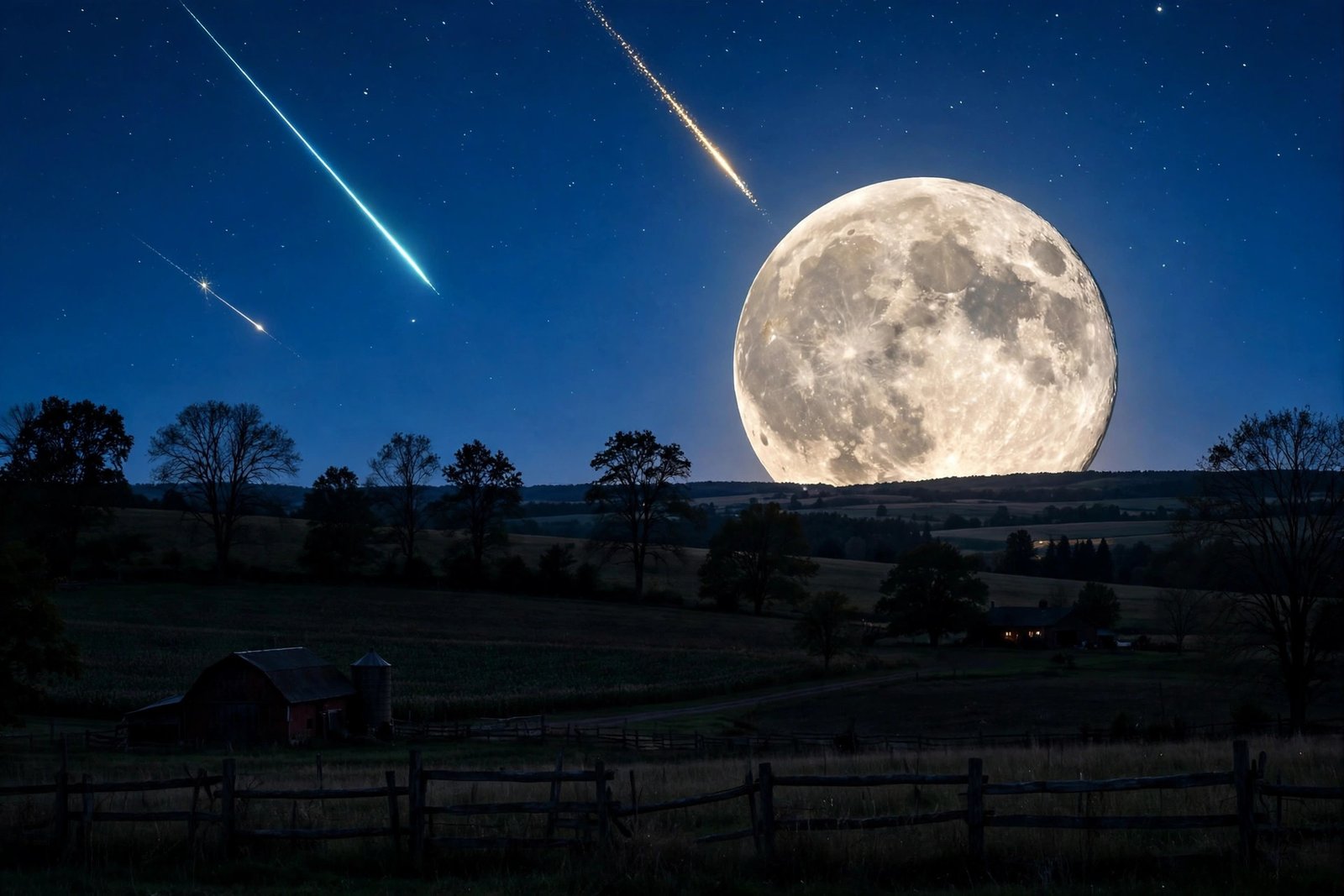
November is the month when the night sky puts on its best show of the fall. The air turns crisp, the evenings arrive early, and the darkness that makes winter feel long is, for stargazers, a gift: more hours of dark, clearer air, and a calendar crowded with events. In November 2026, skywatchers get three meteor showers, a meeting of Mars and Jupiter before dawn, Uranus at its brightest, and the year’s first supermoon in ten months — the full Beaver Moon on November 24. Here is what to watch, when to look, and how to see it without any special equipment.
The headline events are easy to remember. The Southern Taurids peak on the nights of November 4-5, the Northern Taurids on November 11-12, and the Leonids — the fastest meteors of the year — peak overnight from November 16 into the morning of November 17, with some guides giving November 17-18 as the peak window. The full Beaver Moon reaches peak illumination on Tuesday, November 24, at 9:53 a.m. Eastern time, which means it will look fullest at moonrise on the evenings of November 23 and 24. Around November 14-16, Mars and Jupiter appear close together before dawn, and Uranus reaches opposition on November 25-26, its best night of the year.
The Beaver Supermoon on November 24
November’s full moon is traditionally called the Beaver Moon, a name traced to the time of year when beavers finish their preparations for winter, and when trappers once set beaver traps before the waters froze. In 2026 it is also a supermoon: the full moon occurs near perigee, the point in its orbit closest to Earth, so it appears somewhat larger and brighter than an average full moon. Guides describe it as up to about 14 percent larger and 30 percent brighter than a full moon at its farthest point, though the difference is subtle to the eye and most dramatic when the moon sits low near the horizon.
Because peak illumination falls in the morning for the eastern United States, the best viewing is at moonrise on the evenings of November 23 and 24, when the moon climbs above the eastern horizon around sunset. Look for it near the Pleiades star cluster and the bright orange star Aldebaran. This supermoon is the first of three consecutive supermoons, with more to follow in December and January, so November is the start of a run, not a one-night event. No telescope is needed; the moon is the easiest object in the sky, and binoculars will reveal its craters and dark plains in satisfying detail.
The new moon on November 9 is the month’s darkest night, and it matters for meteor watching. Dark skies are the single biggest factor in how many meteors you will see, more important than any app or gadget. The Taurids and Leonids both benefit from favorable moonlight this year at key moments, which is part of why November 2026 is a good month to step outside.
Three meteor showers in one month
November is unusual in offering three meteor shower peaks. The Southern Taurids peak first, on November 4-5, producing a low but steady stream of slow-moving meteors, with a reputation for occasional brilliant fireballs. The Northern Taurids follow on November 11-12, under dark skies near the new moon, which is ideal. Taurid meteors are slow and long-lasting, and while their hourly rates are modest, their fireballs — meteors bright enough to cast shadows — are what people remember.
The Leonids are the month’s star shower. They peak late on November 16 through the early morning of November 17, with some guides extending the peak into November 17-18. Expect around a dozen to 20 meteors per hour under dark skies, fast and bright, often leaving glowing trails. The Leonids are debris from comet 55P/Tempel-Tuttle, which orbits the sun roughly every 33 years, and about every 33 years the shower can erupt into a storm of a thousand or more meteors per hour. 2026 is not a storm year, but the Leonids’ speed and brightness make even a modest showing worth the late night.
How to watch a meteor shower is refreshingly simple, and the rules have not changed in decades. Find the darkest spot you can reach, away from streetlights and porch lights. Let your eyes adapt for at least 20 minutes without looking at your phone. Lie back in a reclining chair or on a blanket, look at a broad sweep of sky rather than a single point, and be patient. Meteors can arrive in bursts with long quiet stretches between them, so give yourself at least an hour. Dress far warmer than you think you need: November nights punish the underdressed, and cold is the reason most meteor watches end early.
Mars meets Jupiter before dawn
Around November 14-16, Mars and Jupiter appear close together in the pre-dawn sky, passing within about 1.2 degrees of each other — close enough to fit in a single binocular view. Jupiter shines far brighter, at about magnitude -2.1, with Mars a dimmer magnitude 0.7, and both sit in the constellation Leo. Earlier in the month, around November 2-3, the moon, Mars, and Jupiter form a tight line above the eastern horizon around midnight, a preview of the conjunction to come.
Planetary conjunctions are about patience and timing rather than equipment. The pair is best in the hour or two before dawn, when Leo has climbed high enough to clear rooftops and trees. Binoculars will show Jupiter’s four bright Galilean moons as tiny points in a line, a sight that still surprises first-time viewers. Mars will show as a small reddish disk, without surface detail in binoculars, but its color next to Jupiter’s cream-white glow is the point of the pairing.
Uranus at opposition and the Pleiades
On November 25-26, Uranus reaches opposition, the point where it sits opposite the sun in Earth’s sky and appears at its brightest and closest for the year. Uranus is just at the edge of naked-eye visibility under truly dark skies, but binoculars make it a reliable target: look for a small, steady, pale green-blue disk that does not twinkle the way stars do. Star charts and astronomy apps help here, because Uranus looks star-like at first glance and the trick is confirming which point of light is the planet.
The Pleiades star cluster, also called the Seven Sisters, is at its best in November too, reaching opposition on November 18 and visible all night. It is one of the sky’s most beautiful binocular objects: a tight glittering cluster of young blue stars, with more stars appearing the longer you look. The moon passes near the Pleiades around November 24, so the two share the sky on supermoon night. For beginners, the Pleiades are the perfect first deep-sky target, because they are easy to find and instantly rewarding.
Where to watch in the United States
The best viewing in America is wherever the sky is darkest and the horizon is open. National parks and International Dark Sky places are the gold standard, but you do not need to travel far: a rural road, a lake shore, or a hilltop away from town lights will transform what you see. Light pollution maps, free online, show dark pockets surprisingly close to most cities, and even a 20-minute drive out of town can double or triple your meteor count.
Weather is the wildcard. November brings clear cold fronts that scrub the sky clean, and also cloud systems that can hide a whole shower. Check the forecast for cloud cover, not just temperature, and be ready to shift your watch by a night: meteor showers are active for days around their peak, so a cloudy peak night does not mean a lost shower. The Taurids in particular are broad streams, active for weeks, so a clear night a few days from peak is still a good night.
Families can make the most of the early events. The Beaver Moon rises at sunset, which is perfect for children, and the Taurids start in the evening hours, even if their best rates come after midnight. The Leonids demand a late night, but teenagers and night owls will find the fast meteors worth it. Bring blankets, hot drinks, and a red flashlight — red light preserves night vision, while white phone screens destroy it for 20 minutes at a time.
Why November’s sky feels special
There is a reason November skywatching has its own following. The summer constellations are setting, the winter constellations are rising, and the sky feels like it is changing guard. Orion climbs in the east by late evening, Taurus and the Pleiades ride high by midnight, and Gemini, home of the December Geminids, is already on its way. November is the bridge between the warm-weather sky and the winter sky, and its events reward anyone willing to step outside and look up.
It is also a democratic kind of astronomy. Every event in this guide is visible with the naked eye, from anywhere in the United States with a reasonably dark sky, and none of it costs anything. The moon, the meteors, the planets — they belong to everyone, and November 2026 offers them in unusual abundance. Mark the dates, dress warmly, and give your eyes time to adapt. The sky will do the rest.
Frequently asked questions
When is the full Beaver Moon in November 2026?
The full Beaver Moon peaks on Tuesday, November 24, 2026, at 9:53 a.m. Eastern time. It will appear fullest at moonrise on the evenings of November 23 and 24, and it is a supermoon, the first of three consecutive supermoons.
When is the best time to see the Leonid meteor shower?
The Leonids peak late on November 16 through the early morning of November 17, 2026, with some guides giving November 17-18. Look after midnight, when the constellation Leo has risen, and expect around a dozen to 20 meteors per hour under dark skies.
Do I need a telescope to see November’s sky events?
No. The moon, all three meteor showers, and the Mars-Jupiter pairing are naked-eye sights. Binoculars improve the view of the moon’s craters, Jupiter’s moons, the Pleiades, and Uranus, but they are optional.
What is the darkest night in November 2026?
The new moon falls on November 9, 2026, giving the darkest skies of the month. The Northern Taurids, peaking November 11-12, benefit from the dark moonless skies nearby.
Related reading
If you enjoy America’s nighttime stories, read our guide to Sleepy Hollow, New York, and the Headless Horseman, our look at the Stanley Hotel’s haunted history, and where to hear bugling elk during the autumn rut.
Sources for this article include Fox Weather’s November 2026 skywatching guide, National Geographic’s November night sky events guide, and the Riverbend Astronomy Club’s November 2026 sky guide.