
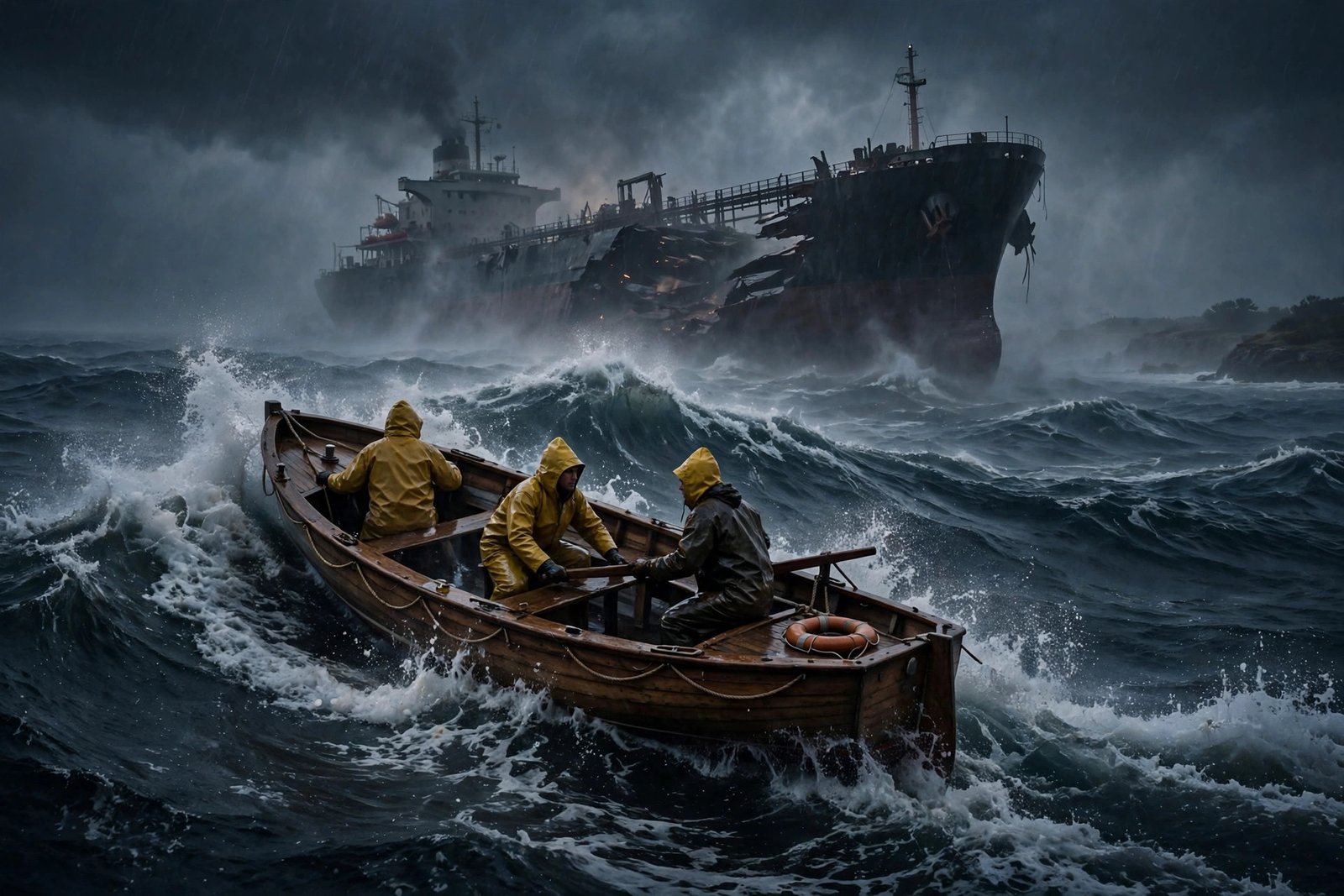
On the night of February 18, 1952, a nor’easter of historic violence tore into Cape Cod, Massachusetts — and two American oil tankers, in two separate places, snapped in half in the same storm. The rescue that followed is still considered the greatest small-boat rescue in United States Coast Guard history: four men in a 36-foot wooden lifeboat, in seas reported at 60 feet, who brought 32 shipwrecked sailors home through a blizzard — in a boat built to carry a fraction of that number. This is the story of the Pendleton rescue, and of the rescue culture that produced it.
Two Ships Broken by the Same Storm
The storm struck with 70-knot winds and mountainous seas. The tanker Fort Mercer, off Cape Cod, broke in two — but managed to get a radio distress call out, drawing five large Coast Guard cutters, a Navy ship and aircraft into a massive rescue effort. Thirty-eight of the 43 men aboard Fort Mercer would ultimately be saved, in a heroic operation in its own right.
What no one knew at first was that a second tanker, the 503-foot Pendleton, bound for Boston with a cargo of kerosene and heating oil, had also split in half — silently, without a working radio call. Its captain and seven crewmen were trapped on the bow section; 33 men were stranded on the stern. The bow, and all eight men on it, would be lost. The stern section drifted, powerless, toward the deadly shoals off Chatham. It was the afternoon before the Coast Guard spotted it — by which time nearly every rescue resource on the Cape was committed to Fort Mercer.
That left Chatham Lifeboat Station, and whatever crew it could scrape together.
Four Volunteers and a 36-Foot Boat
Boatswain’s Mate First Class Bernard ‘Bernie’ Webber was ordered to take out the station’s motor lifeboat, CG-36500, and attempt the rescue. He picked three men: Engineman Andrew Fitzgerald, Seaman Richard Livesey, and Seaman Ervin Maske — the last a crewman visiting from a nearby lightship. They were, by every account, volunteers for a mission many at the station quietly considered unsurvivable. Webber himself later said he did not expect to return.
The CG-36500 was a 36-foot wooden motor lifeboat — self-righting and self-bailing, built tough, but designed for a small crew and, by most accounts, no more than about a dozen to sixteen people in safety. To reach the wreck, Webber first had to cross the Chatham Bar, a gauntlet of breaking shoals that was lethal in calm weather. That night, waves smashed over the little boat, tearing away its windshield and destroying its compass — its only real means of navigation — while glass cut Webber’s face. In near-zero visibility, in horizontal snow, he steered by instinct, seamanship and the sound of the surf.
Then, out of the black, the searchlight found it: the looming, pitching stern of the Pendleton, rolling in the seas with 33 men aboard and no power, no lights, and no way off.
The four men had known each other only as shipmates of circumstance. Maske was not even stationed at Chatham — he was a seaman from the Stonehorse lightship who happened to be ashore and volunteered. Fitzgerald, the engineman, spent much of the rescue below in the bucking engine space and at the rails hauling men aboard, half-blinded by spray. Livesey, barely into his service, worked the deck as the boat rolled. None of them had trained for a night like this, because no training could simulate it. What they had was a coxswain who understood the bar, a boat that refused to sink, and a shared refusal — never discussed, because it never needed to be — to turn back while men were still on that wreck.
‘You Have to Go Out’ — The Rescue Itself
What Webber did next defied arithmetic. Positioning a 36-foot boat against a steel hull in 60-foot seas — without being crushed against it or swamped — he brought the CG-36500 alongside the wreck again and again. The tanker’s crew threw down a rope ladder, and one by one, as the lifeboat rose and plunged on the waves, the men of the Pendleton timed their jumps and climbs down into the boat, where Fitzgerald, Livesey and Maske hauled them in and packed them wherever a human being could fit.
Thirty-two men came down that ladder. One did not survive: George ‘Tiny’ Myers, the Pendleton‘s big-hearted cook, who stayed at the rail helping his shipmates into the boat until a wave tore him into the sea as he tried to board last. Webber, with 36 souls now aboard a boat meant for a third of that, with no compass and no windshield, faced the final problem: finding Chatham in a whiteout, across the same murderous bar, in an overloaded boat riding inches from swamping. He turned toward where he believed the shore and its lights had to be — and found it. The CG-36500 came into Chatham with all 32 survivors alive.
All four Coast Guardsmen received the Gold Lifesaving Medal, the service’s highest award for heroism in rescue — an extraordinary blanket award for a single boat crew. Decades later, the Coast Guard reportedly tried to recreate the loading for a demonstration and could not fit 36 people aboard the little lifeboat at all. The story was told in the book The Finest Hours by Michael J. Tougias and Casey Sherman, and in Disney’s 2016 film of the same name. The CG-36500 itself survives, restored by the Orleans Historical Society, listed on the National Register of Historic Places, and still afloat on Cape Cod — the most famous lifeboat in America.
Meanwhile, the Second Rescue
It is easy to forget, in the glow of the Pendleton story, that the Coast Guard was fighting the same storm twice that night. The Fort Mercer‘s two halves were miles away, and the cutters on scene faced their own nightmare: lowering boats and hauling men up icy steel sides in breaking seas, in the dark. Survivors were pulled from both sections across hours of effort, and 38 of the 43 men aboard lived — a rescue rate that would headline any other week in maritime history. That the Fort Mercer operation is the ‘forgotten’ half of February 18, 1952 tells you everything about the standard the Pendleton crew set. Two broken tankers, one storm, and a single service answering both calls with everything it had: that is the whole Coast Guard story in one night.
A Culture Built on Going Out Anyway
The Pendleton rescue was extraordinary, but it was not an accident. It grew out of a lifesaving tradition older than the Coast Guard’s name: the surfmen of the U.S. Life-Saving Service, who patrolled beaches on foot and rowed into wrecks in open boats. Their unofficial motto, passed down through generations of Coast Guardsmen, says it all — regulations promised that a boat had to go out when called; they said nothing about it having to come back. Webber and his crew spoke that language fluently.
That culture still defines the service, as the Coast Guard Foundation’s account of the rescue underlines. The modern Coast Guard’s rescue swimmers, helicopter crews and boat drivers operate with aircraft, radios and training Webber could not have imagined — but the ethic is identical, and so, often, is the math: small crews, terrible weather, strangers in the water, and a decision to go anyway. When the service counts its greatest legends, the benchmark is still a wooden boat off Chatham in 1952.
The Legacy: A Boat, a Cutter and a Promise Kept
Webber stayed in the Coast Guard, served for years more, and eventually wrote his memoir of the Chatham years; he died in 2009, still deflecting the word ‘hero’ toward his crew and his boat. The service formally answered his modesty in steel: the first of its modern Sentinel-class fast response cutters was named USCGC Bernard C. Webber, commissioned in 2012 and homeported in Miami — each cutter in the class honoring an enlisted Coast Guard hero, a fleet built explicitly to carry men like the Chatham four into the service’s future. The little lifeboat itself, after retirement in 1968 and years of neglect, was rescued a second time — by the volunteers of the Orleans Historical Society, who restored CG-36500 to operating condition. She still runs on Cape Cod waters, a wooden artifact that outlived every prediction made about her on the night she mattered most.
It is worth pausing on the human shape of that night. Webber was 23 years old. Fitzgerald, Livesey and Maske were young men with no obligation to be heroes; two tankers, 70 rescued men across both wrecks, and a storm that swallowed a captain and his crew whole. The Pendleton‘s stern remained visible off Chatham for years, a rusting monument. But the real monument is the standard the rescue set: in the Coast Guard, ‘impossible’ is a weather report, not an excuse. Four men in a 36-foot boat proved it — and the service has been living up to them ever since.