
Every summer, on the last Wednesday of July, something happens on the Virginia coast that sounds like a tall tale and looks like a movie: a herd of wild ponies swims across a saltwater channel, guided by riders known as Saltwater Cowboys, while tens of thousands of people watch from boats, marsh banks and livestreams around the world. It is the Chincoteague Pony Swim — and in 2025, the tradition celebrated its 100th anniversary.
The ponies of Assateague Island are among America’s most beloved wild animals. They are also wrapped in one of the country’s favorite origin stories: that they descend from horses that swam ashore from a wrecked Spanish galleon. So which is it — shipwrecked survivors, or something more ordinary? And how did a fire company’s fundraiser become a century-old American institution? Here is the story, with the legend and the documented history kept carefully apart.
Two islands, one famous herd
Assateague is a barrier island about 37 miles long, straddling the Maryland–Virginia line off the Delmarva Peninsula. The island is entirely protected parkland: Assateague State Park and Assateague Island National Seashore on the Maryland side, and the Chincoteague National Wildlife Refuge on the Virginia end. Just across a narrow channel sits Chincoteague Island, a working watermen’s town of oyster boats and summer cottages.
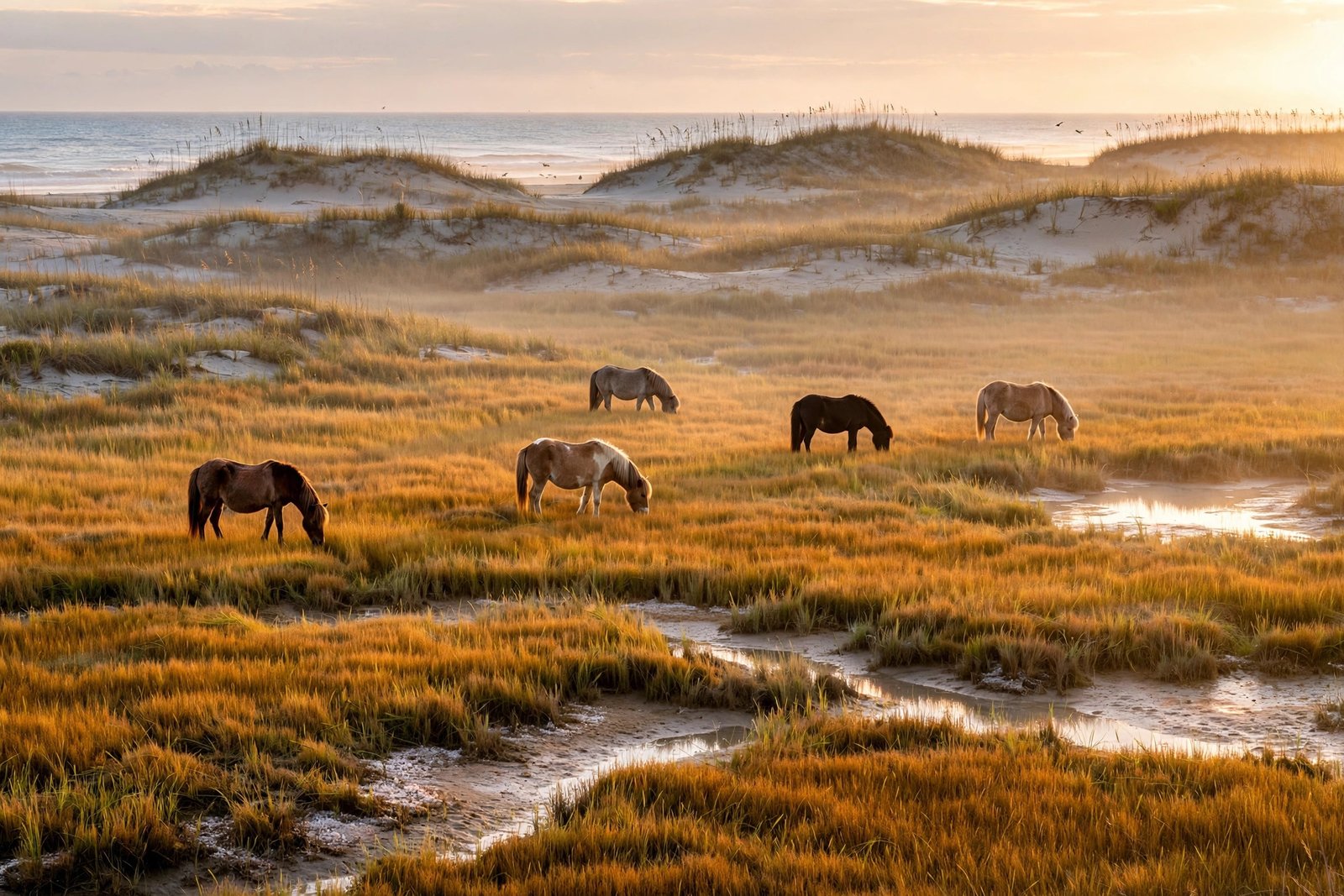
Wild horses — officially called ponies because of their small size, though they are fully horses in build — live on both ends of Assateague, separated by a fence at the state line. The Maryland herd is managed by the National Park Service and roams free year-round. The Virginia herd, the famous Chincoteague ponies, is owned by the Chincoteague Volunteer Fire Company, which grazes them on the wildlife refuge under a federal permit that caps the herd at about 150 adult animals. That cap is the reason for everything that follows: each year, most of the spring’s foals must leave the island — and the whole world shows up to watch them go.
The legend: survivors of a Spanish shipwreck
Ask a local how the ponies got to Assateague and you will hear the romantic version first. According to legend, centuries ago a Spanish galleon — in some tellings, a ship of the 1750 treasure fleet, in others a 16th-century vessel — wrecked off the Assateague coast in a storm. The horses aboard, the story says, swam for their lives, reached the island, and went wild. Their descendants, toughened by salt marsh and storm, are the ponies you see today.
One specific wreck is often named: La Galga, a Spanish ship that ran aground on Assateague in 1750 during a hurricane that scattered a treasure fleet sailing from Havana to Spain. The wreck is real enough as an event — the ship grounded, the crew salvaged cargo and came ashore — but there is no record that horses were aboard, let alone that any survived to found a herd. It makes, as more than one writer has conceded, a great story. It remains a legend: beloved, unproven, and almost certainly not the whole truth.
The documented history: a fence made of water
The National Park Service’s assessment is more prosaic and far better supported. The ponies most likely descend from horses and livestock that mainland settlers turned loose on the barrier islands in the late 1600s. The reasoning was economic: colonial laws required fencing to contain livestock on the mainland, and mainland grazing could be taxed. An island was a natural, fence-free pasture — the water did the fencing for free. Over generations, island-born horses adapted to the harsh environment: they grew small and hardy on a diet of salty marsh grass, developed the ability to thrive on forage that would starve a stable-kept horse, and learned to drink from the island’s freshwater ponds (their salty diet is why the ponies famously drink a great deal of water and often look round-bellied).
Pony penning itself — rounding up island horses to sort, brand and sell some of them — is documented on the Eastern Shore going back to the colonial era, long before it became a spectacle. What the 20th century added was organization, a cause, and a very good book.
How the Pony Swim began: fires, firefighters and 1925
The modern tradition starts, improbably, with fire. In the early 1920s, two devastating fires swept through Chincoteague’s Main Street. The town organized a volunteer fire company — but a fire company needs equipment, and equipment needs money. The firefighters’ solution was to take the old pony penning, add a carnival, and turn it into a fundraiser.
The first official Pony Penning under the fire company was held in 1925. Local horsemen — the Saltwater Cowboys — rounded up the Assateague herd, swam the ponies across the channel at slack tide, and auctioned foals to raise money for the new company. It worked. A century later, the swim and auction still fund the Chincoteague Volunteer Fire Company, still pay for the herd’s veterinary care and upkeep, and still anchor the town’s biggest week of the year, as this account of the 100th Pony Penning celebration describes.
Then came the book that made it all famous. In 1947, author Marguerite Henry published Misty of Chincoteague, a children’s novel based on a real Chincoteague family, the Beebes, and a real palomino pinto filly named Misty. The book became a classic — it was a Newbery Honor book — and its 1961 film adaptation, shot on the islands, turned a local fundraiser into a national pilgrimage. Generations of horse-loving kids grew up dreaming of Pony Penning Week. Many of them now bring their grandchildren.
Pony Penning Week: how it unfolds
The event is a full week, always culminating on the last Wednesday and Thursday of July:
- The roundups: in the days before the swim, Saltwater Cowboys gather the southern and northern herds into corrals on Assateague, where foals are checked and the herd is readied.
- The swim (Wednesday): at slack tide — the brief window between tides when the channel current stills — the Cowboys swim the herd across Assateague Channel to Chincoteague. The crossing takes only a few minutes, and foals swim beside their mothers. Huge crowds line the route.
- The parade and carnival: the ponies rest, then parade down Main Street to the carnival grounds, where the fire company’s carnival runs through the week.
- The auction (Thursday): most foals are auctioned to the public. Prices in recent decades have ranged from a few thousand dollars to far more for special foals, and proceeds fund the fire company and the herd’s care. A handful of foals each year are designated “buybacks” — they are auctioned for fundraising but return to Assateague to replenish the herd, a system that lets the population renew itself.
- The swim back (Friday): the remaining mares and stallions swim home to Assateague to live wild for another year.
The ponies live out their days on the island — grazing the marshes, enduring nor’easters, and being photographed, at a respectful distance, by millions of visitors. The Maryland herd, managed separately by the National Park Service, lives entirely wild with minimal intervention; the Park Service uses fertility control to keep that herd at a size the island’s ecology can support, a reminder that even wild icons need managing on a small island. Visitors are required to keep their distance — these are genuinely wild animals, and the Park Service’s guidance (explained in its coverage of the herd’s history and the swim tradition) is to admire from afar and never feed them, since human food and close contact are leading causes of harm to the Maryland ponies.
Legend vs history: the honest summary
Legend
- The ponies descend from horses that escaped a wrecked Spanish galleon — possibly La Galga in 1750. There is no documentary evidence of horses aboard, and historians treat the tale as folklore.
Documented
- Settlers grazed livestock on the barrier islands from the late 1600s to dodge fencing laws and taxes; the ponies most likely descend from that colonial stock, per the National Park Service.
- Pony pennings on the Eastern Shore predate the modern event by centuries.
- The Chincoteague Volunteer Fire Company formalized the swim and auction in 1925 to fund fire equipment after two town fires.
- Marguerite Henry’s 1947 Misty of Chincoteague and the 1961 film made the herd world-famous.
- The Virginia herd is capped at about 150 adults under a refuge grazing permit; the auction and buyback system maintains it.
- The 100th annual Pony Swim took place in July 2025.
Perhaps the truth does not need the shipwreck. A herd of tough little horses, surviving on salt grass and storm water on a sliver of island, rounded up once a year by volunteer firefighters on horseback to pay for the town’s fire trucks — that is already one of the best stories on the American coast. The galleon is just the garnish. The swim, the Cowboys and the ponies themselves are entirely real, and every July, a hundred years on, they prove it again.