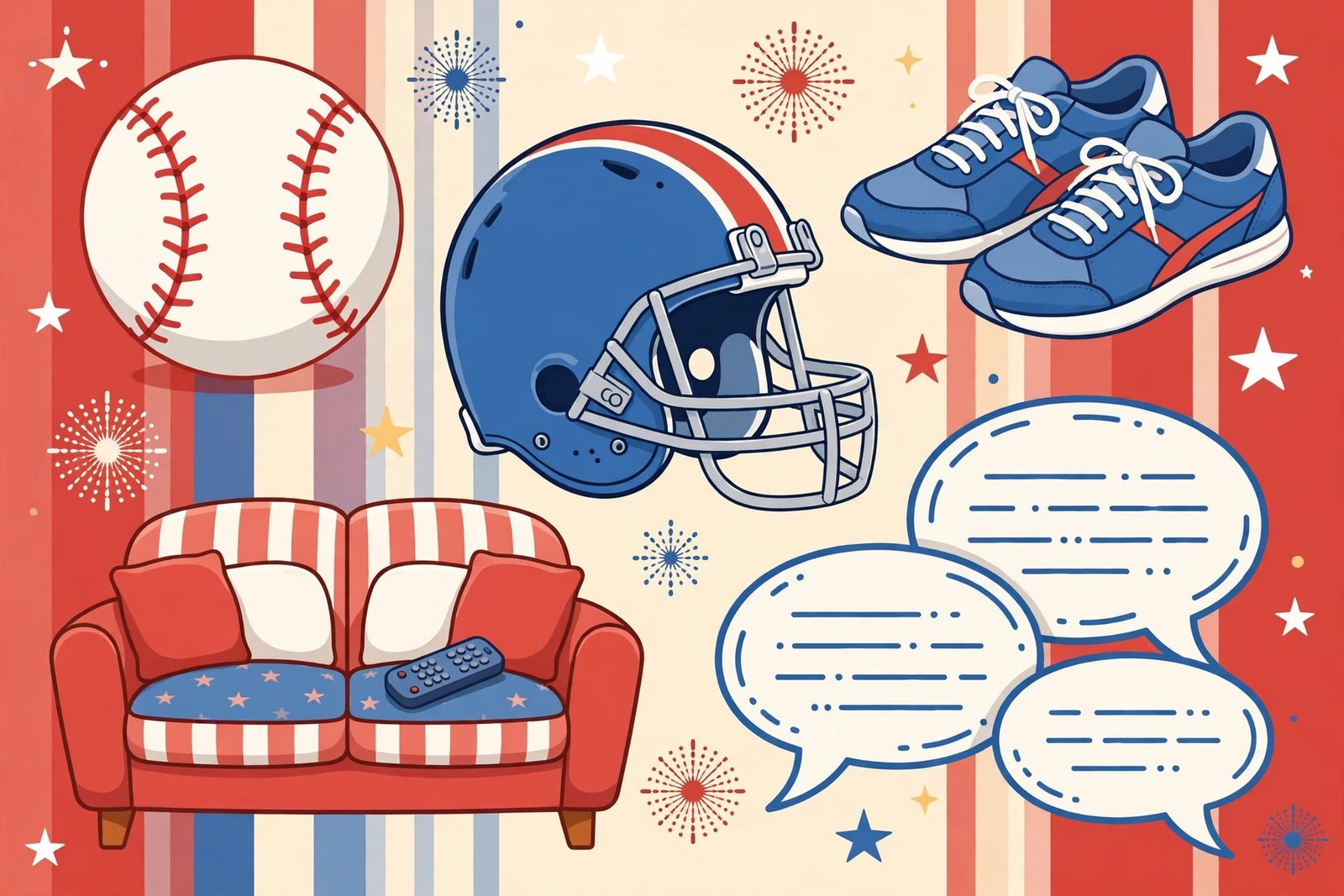
Every English speaker knows the strange feeling of using a perfectly ordinary word and being met with a blank stare. For Americans traveling abroad, that moment comes often. Words that feel as natural as breathing at home, words heard on television, in offices, and on playgrounds across the United States, turn out to be almost unknown in Britain, Australia, or Canada. American English has been drifting away from the English of the rest of the world for more than two centuries, and the gap is full of stories about baseball, the frontier, Hollywood, and one very determined dictionary maker.
The split began early. When Noah Webster published his American dictionary in 1828, he deliberately set out to create a distinctly American version of the language, simplifying spellings such as colour to color and centre to center. That spirit of independence never left American English. New inventions, new sports, new industries, and new waves of immigration kept adding words, while old words took on new meanings. The result is a rich collection of Americanisms: words and phrases that Americans use every day and that the rest of the English-speaking world either does not use at all or uses very differently.
From the Ballpark: Rain Checks and Ballpark Figures
No American pastime has given the language more phrases than baseball. Take a rain check is a perfect example. In the 1880s, when a baseball game was rained out, clubs began issuing spectators a ticket for a later game, a literal rain check, so fans would not lose the price of admission. The St. Louis club is often credited with making the practice formal policy. By the 1890s the phrase had already escaped the ballpark, and today an American who says, let us take a rain check on dinner, simply means, not tonight, but let us do it another time. Visitors sometimes hear it as a weather report, which it is not.
Ballpark figure works the same way. A ballpark is a baseball stadium, and a ballpark figure is a rough estimate, a number in the right range even if it is not exact. The figurative use grew up in the middle of the twentieth century, and it is now standard in American business conversation. To be in the same ballpark means to be roughly in agreement, while to hit something out of the park means to succeed spectacularly. Touch base is another baseball borrowing: just as a runner must touch the bases, an American who wants to touch base with you wants a quick check-in, a brief contact to confirm where things stand.
Monday morning quarterback belongs to American football rather than baseball, but it follows the same pattern. Because most professional football games are played on Sundays, a Monday morning quarterback is someone who criticizes decisions with the benefit of hindsight, second-guessing the coach from the comfort of the couch. The phrase only makes sense in a country where football dominates the weekend, which is exactly why it sounds so puzzling elsewhere.
Everyday Objects With American Names
Some of the most confusing differences are not phrases at all but ordinary nouns. Americans wear sneakers. Britons wear trainers, Canadians often say runners, and Australians may say joggers. The American word comes from the idea that rubber-soled shoes let you sneak around quietly, and it stuck so firmly that Americans now call almost any athletic shoe a sneaker, even if nobody is sneaking anywhere.
Americans play soccer. Almost everyone else calls the same game football, and what Americans call football is known elsewhere as American football or gridiron. The word soccer itself actually comes from Britain, as a shortening of association football, but it was Americans who kept it while the rest of the world settled on football. The result is one of the most famous transatlantic misunderstandings, repeated every four years when the World Cup rolls around.
The same pattern repeats across daily life. An American baby wears a diaper, rides in a stroller, and sleeps in a crib. A British baby wears a nappy, rides in a pram or pushchair, and sleeps in a cot. An American driver opens the trunk of a car and checks under the hood; a British driver opens the boot and checks under the bonnet. An American asks for the restroom, a polite euphemism that can confuse visitors who are looking for a place to rest, while a Briton asks for the loo or the toilet. None of these words is better than the other, but each marks its speaker instantly.
Words Born on the Frontier and the Open Road
America’s history of westward expansion left its own vocabulary. The word buck as slang for a dollar is often traced to the frontier trade in buckskins, animal hides that were used almost like currency in early America. To say something gives you more bang for your buck is to say it is good value, a phrase later made famous in politics when President Dwight D. Eisenhower used it in the 1950s to describe getting strong defenses at lower cost.
Other frontier-flavored words survive in regional speech. In the American South, y’all is the friendly plural of you, a word that fills a gap English otherwise leaves open and that visitors quickly learn to love. Out West and in rural areas, a word like cattywampus, meaning crooked or askew, still pops up in conversation, a playful survival from older American dialect. These words remind us that American English was shaped not just by cities and offices but by farms, trails, and small towns spread across a continent.
Hollywood, Television, and the Couch Potato
Modern American media added another layer. Couch potato, a gently mocking term for someone who spends too much time watching television, appeared in the 1970s and spread with the rise of TV culture. It plays on the older slang boob tube for a television set, and it captures a very American image: an evening on the sofa, remote in hand, show after show. The phrase is understood in Britain too, but it remains far more at home in American conversation.
Spill the beans, meaning to reveal a secret, and piece of cake, meaning something very easy, are older expressions that became thoroughly American through popular use. Spill the beans may be connected to an old voting custom in which beans were used as ballots, though the exact origin is debated, and that uncertainty is part of the fun of language history. Piece of cake became popular in the 1930s and has never left. A bachelor party, the celebration for a groom before his wedding, is another American institution with its own vocabulary: elsewhere the same event is a stag party, and the bride’s equivalent is a hen party rather than a bachelorette party, though American reality television has exported the bachelor and bachelorette versions around the world.
Why the Differences Persist
It is tempting to ask why these differences survive in an age of global streaming and instant communication. Part of the answer is that language is identity. Americans keep saying sneakers and soccer because those words feel like home, and because the institutions behind them, American schools, sports leagues, and workplaces, reinforce them daily. New words keep arriving, too, from technology, social media, and regional culture, so the gap is not closing so much as shifting.
Another part of the answer is sheer size. The United States is a huge, varied country, and its internal variety, from Southern y’all to New York’s bodega, from California slang to Midwestern nice, is itself a world of English. American English does not need to match British English, because it has its own dictionaries, style guides, and media ecosystem. When a British viewer hears an American character on television say, let me touch base, or, give me a ballpark figure, the phrase may sound foreign, but to the American audience it is simply how people talk.
For travelers, the lesson is a happy one. These differences rarely cause real trouble, and they often start the best conversations. Asking an American what a rain check means, or why they call it soccer, is an invitation to a story about baseball tickets, frontier traders, or a dictionary maker with a plan for a new nation. Language differences are not barriers. They are small windows into how a country sees itself, and American English, with its ballparks and buckskins and bachelor parties, offers a particularly colorful view.
Frequently Asked Questions
What is a rain check, and where did the phrase come from?
A rain check is a promise to accept an offer at a later date. It comes from nineteenth-century American baseball, where clubs issued spectators a ticket for a future game when rain washed out the one they had paid to see. The figurative use, meaning to postpone plans politely, was already in use by the 1890s.
Why do Americans say soccer instead of football?
Americans say soccer for the game the rest of the world calls football, and they use football for their own gridiron game. The word soccer comes from a shortening of association football, and it was kept in the United States while most other countries settled on football for the kicking game.
What is a ballpark figure?
A ballpark figure is a rough estimate, a number that is in the right general range without being exact. It comes from baseball, where the ballpark is the stadium, and the figurative use became common in American business and everyday speech in the middle of the twentieth century.
Are American English words really not used anywhere else?
Not entirely. Many American words are understood abroad thanks to films, television, and the internet, and some, like couch potato, have crossed over. The point is that these words originated in the United States or are standard there while remaining unusual or absent in everyday speech elsewhere, which is why they still surprise visitors.
Related reading
- US State Facts That Sound Fake but Are True
- How National Parks Power America’s Gateway Towns
- Bisbee, Arizona: The Queen Mine Town That Is a Hidden Gem
To explore more of these expressions, see Mental Floss on American phrases that baffle the rest of the world, the history of the rain check, and American phrases other countries do not understand.